
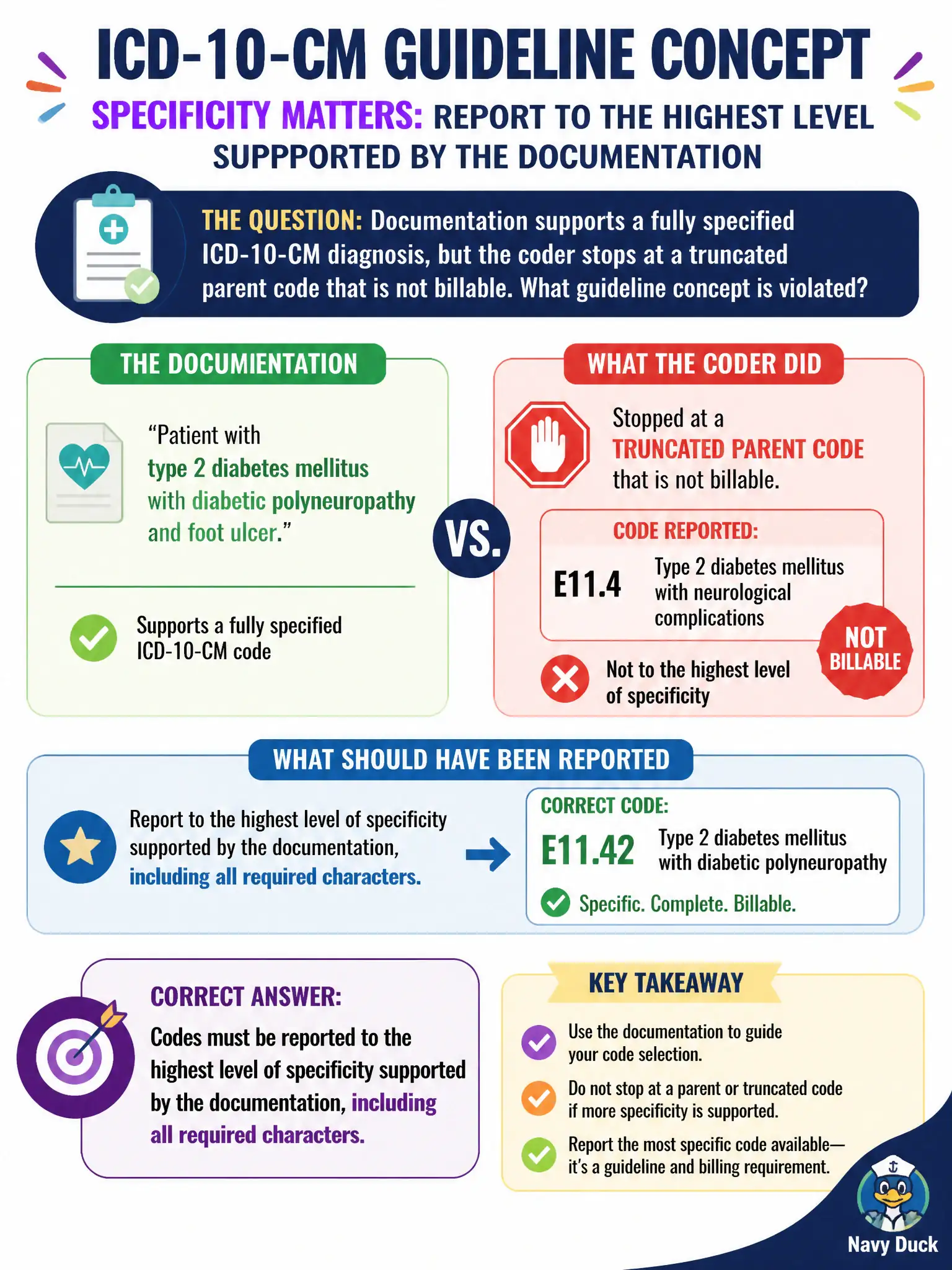
Documentation supports a fully specified ICD-10-CM diagnosis, but the coder stops at a truncated parent code that is not billable. What guideline concept is violated?
Select an answer to reveal the explanation.
Short Explanation
Stopping halfway through a code is like writing half an address—mail won’t land. If the note supports the full character string, take it all the way. Truncating a billable code early is a classic specificity miss.
Full Explanation
Official Guidelines require coding to the highest level of specificity supported by the medical record. Valid codes include all characters required by the Tabular List for that category. When documentation supports a fully specified ICD-10-CM diagnosis but the coder stops at a truncated parent code that is not billable, the highest-specificity requirement is violated—codes must be reported to the highest level of specificity supported, including all required characters. Claiming codes may always be truncated to three characters for physician-office claims fails. Claiming laterality characters are optional whenever the note mentions a bilateral exam fails when laterality is required for the selected code. Preferring unspecified codes whenever a more specific code exists fails guideline direction. Exam caveat: unspecified remains correct only when documentation cannot support greater detail. Operational check: complete every required character shown in the Tabular, refuse non-billable truncated parents when a complete code is supported, and validate billable length before claim submission. In civic and community clinic workflows, document the chosen pathway in the coding rationale so auditors can see how the record supported specificity, sequencing, and instructional-note compliance on the professional claim.