
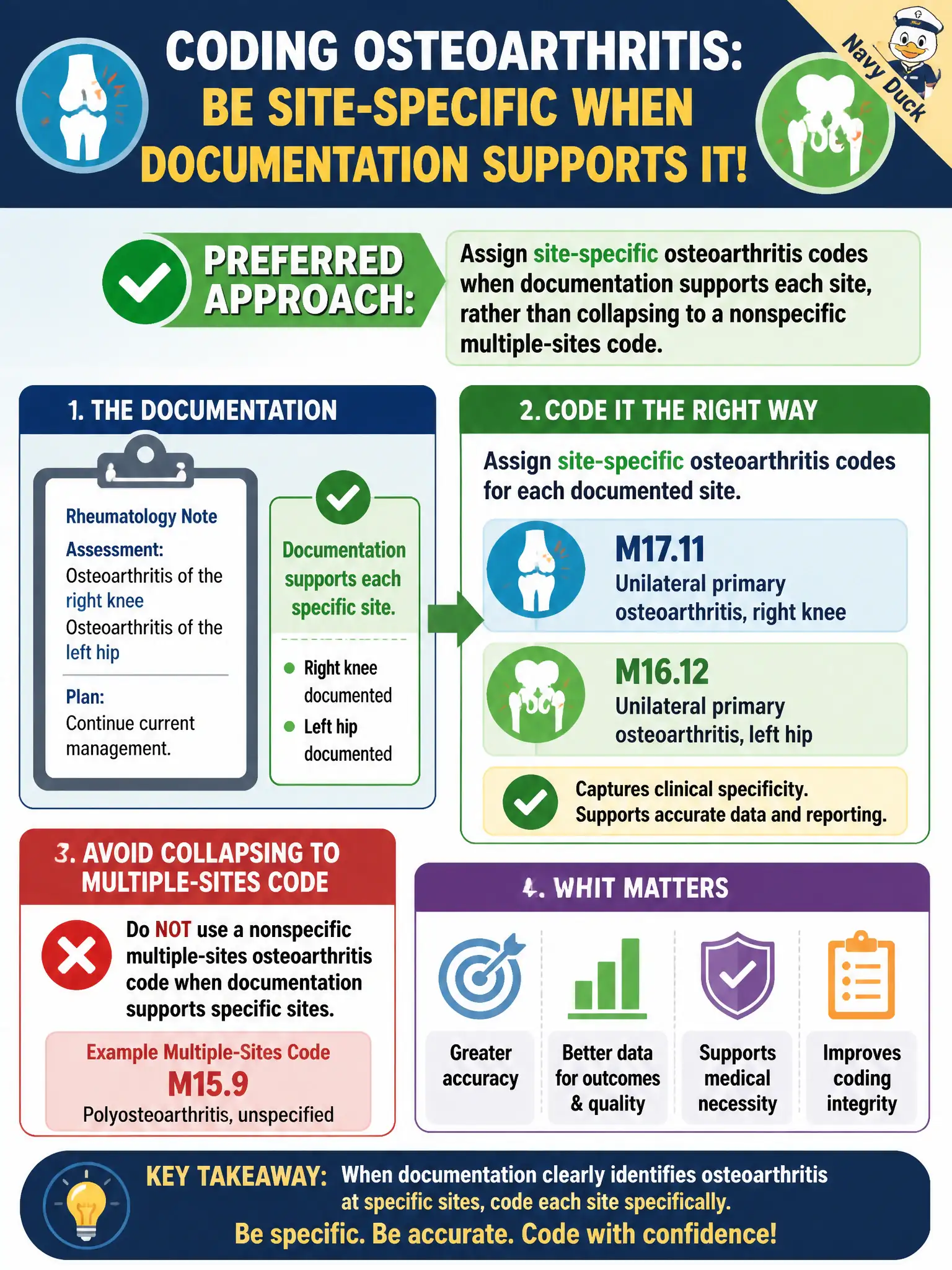
A rheumatology note documents osteoarthritis of the right knee and left hip with enough detail for site-specific coding. A multiple-sites OA option also exists in the classification. What is the preferred approach?
Select an answer to reveal the explanation.
Short Explanation
Specificity wins when the note hands it to you. Right knee and left hip OA aren’t a vague ‘multiple sites’ shrug if you can code each joint cleanly. Don’t crush clear sites into a blurrier bucket just to save keystrokes.
Full Explanation
ICD-10-CM favors the highest specificity supported by documentation. When a rheumatology note documents osteoarthritis of the right knee and left hip with enough detail for site-specific coding, assign site-specific osteoarthritis codes rather than collapsing to a nonspecific multiple-sites code. Always using the multiple-sites osteoarthritis code whenever more than one joint is mentioned, even if each site is fully specified, underuses available specificity. Coding only the most painful joint and omitting other documented osteoarthritic sites fails completeness. Using an unspecified osteoarthritis code and never reporting laterality for joints fails when laterality and sites are documented. Exam caveat: multiple-sites options remain appropriate when documentation supports that pattern without usable site detail. Operational check: code right-knee and left-hip OA separately when specified, preserve laterality, and reserve multiple-sites or unspecified codes for true lack of site detail. In civic and community clinic workflows, document the chosen pathway in the coding rationale so auditors can see how the record supported specificity, sequencing, and instructional-note compliance on the professional claim.