
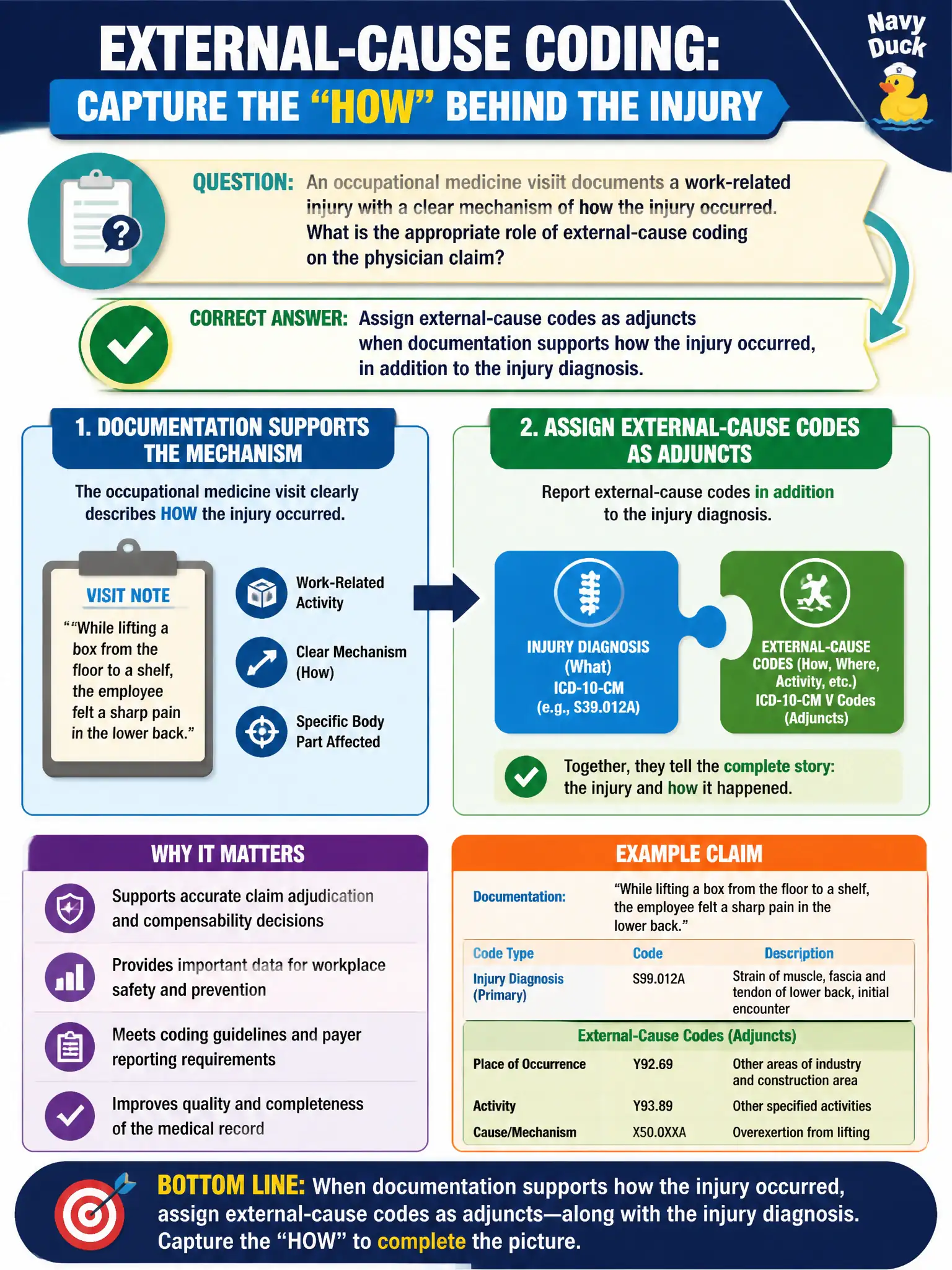
An occupational medicine visit documents a work-related injury with a clear mechanism of how the injury occurred. What is the appropriate role of external-cause coding on the physician claim?
Select an answer to reveal the explanation.
Short Explanation
External-cause codes are the ‘how it happened’ footnotes—not the injury itself. When the note spells out the mechanism for a work injury, those adjunct codes can travel with the injury diagnosis. They don’t kick the injury code off the claim.
Full Explanation
External-cause codes describe the mechanism, place, and activity related to an injury and are reported in addition to the injury diagnosis when documentation supports them. When an occupational medicine visit documents a work-related injury with a clear mechanism of how the injury occurred, assign external-cause codes as adjuncts in addition to the injury diagnosis. Never reporting external-cause codes on professional claims because they apply only to hospital facility bills fails; physician-office and occupational medicine claims may include them when documented and payer-relevant. Replacing the injury diagnosis with an external-cause code as the sole diagnosis fails; external cause is adjunctive, not a substitute for the injury condition. Reporting external-cause codes only when the patient requests workers' compensation paperwork fails documentation-based coding—patient paperwork requests do not define code eligibility. Exam caveat: follow payer expectations for workers' compensation while still coding from the clinical record. Operational check: code the injury first, add mechanism place and activity external-cause codes supported by the note, and never let external cause replace the injury diagnosis.