
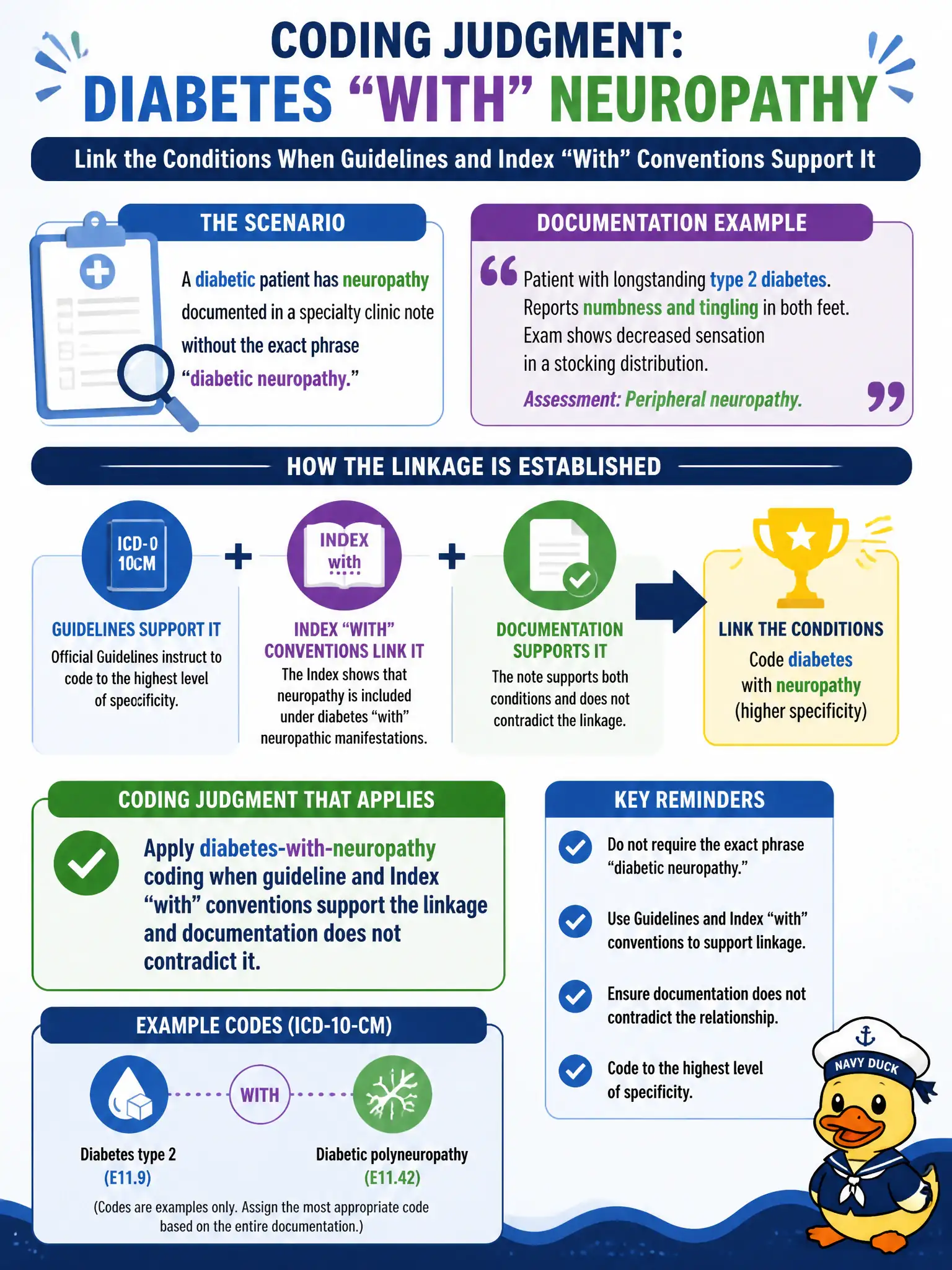
A diabetic patient has neuropathy documented in a specialty clinic note without the exact phrase “diabetic neuropathy,” but Index and “with” conventions may link diabetes and neuropathy. What coding judgment applies?
Select an answer to reveal the explanation.
Short Explanation
You don’t always need the exact marketing slogan “diabetic neuropathy” printed in the note. If diabetes and neuropathy are both there and the Index “with” rules say they’re related—and the chart doesn’t deny it—code the linked combo.
Full Explanation
ICD-10-CM with conventions and diabetes classification instructions often presume a relationship between diabetes and listed manifestations such as neuropathy unless documentation indicates they are unrelated. When a diabetic patient has neuropathy documented in a specialty clinic note without the exact phrase diabetic neuropathy, apply diabetes-with-neuropathy coding when guideline and Index with conventions support the linkage and documentation does not contradict it. Never linking diabetes and neuropathy unless the exact phrase appears fails the with convention. Coding only neuropathy and always omitting diabetes from professional claims fails while diabetes remains an active documented disease. Replacing diabetes codes with a personal-history Z-code whenever neuropathy is present fails for active diabetes. Exam caveat: if the note explicitly attributes neuropathy to another cause unrelated to diabetes, do not force the diabetes combination. Operational check: confirm both diabetes and neuropathy, check for contradiction of linkage, apply the combination pathway when conventions support it, and keep diabetes as current disease. In civic and community clinic workflows, document the chosen pathway in the coding rationale so auditors can see how the record supported specificity, sequencing, and instructional-note compliance on the professional claim.