
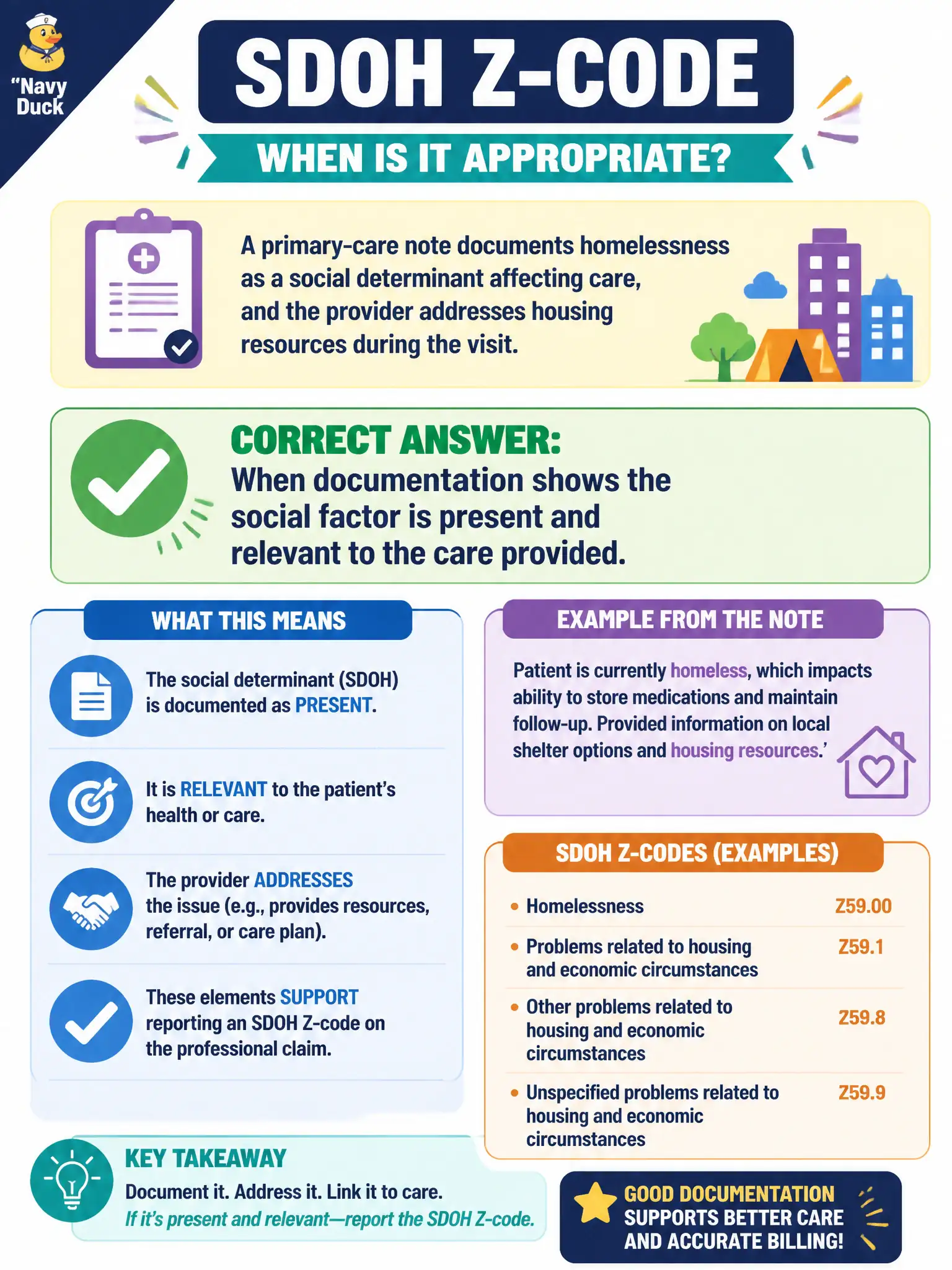
A primary-care note documents homelessness as a social determinant affecting care, and the provider addresses housing resources during the visit. When is an SDOH Z-code appropriate on the professional claim?
Select an answer to reveal the explanation.
Short Explanation
Think of SDOH Z-codes like sticky notes that matter to the visit—not wallpaper for every chart. If homelessness is written down and the clinician actually worked the housing angle, that Z-code earns its spot alongside the clinical diagnoses.
Full Explanation
ICD-10-CM allows reporting of social determinants of health Z-codes when documentation supports that the factor exists and is pertinent to the encounter. In a primary-care note documenting homelessness as a social determinant affecting care, with housing resources addressed during the visit, an SDOH Z-code is appropriate because the social factor is present and relevant to the care provided. Never reporting SDOH because they are hospital-facility-only fails; physician-office claims may report supported SDOH codes. Requiring a separate SDOH consent form for every visit as a coding prerequisite fails—consent workflows are operational, not a substitute for documentation-based code assignment. Using an SDOH code as a substitute for the medical problem that prompted the encounter fails because SDOH codes supplement, not replace, clinical diagnoses. Exam caveat: relevance must be shown in the note; incidental demographic mentions without care impact are weaker support than addressed social needs. Operational check in civic clinics: verify homelessness is documented and addressed, assign the matching SDOH Z-code alongside clinical diagnoses, and never let SDOH displace the medical reason for the visit.