
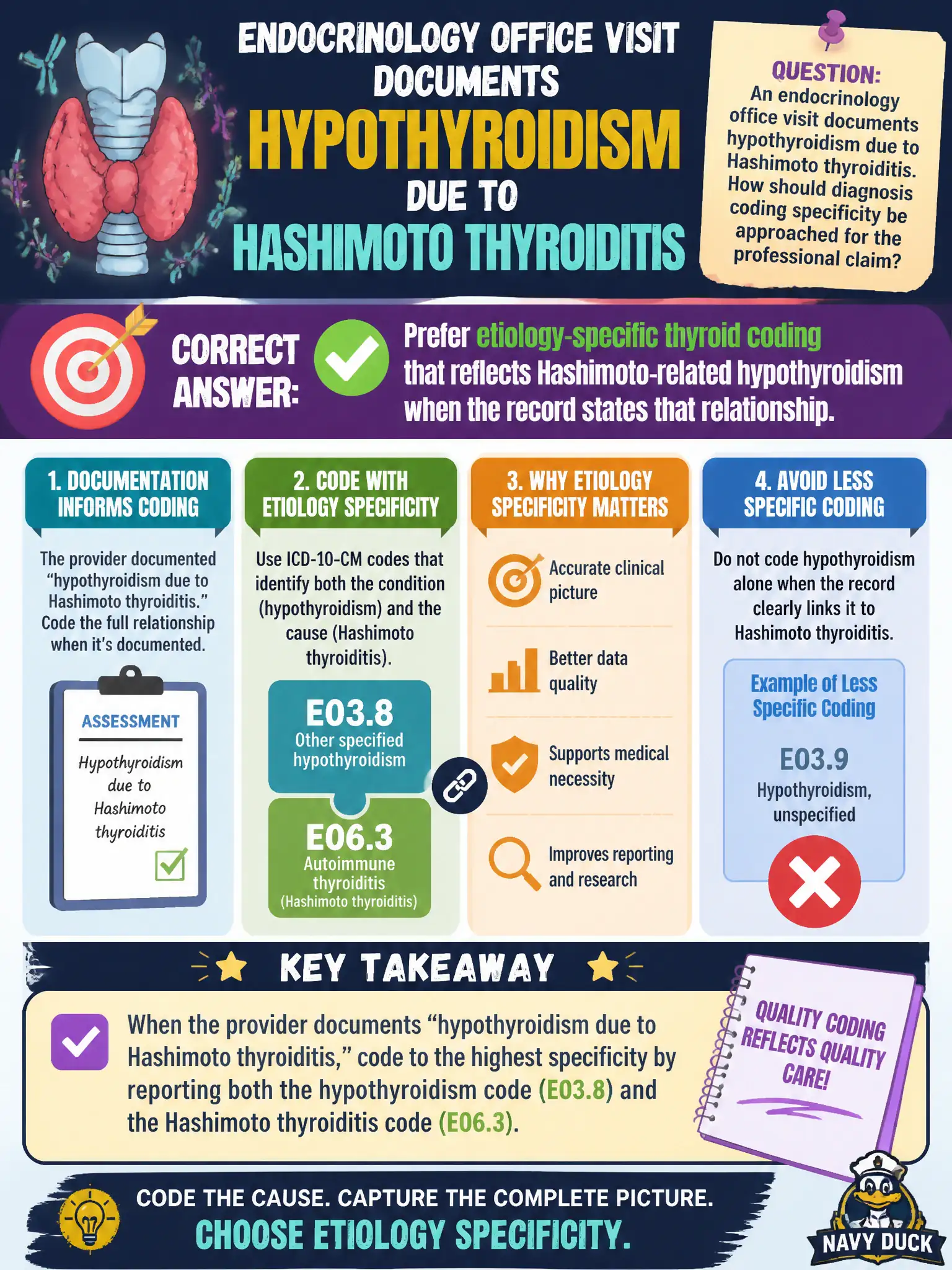
An endocrinology office visit documents hypothyroidism due to Hashimoto thyroiditis. How should diagnosis coding specificity be approached for the professional claim?
Select an answer to reveal the explanation.
Short Explanation
If the note already names Hashimoto as the reason for the low thyroid, don’t park the claim in the vague “hypothyroidism, unspecified” lot. Specificity is like putting the right street address on a package—etiology beats a generic label when it’s documented.
Full Explanation
ICD-10-CM Official Guidelines direct outpatient and physician-based coders to assign codes to the highest level of specificity supported by the documentation. When an endocrinology office visit documents hypothyroidism due to Hashimoto thyroiditis, etiology-specific thyroid coding that reflects Hashimoto-related hypothyroidism is preferred over an unspecified hypothyroidism code. Reporting only unspecified hypothyroidism and ignoring the documented Hashimoto etiology fails available specificity when the causal relationship is stated. Coding Hashimoto thyroiditis alone and omitting hypothyroidism fails when both the autoimmune thyroiditis and the hypothyroid state are documented as part of the clinical statement. Substituting a thyroid neoplasm code because autoimmune disease supposedly implies malignancy-risk coding fails without neoplasm documentation. Exam caveat: follow Tabular instructional notes for any additional thyroid or antibody-related detail the classification requires, without inventing malignancy. Operational check: confirm the Hashimoto etiology link, select the etiology-specific hypothyroidism pathway, and reject unspecified-only or neoplasm substitutes unsupported by the endocrine note.