
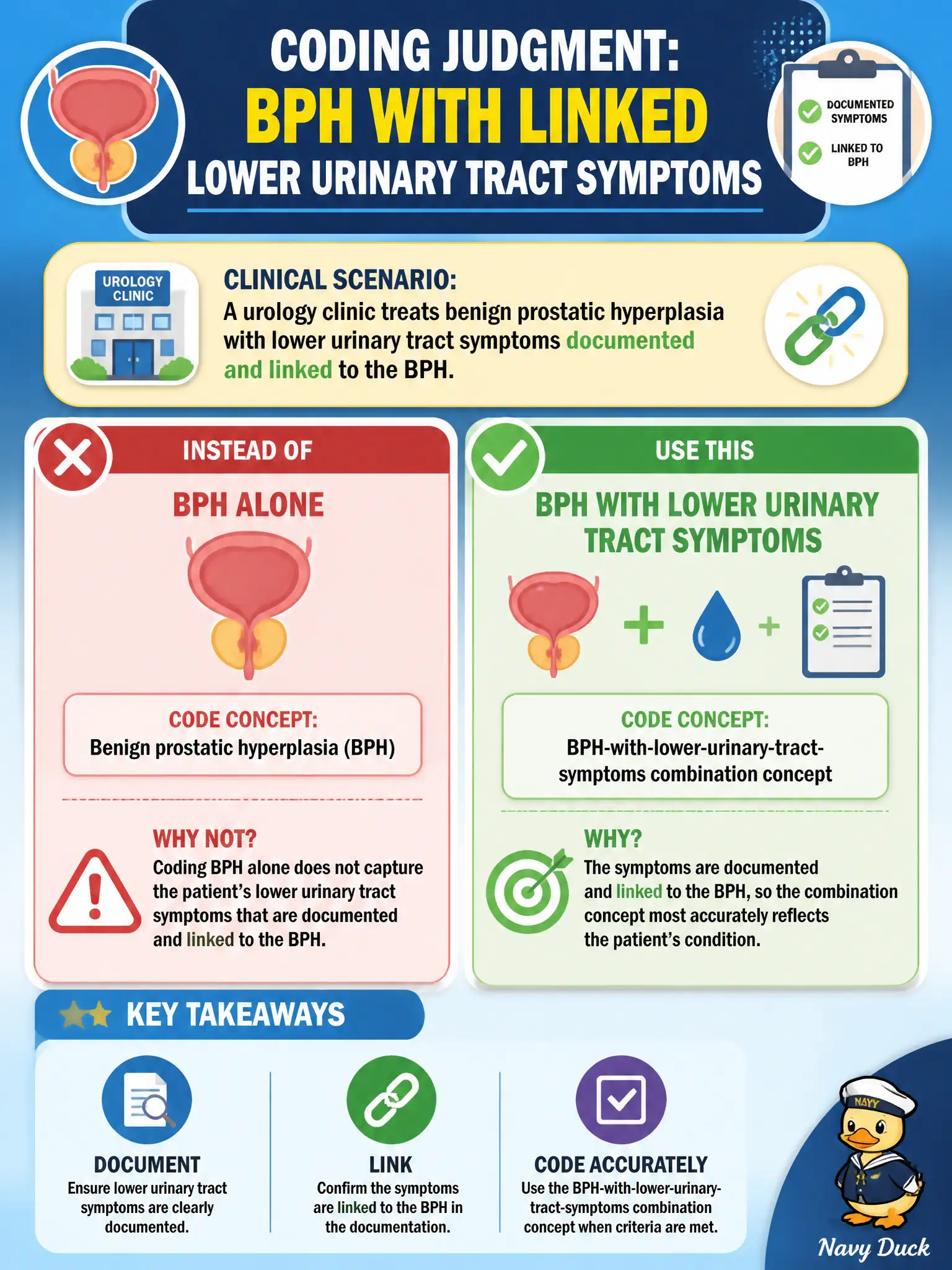
A urology clinic treats benign prostatic hyperplasia with lower urinary tract symptoms documented and linked to the BPH. What is the preferred coding judgment?
Select an answer to reveal the explanation.
Short Explanation
BPH plus those bathroom symptoms that the urologist ties to the prostate? That's the combination path—not plain BPH, and not a lonely frequency code that forgets the prostate diagnosis.
Full Explanation
ICD-10-CM includes combination coding for hyperplasia of prostate with lower urinary tract symptoms when LUTS are documented in association with BPH. In a urology clinic treating BPH with LUTS linked to the hyperplasia, use the BPH-with-LUTS combination concept rather than BPH alone. Coding BPH without LUTS even when obstructive or irritative symptoms are clearly attributed to hyperplasia fails available specificity on the physician claim. Coding only unspecified urinary frequency and omitting BPH fails when BPH is the established diagnosis explaining the symptoms. Assigning acute prostatitis automatically whenever LUTS are present fails without prostatitis documentation; LUTS are not synonymous with acute infection. Exam caveat: combination use still requires the symptom-BPH link in the record; unrelated urinary symptoms from another cause should not be forced into the BPH-with-LUTS pathway. Operational check: confirm BPH diagnosis, confirm LUTS and the provider's linkage to hyperplasia, select the combination concept, and avoid prostatitis or symptom-only substitutes unsupported by the urology note. In civic and community clinic workflows, document the chosen pathway in the coding rationale so auditors can see how the record supported specificity, sequencing, and instructional-note compliance on the professional claim.