
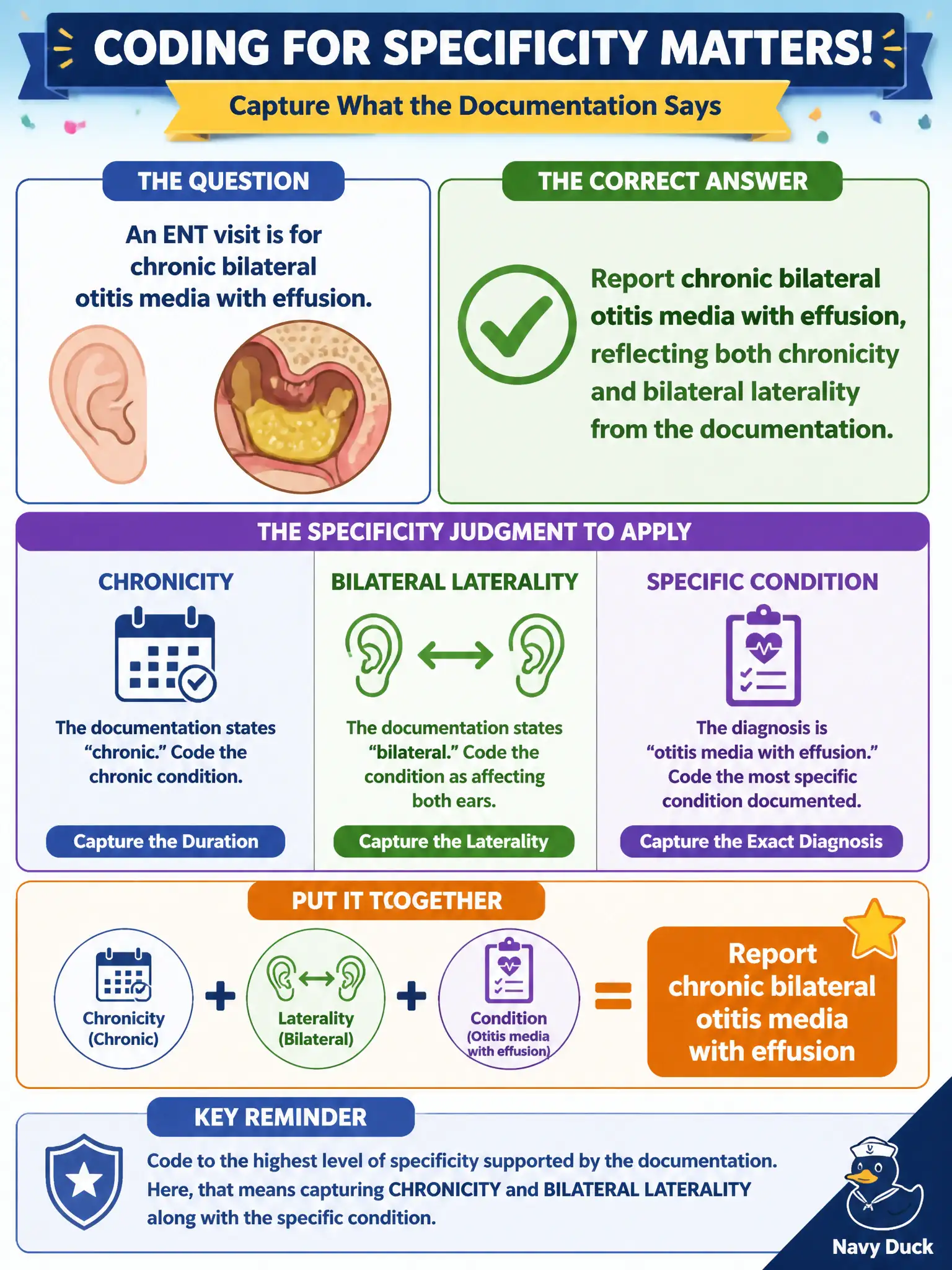
An ENT visit is for chronic bilateral otitis media with effusion. What specificity judgment should guide diagnosis coding?
Select an answer to reveal the explanation.
Short Explanation
The note said chronic and both ears—so the code story needs those two words. Don't downshift to acute one-sided or a mushy unspecified otitis when the ENT already gave you the detail.
Full Explanation
Middle-ear disease codes often distinguish acute versus chronic disease and require laterality when available. For an ENT visit documenting chronic bilateral otitis media with effusion, report chronic bilateral otitis media with effusion so chronicity and bilateral laterality from the documentation are reflected on the professional claim. Coding only acute unilateral otitis media because ambulatory ENT visits supposedly default to that pattern fails when the note states chronic bilateral disease with effusion. Using unspecified otitis media without laterality or chronicity fails when both elements are documented and classifiable. Coding sensorineural hearing loss alone and omitting middle-ear disease fails when effusion and otitis media are the documented conditions unless hearing loss is separately established and relevant. Exam caveat: effusion versus suppurative distinctions matter in the Tabular—match the ENT wording rather than assuming infection type. Operational check: capture chronicity, effusion or type, and bilateral laterality from the assessment, then verify the Tabular entry instead of defaulting to unspecified or acute unilateral codes. In civic and community clinic workflows, document the chosen pathway in the coding rationale so auditors can see how the record supported specificity, sequencing, and instructional-note compliance on the professional claim.