
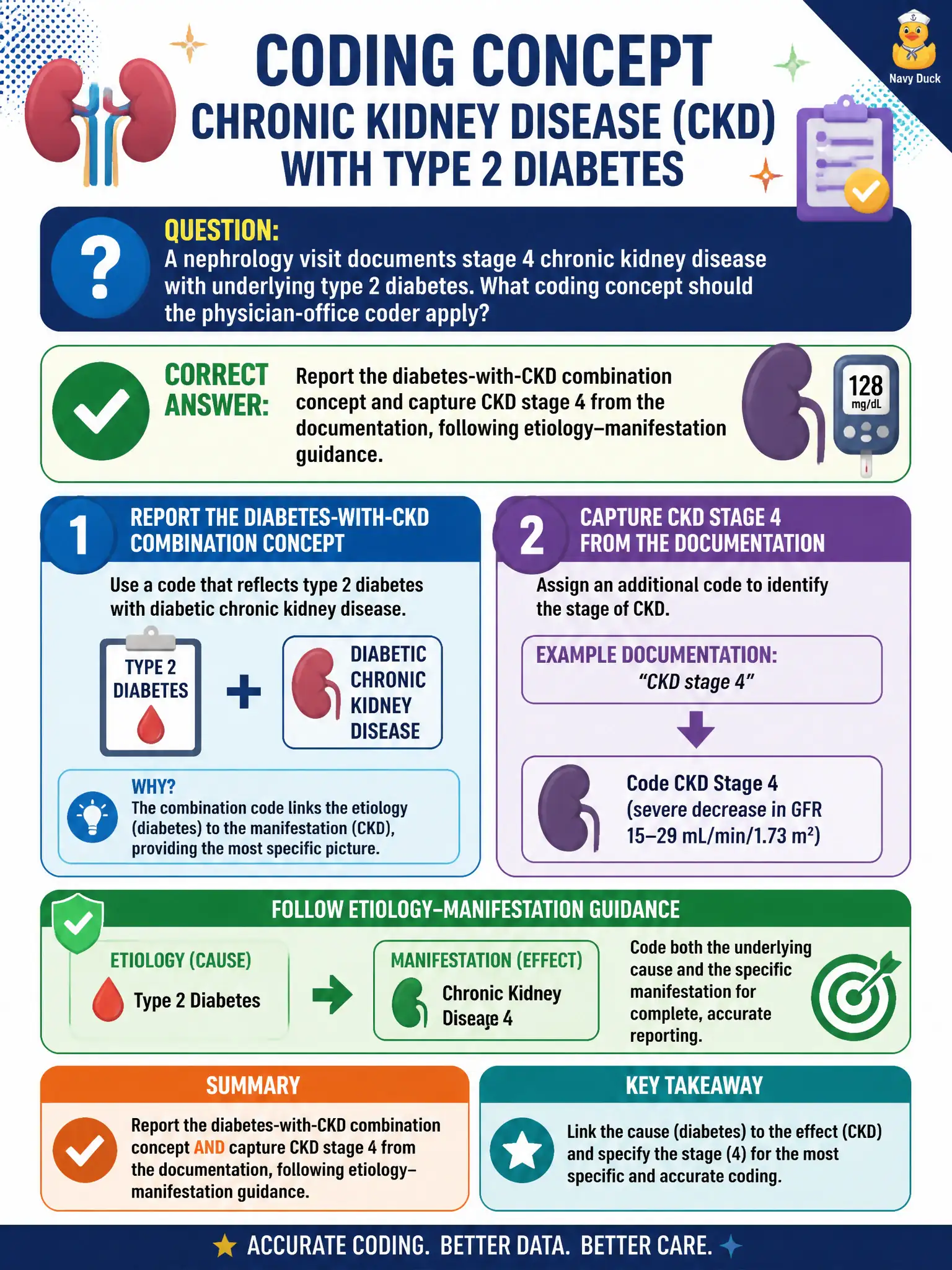
A nephrology visit documents stage 4 chronic kidney disease with underlying type 2 diabetes. What coding concept should the physician-office coder apply?
Select an answer to reveal the explanation.
Short Explanation
Diabetes causing CKD is a package deal in ICD-10-CM—use the diabetes-with-CKD family and still nail the stage the nephrologist wrote (stage 4). Stage 4 isn't ESRD, and history codes don't belong when the disease is active.
Full Explanation
When a nephrology visit documents stage 4 chronic kidney disease with underlying type 2 diabetes, physician-office coding follows the diabetes-with-CKD combination concept and captures CKD stage 4 from the documentation, consistent with etiology-manifestation and related guideline instruction. Coding only stage 4 CKD and never reporting diabetes fails when diabetes is the documented underlying cause and combination guidance applies on the professional claim. Automatically coding end-stage renal disease for stage 4 fails; stage 4 and ESRD are distinct concepts and must not be interchanged based on severity assumptions. Using personal history of CKD because diabetes is present fails while kidney disease remains active under management in the nephrology clinic. Exam caveat: always complete any required stage code and heed code-first and use-additional-code notes in the Tabular for diabetes and CKD on professional claims, not only facility abstracts. Operational check: confirm diabetes type and the causal CKD relationship, assign the diabetes-with-CKD combination pathway, add stage 4 specificity, and refuse ESRD or history coding unsupported by the nephrology note. In civic and community clinic workflows, document the chosen pathway in the coding rationale so auditors can see how the record supported specificity, sequencing, and instructional-note compliance on the professional claim.