
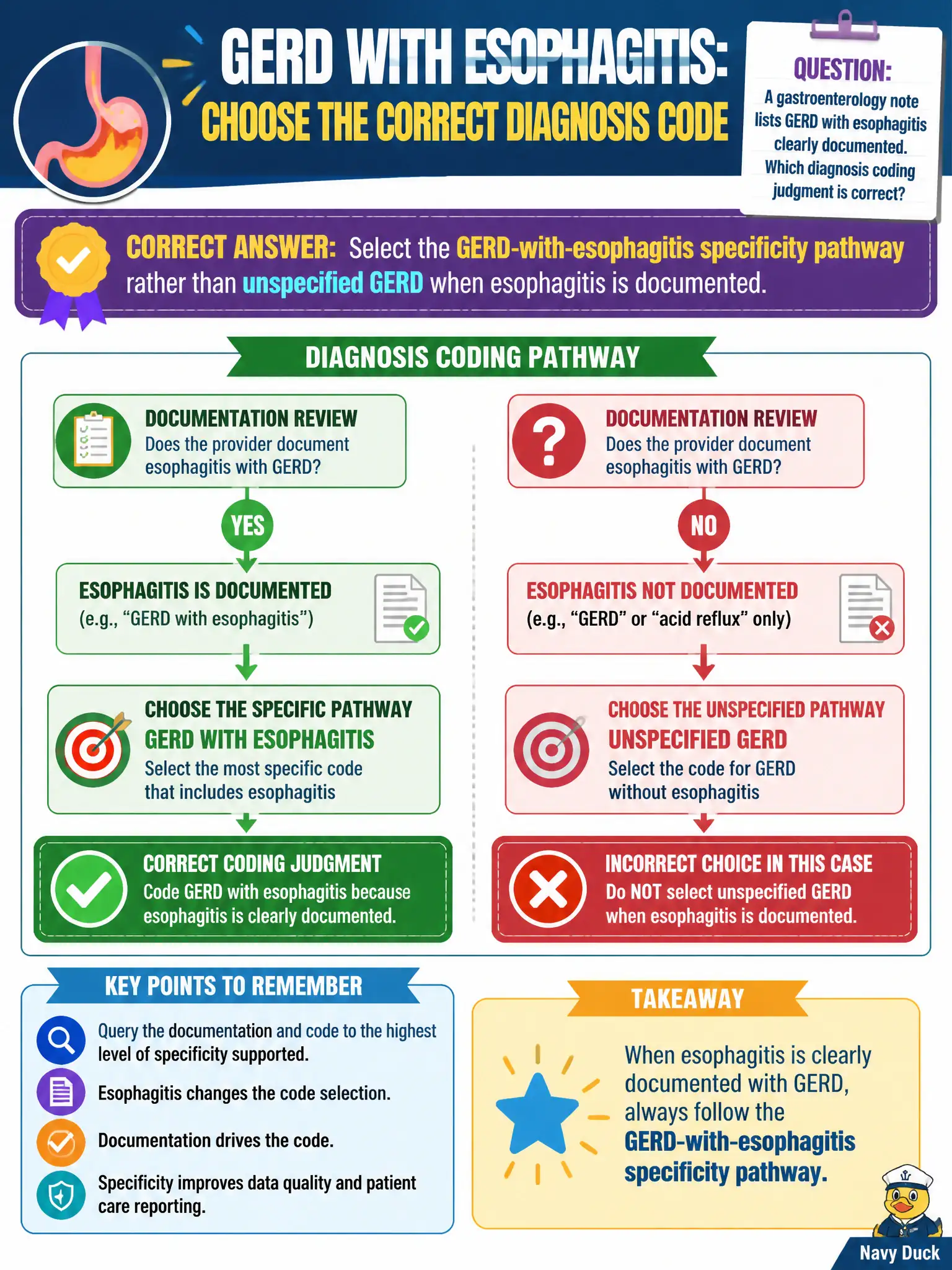
A gastroenterology note lists GERD with esophagitis clearly documented. Which diagnosis coding judgment is correct?
Select an answer to reveal the explanation.
Short Explanation
The chart already said GERD with esophagitis—so don't water it down to plain GERD. Specificity is sitting right there in the assessment; pick the combination/more-specific path that matches the words.
Full Explanation
Coders must assign diagnoses to the highest specificity supported by the record. When a gastroenterology note in a physician practice clearly lists GERD with esophagitis, the GERD-with-esophagitis specificity pathway is preferred over unspecified GERD or GERD without esophagitis. Coding GERD without esophagitis because the two can never be reported together fails when the classification and documentation support the combined or more-specific concept that matches the assessment. Coding only esophagitis and ignoring GERD fails when both appear in the assessment as the linked reflux disease statement the clinician is managing. Substituting an unrelated gastritis code fails because gastritis is a different clinical concept and does not represent documented GERD with esophagitis on the professional claim. Exam caveat for CCS-P: if esophagitis type is further specified in the note, follow Tabular distinctions rather than stopping at a less specific reflux code that discards available detail. Operational check in clinic coding: match the exact diagnostic phrase GERD with esophagitis, select the corresponding specific code path, verify instructional notes in the Tabular, and avoid splitting or substituting unrelated GI codes that weaken medical-necessity alignment.