
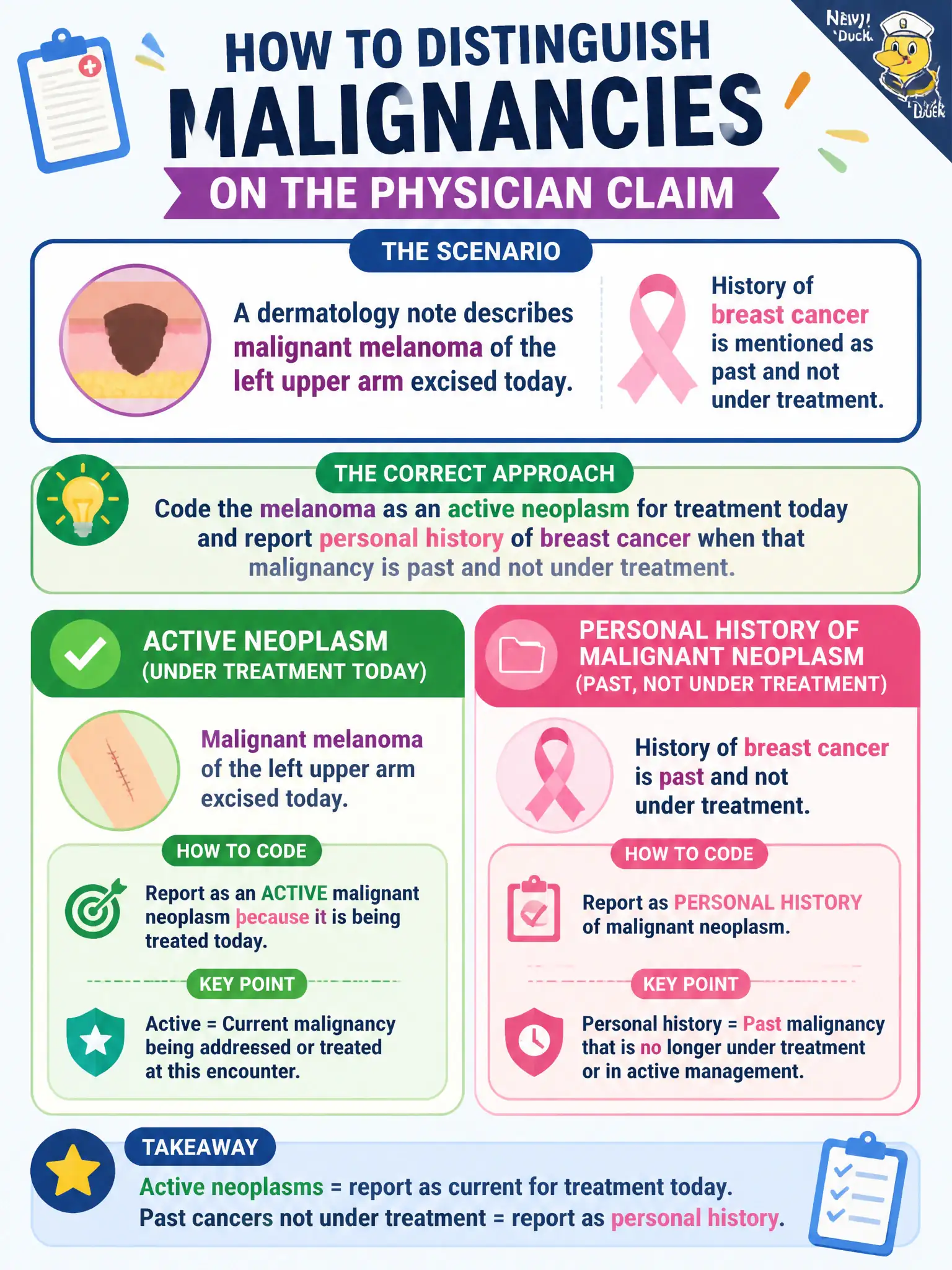
A dermatology note describes malignant melanoma of the left upper arm excised today. History of breast cancer is mentioned as past and not under treatment. How should the malignancies be distinguished on the physician claim?
Select an answer to reveal the explanation.
Short Explanation
Active cancer is the one you're still fighting; history is the scrapbook entry. Melanoma excised today is current and gets a malignancy code. Old breast cancer that's done and not being treated gets a personal-history code—not another active cancer flag.
Full Explanation
Neoplasm coding on physician claims distinguishes active malignancy under treatment from personal history. When a dermatology note documents malignant melanoma of the left upper arm excised today, the melanoma is coded as an active malignant neoplasm for the documented site. A breast cancer mentioned only as past disease not under treatment is reported with a personal history of malignant neoplasm concept, not as a second active primary. Coding both cancers as active primaries fails when the breast malignancy is documented solely as history without current treatment. Coding only personal history of melanoma and omitting the excised lesion fails because excision of melanoma for current disease is active neoplasm care, not historical status. Collapsing both into a single unspecified neoplasm code fails specificity requirements for site and behavior tracking on professional and oncology-related reporting. Exam caveat: if adjuvant therapy or active surveillance documentation still treats a history site as current disease, follow the record—history versus active turns on treatment status and provider documentation, not the word history in isolation. Operational check: for each cancer mention, ask whether it is being treated or managed today as current disease; code active malignancy for current care and personal history only for past malignancy no longer under treatment, preserving site specificity.