
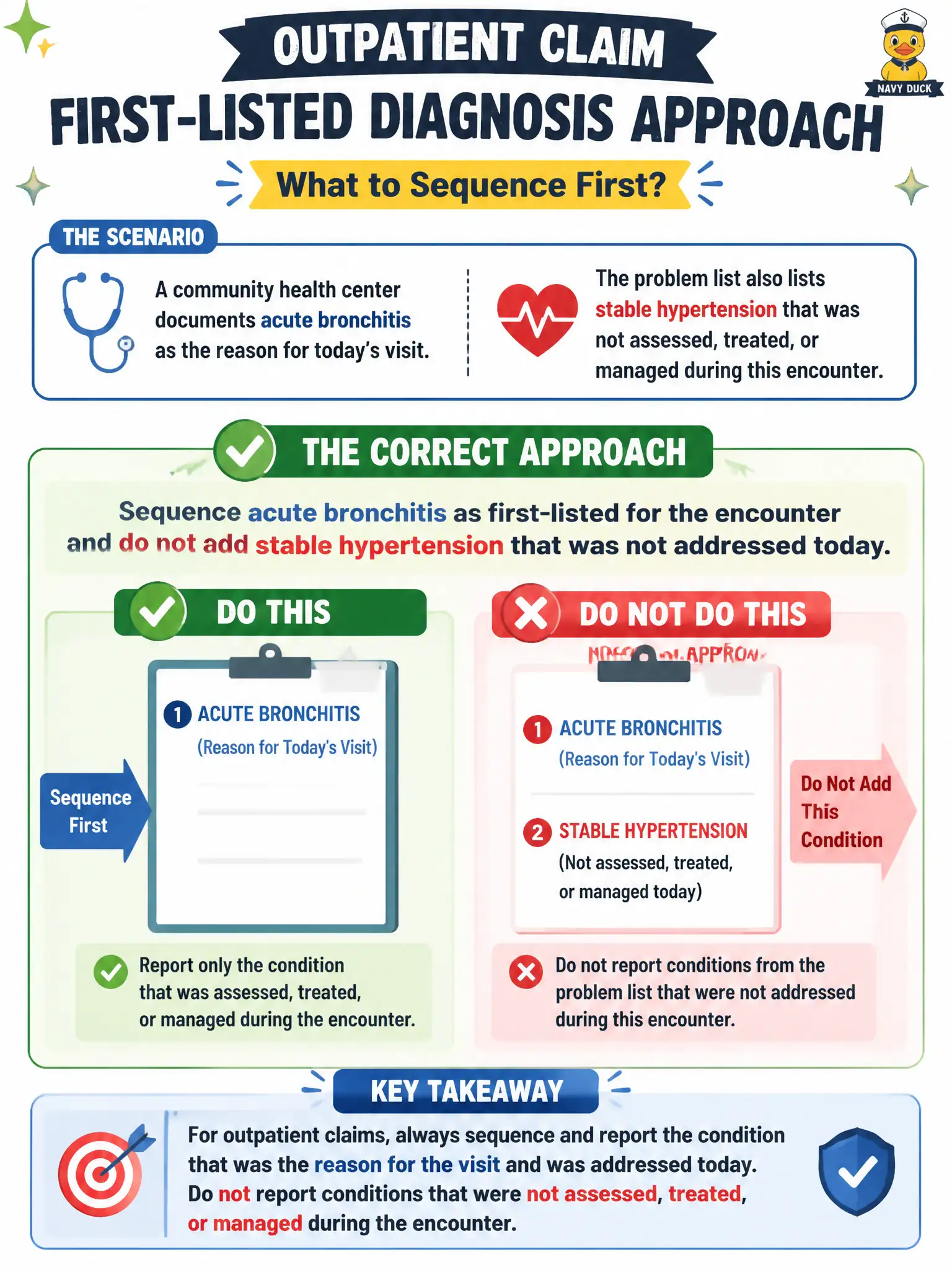
A community health center documents acute bronchitis as the reason for today's visit. The problem list also lists stable hypertension that was not assessed, treated, or managed during this encounter. What is the correct first-listed diagnosis approach for the outpatient claim?
Select an answer to reveal the explanation.
Short Explanation
Outpatient coding is like ringing up what you actually bought today—not everything still sitting in the pantry. Acute bronchitis is why the patient came in, so it leads. Stable hypertension that nobody touched today stays off this ticket.
Full Explanation
For community health center and other outpatient professional claims, the first-listed diagnosis is the condition chiefly responsible for the services provided at that encounter. When acute bronchitis is the reason for today's visit and stable hypertension on the problem list was not assessed, treated, or managed, acute bronchitis is sequenced first and the untouched hypertension is not added solely because it appears on a chronic registry list. Listing hypertension first because chronic always outranks acute fails the outpatient sequencing concept: chronicity does not automatically create first-listed status when the visit focus is an acute respiratory problem. Omitting bronchitis to code only problem-list conditions fails because registry consistency is not a substitute for encounter-based diagnosis selection on the physician claim. Coding both as co-equal primary diagnoses fails because ambulatory claims require a single first-listed diagnosis; dual primary sequencing is not a valid outpatient construct. Exam caveat: additional chronic conditions may be reported when they are addressed or clearly affect management that day—problem-list presence alone is not enough, but documented evaluation or medication adjustment can justify secondary reporting. Operational check in civic clinic workflows: scan the assessment and plan for what was actually worked today, place that condition first, and add other diagnoses only when the note shows treatment, evaluation, or management impact at this visit.