
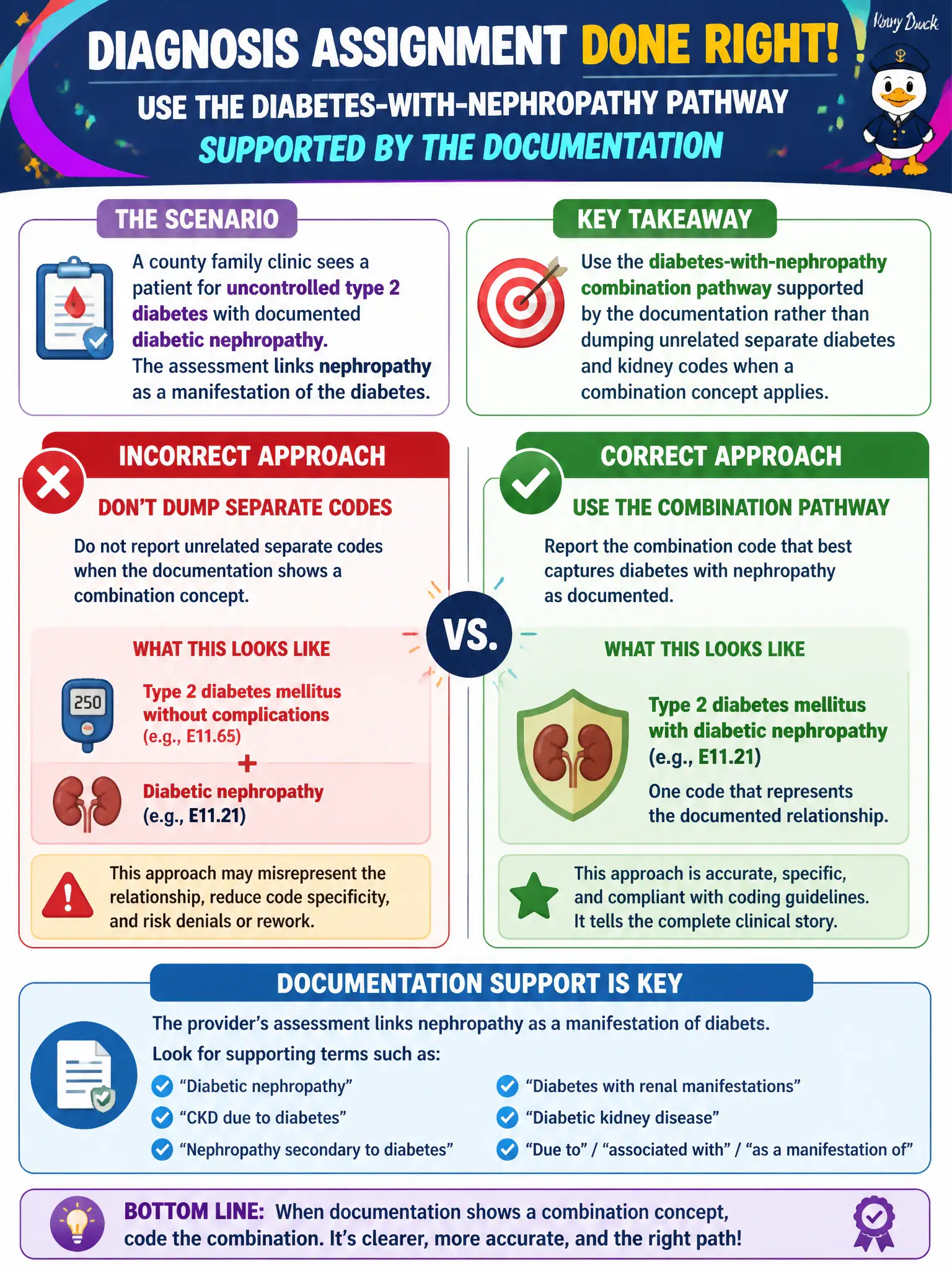
A county family clinic sees a patient for uncontrolled type 2 diabetes with documented diabetic nephropathy. The assessment links nephropathy as a manifestation of the diabetes. How should the coder approach diagnosis assignment for this physician claim?
Select an answer to reveal the explanation.
Short Explanation
Think of combination codes like a two-for-one meal deal when the chart already ties the sides together. If the clinic documents type 2 diabetes with nephropathy as a linked manifestation, you grab that diabetes-with-nephropathy family instead of inventing a loose pile of unrelated codes. The documentation already did the linking work for you.
Full Explanation
ICD-10-CM Official Guidelines instruct physician-office and outpatient coders to assign a combination code when the classification provides one that fully identifies the diagnostic statement. In a county family clinic record that links uncontrolled type 2 diabetes with diabetic nephropathy as a manifestation, the correct approach is the diabetes-with-nephropathy (or diabetes-with-chronic-kidney-disease) combination pathway supported by that causal relationship, not a loose pile of unrelated diabetes and kidney codes that ignore the documented link. Omitting nephropathy because a separate nephrology note is absent fails conceptually: the linking assessment in the clinic note is sufficient for manifestation coding when guidelines and Tabular notes are met; a specialty consult is not a universal prerequisite. Defaulting to type 1 diabetes with nephropathy fails because nephropathy does not redefine diabetes type; insulin use or kidney involvement does not convert documented type 2 disease into type 1. Reporting personal history of diabetes only fails because active diabetes with a current manifestation is present disease under management, not a resolved historical status. Exam caveat for CCS-P physician-based work: combination preference still requires Tabular verification for any code-also stage, use-additional-code, or etiology notes that complete the statement—do not stop at the Index hit. Operational check before finalizing the claim: confirm the assessment explicitly ties nephropathy to diabetes, select the combination concept that matches type and manifestation, then verify any required CKD stage or additional instructional codes in the Tabular rather than inventing separate unrelated codes.