
A clinic plans to bill an APP follow-up under Medicare incident-to. Beyond clinical content, what documentation linkage should coding staff look for to support the claim?
Select an answer to reveal the explanation.
Short Explanation
Incident-to claims need a paper trail that ties the visit back to the physician’s plan—and shows who was supervising. A lone APP signature with “bill higher” vibes won’t carry an audit. Document the link, not just the level.
Full Explanation
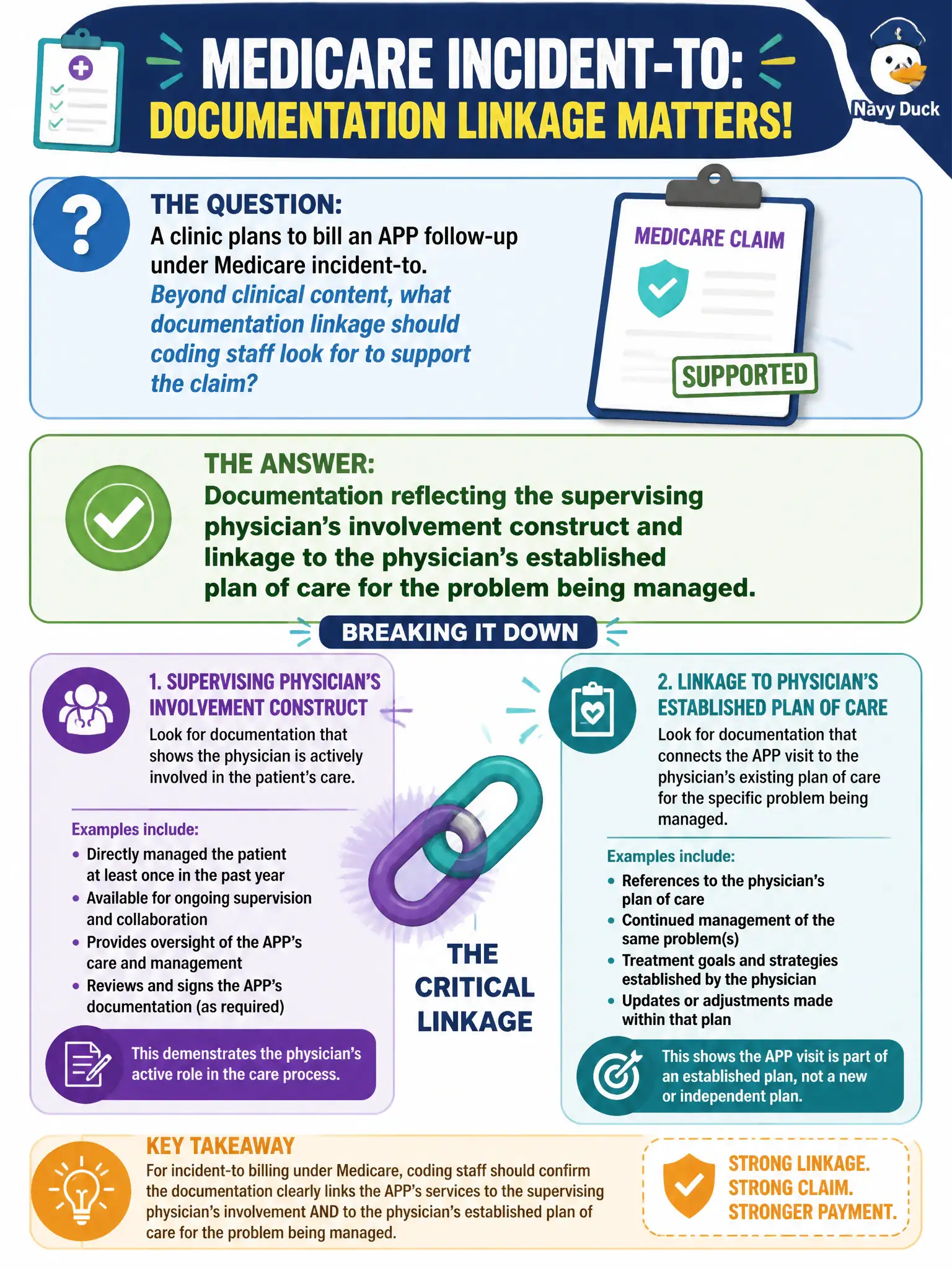
Beyond clinical content, Medicare incident-to claims need documentation that reflects the supervising physician’s involvement construct and linkage to the physician’s established plan of care for the problem being managed. In a public primary-care clinic, that paper trail shows why the APP follow-up may be billed under the physician when other prerequisites are met. Coding staff should look for care-plan continuity and supervision evidence, not merely an APP signature and a high-level CPT.
Relying only on the APP’s signature without reference to the supervising physician or care plan fails by concept because it omits the linkage incident-to audits seek. Documenting that incident-to was chosen solely to increase payment fails because payment motive is not a care-plan or supervision rationale and signals abusive intent. Submitting a blank encounter form with a circled CPT and no assessment or plan fails because there is no clinical or supervisory documentation to support any professional claim, incident-to or otherwise.
Exam caveat: documentation practices vary (attestations, co-signatures, suite-presence logs); the constant is a defensible link to the physician plan and supervision model required for the date of service. Operational check: before releasing an incident-to claim, confirm the note ties the problem to the physician plan and identifies the supervising physician presence construct per clinic policy.