
An APP furnishes a service in a hospital outpatient department. The group asks whether Medicare incident-to can be used the same way as in the freestanding physician office. What is the correct compliance understanding?
Select an answer to reveal the explanation.
Short Explanation
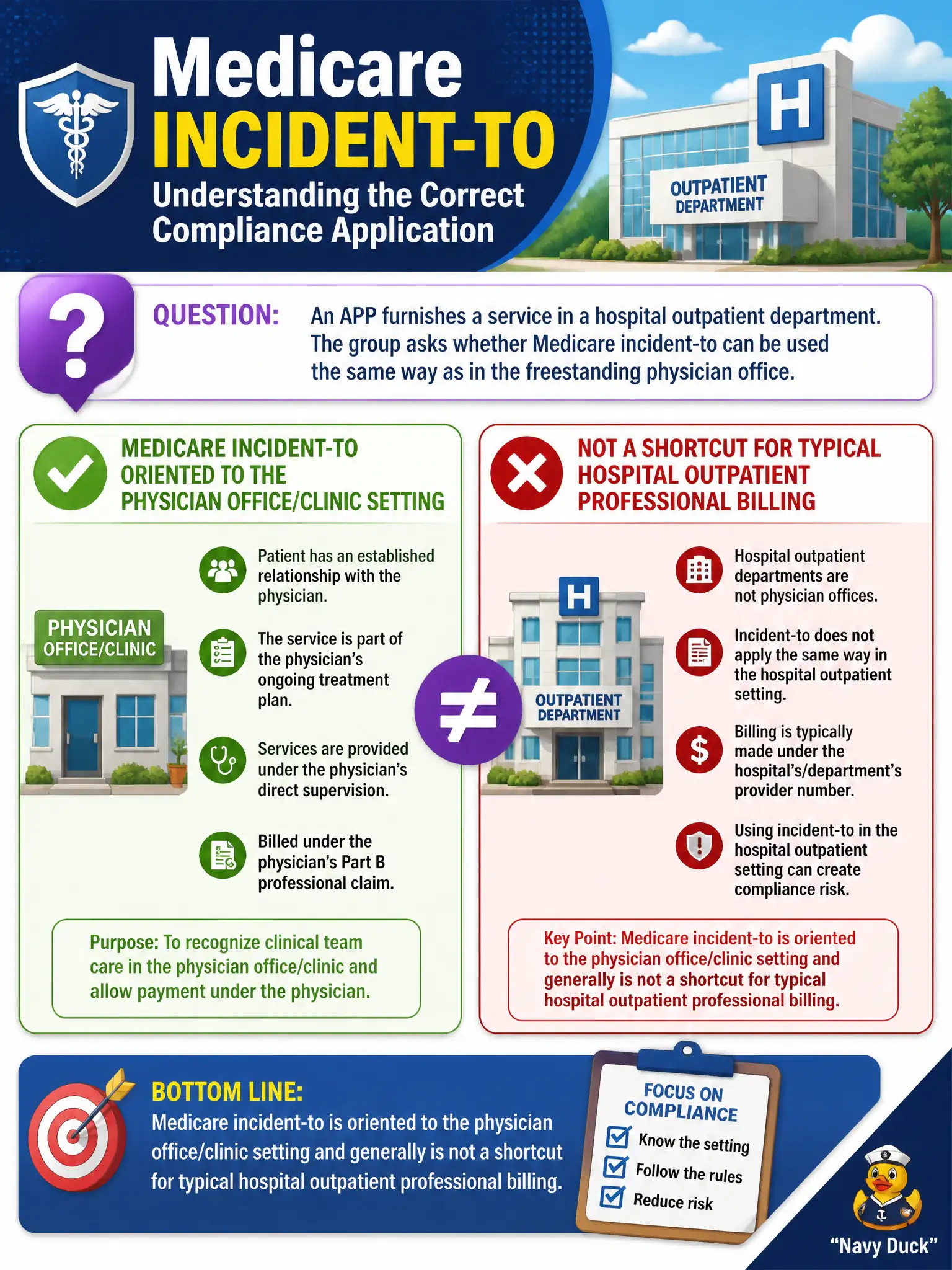
Incident-to grew up in the office suite, not as a universal hospital outpatient hack. Different site, different billing rules. Don’t import office incident-to habits onto the hospital clinic calendar.
Full Explanation
Medicare’s incident-to construct is oriented to services furnished in the physician office/clinic setting under defined conditions. It is generally not a shortcut for typical hospital outpatient professional billing when an APP furnishes a service in a hospital outpatient department. Civic groups that staff both freestanding offices and hospital clinics must apply setting-specific billing rules rather than importing office incident-to habits onto hospital outpatient encounters.
Claiming hospital outpatient departments always allow unrestricted incident-to under the attending’s NPI fails by concept because setting limits the classic incident-to pathway. Asserting incident-to applies in every POS if a physician co-signs within a year fails because delayed co-signature and universal POS coverage are not the incident-to rule set. Saying facility setting never affects incident-to and only CPT level matters fails because setting is central to whether incident-to is even on the table.
Exam caveat: shared/split billing and other hospital-setting constructs are different frameworks; do not relabel them as “incident-to” without meeting their own requirements. Operational check: when the APP service location is hospital outpatient, route billing through the hospital-setting professional rules and APP direct billing as applicable—not office incident-to templates.