
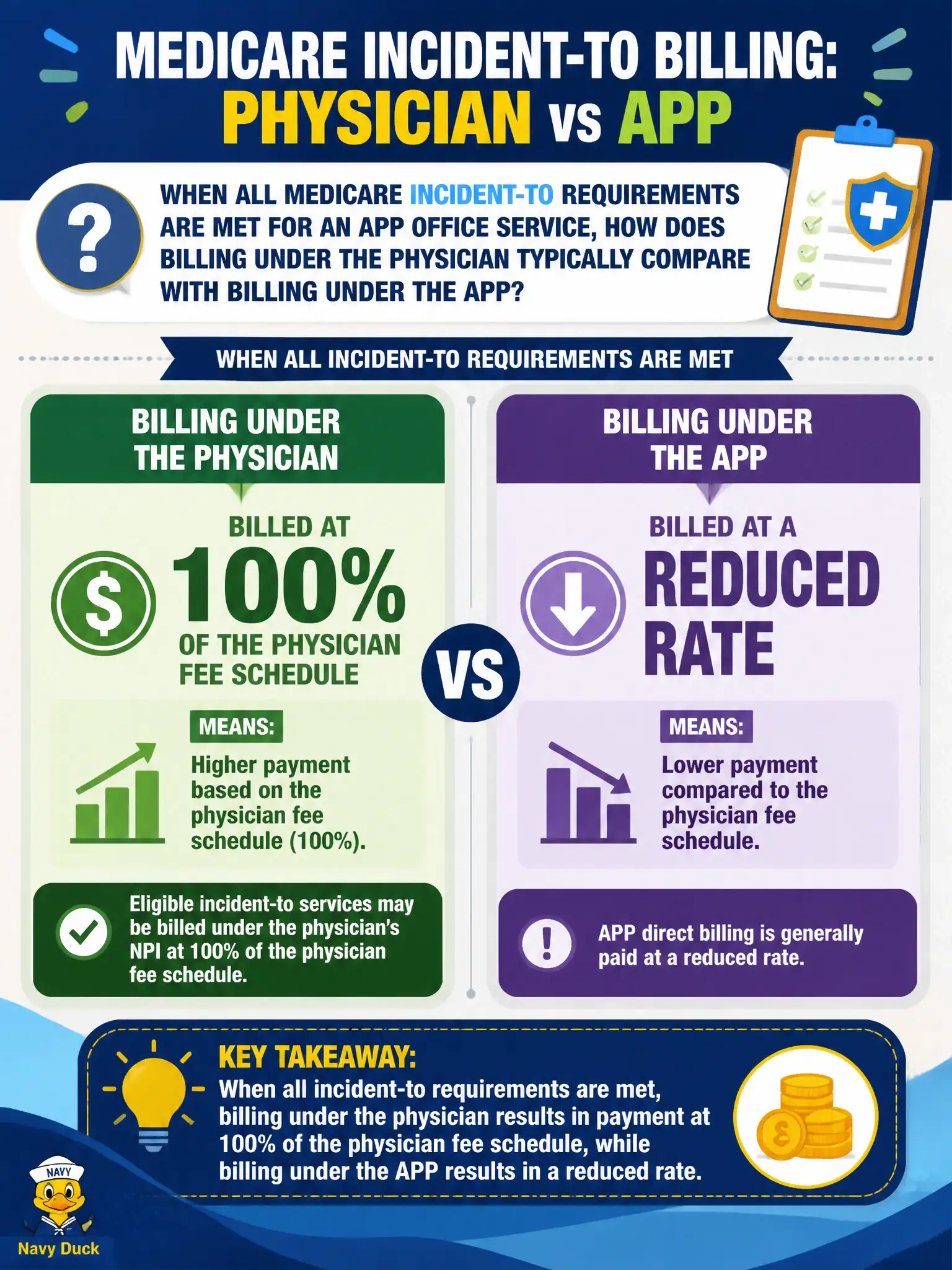
When all Medicare incident-to requirements are met for an APP office service, how does billing under the physician typically compare with billing under the APP?
Select an answer to reveal the explanation.
Short Explanation
Hit every incident-to checkbox and you can often bill under the physician at the full physician rate. Miss the checklist and you’re usually in APP direct-billing land at the reduced percentage. Eligibility decides which wallet you open.
Full Explanation
When all Medicare incident-to requirements are met for an APP office service, eligible services may be billed under the physician’s NPI at 100% of the physician fee schedule. By contrast, APP direct billing is generally paid at a reduced percentage of the physician fee schedule. For civic clinics managing Medicare professional-fee revenue, understanding that payment differential explains why incident-to eligibility must be earned—not assumed—before selecting the physician as billing provider.
Claiming incident-to always pays less than APP direct billing fails by concept because it reverses the usual payment relationship. Asserting identical payment for APP direct billing and incident-to physician billing on every claim fails because the reduced-rate versus full physician-rate distinction is material. Requiring incident-to claims to be billed under the APP NPI at 100% of the physician fee schedule fails because incident-to, when proper, is billed under the physician, and APP NPI billing is the direct-billing pathway.
Exam caveat: commercial payer policies may differ from Medicare; do not export Medicare incident-to payment assumptions to every plan without checking contracts. Operational check: use claim scrubber logic that allows physician-NPI APP claims only when incident-to indicators/documentation gates are present; otherwise default to APP NPI at the appropriate rate.