
A physician group wants to bill Medicare incident-to for services furnished by an APP who works purely as an independent contractor with no W-2 or leased-employee arrangement. What is the compliance concern?
Select an answer to reveal the explanation.
Short Explanation
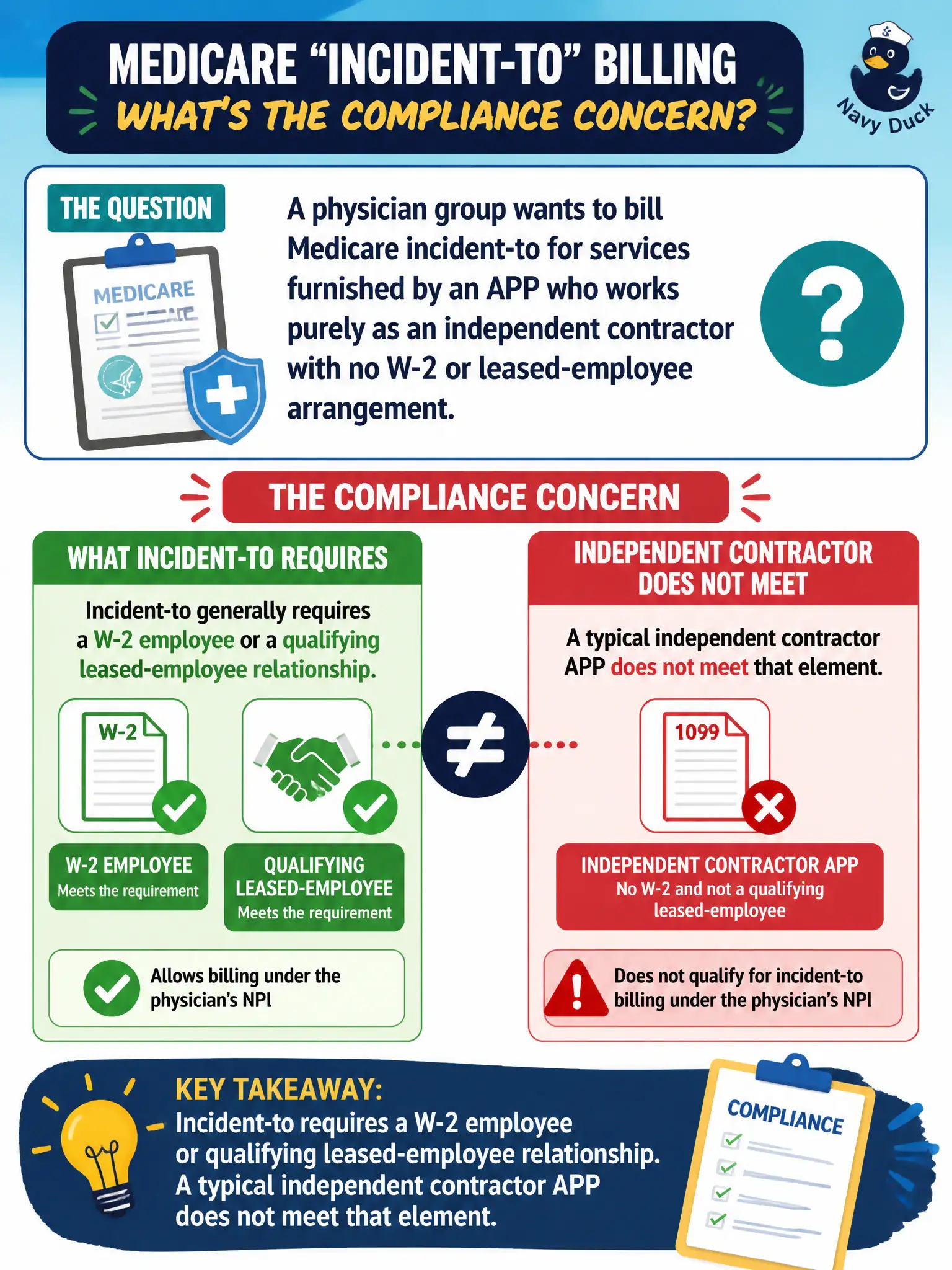
Incident-to isn’t a handshake deal with a 1099 APP. Medicare looks for a real employee or leased-employee hookup. Sharing an EHR login doesn’t turn a contractor into incident-to staff.
Full Explanation
Medicare incident-to generally requires that the auxiliary personnel furnishing the service be employed by the physician/group (commonly W-2) or meet a qualifying leased-employee arrangement. An APP who works purely as an independent contractor without that employment construct typically fails this element, even inside an otherwise well-run civic group practice. Compliance therefore declines incident-to for the typical 1099 contractor APP and uses appropriate direct billing instead, stewarding physician fee-schedule payments correctly.
Assuming independent contractors automatically qualify if they use the group’s EHR fails by concept because system access is not employment status. Treating employment status as irrelevant if taxonomy codes match fails because taxonomy does not create the required employment relationship. Allowing incident-to for contractors only when the patient self-pays fails because self-pay status does not rewrite Medicare’s employment prerequisite for incident-to.
Exam caveat: leased-employee arrangements can qualify when they meet Medicare’s specific conditions; “contractor” labels should be tested against those definitions rather than assumed to pass or fail by nickname alone. Operational check: have credentialing/HR confirm W-2 or leased-employee status before enabling incident-to billing profiles for APPs in the practice management system.