
The same physician sees an established patient in a hospital outpatient clinic rather than in the freestanding group office. Why does place-of-service selection matter for the professional claim?
Select an answer to reveal the explanation.
Short Explanation
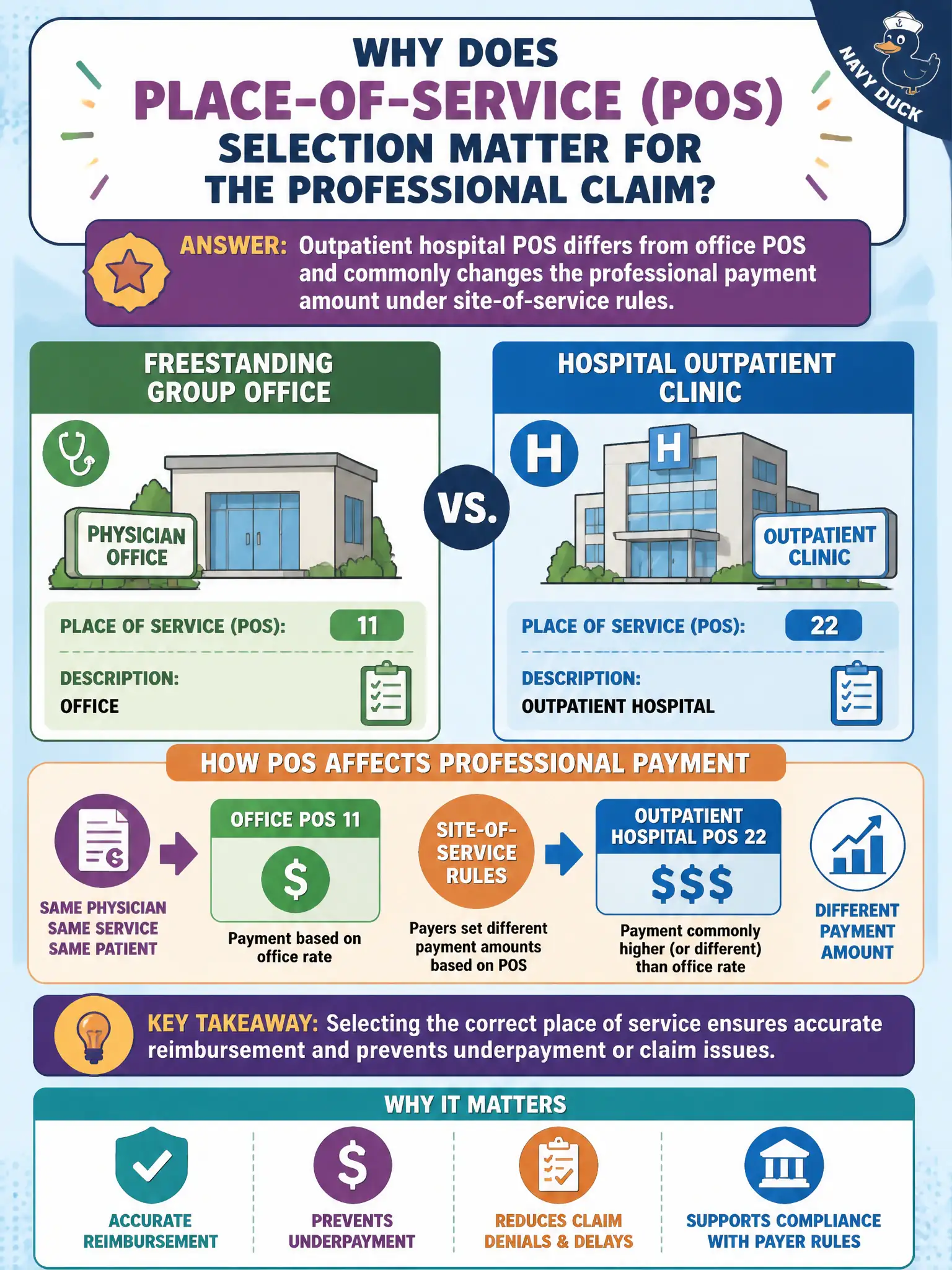
Same doctor, different building—payment can still change. Hospital outpatient clinic isn’t the freestanding office, so POS and site-of-service payment shift. Getting the setting right is as important as picking the CPT.
Full Explanation
When the same physician sees an established patient in a hospital outpatient clinic instead of the freestanding group office, place-of-service selection still matters. Outpatient hospital POS differs from office POS and commonly changes the professional payment amount under site-of-service differential rules. For civic practices that staff both freestanding offices and hospital clinics, accurate POS protects payment integrity and avoids under- or overpayment relative to the true setting.
Treating POS as cosmetic with a universal office rate fails by concept because Medicare and many payers adjust professional payment by site of service. Always using inpatient hospital POS for hospital outpatient professional claims fails because outpatient hospital is not inpatient hospital. Leaving POS blank if CPT and ICD-10-CM are correct fails because POS is a required claim element and a frequent edit/denial driver on CMS-1500 submissions.
Exam caveat: facility charges on a UB-04 are separate from the professional claim; correct professional POS does not replace facility billing rules, and vice versa. Operational check: map each clinic location in the practice management system to the correct POS, train schedulers and coders on office versus hospital outpatient distinctions, and sample paid claims for site-of-service mismatches.