
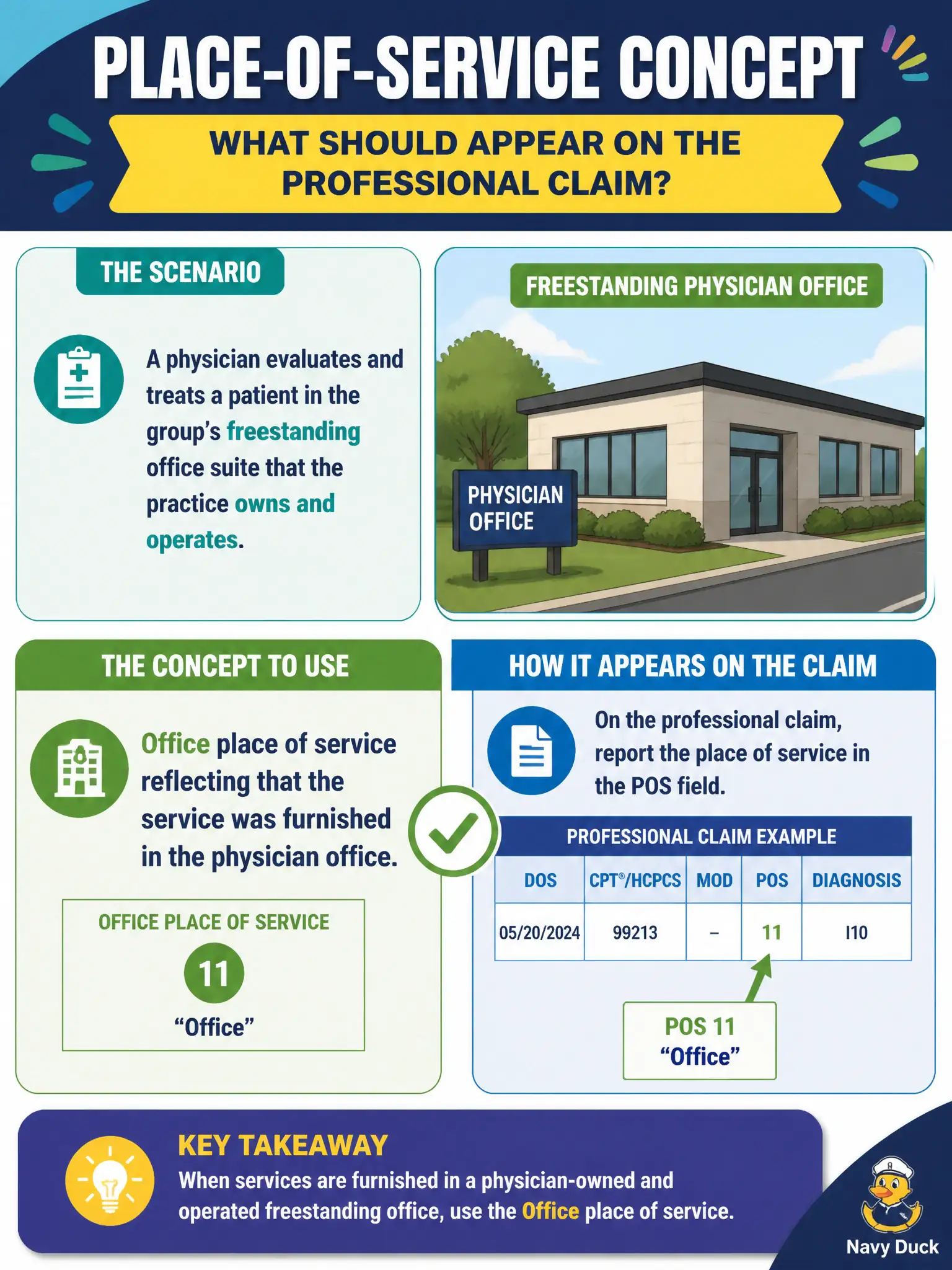
A physician evaluates and treats a patient in the group’s freestanding office suite that the practice owns and operates. Which place-of-service concept should appear on the professional claim?
Select an answer to reveal the explanation.
Short Explanation
Where the service happened is what POS cares about—not where the doctor also has privileges. In the practice’s own office suite, it’s office POS. Don’t stamp “hospital” on an exam-room visit just because the letterhead mentions a medical center.
Full Explanation
Place of service on the professional claim reflects where the service was furnished. When a physician evaluates and treats a patient in the group’s freestanding office suite that the practice owns and operates, the appropriate concept is office place of service. Credentialing elsewhere, visit urgency, or the theoretical possibility of a minor procedure does not relocate an office-suite encounter for CMS-1500 POS purposes. Accurate POS supports correct site-of-service payment for civic outpatient professional billing.
Selecting inpatient hospital POS merely because the physician is hospital-credentialed fails by concept because privileges are not the service location. Choosing emergency department POS because the visit was unscheduled fails because urgency does not redefine an office suite as an ED. Choosing ASC POS because a minor procedure was possible fails because potential procedures do not convert the actual office setting into an ambulatory surgical center.
Exam caveat: if the same physician later treats the patient in a different setting (hospital outpatient clinic, ASC, NF), POS must follow that encounter’s true location—do not hard-code office POS from habit. Operational check: confirm the appointment location and ownership/operation of the suite before finalizing POS, and reconcile scheduling system site codes with claim POS on professional claims.