
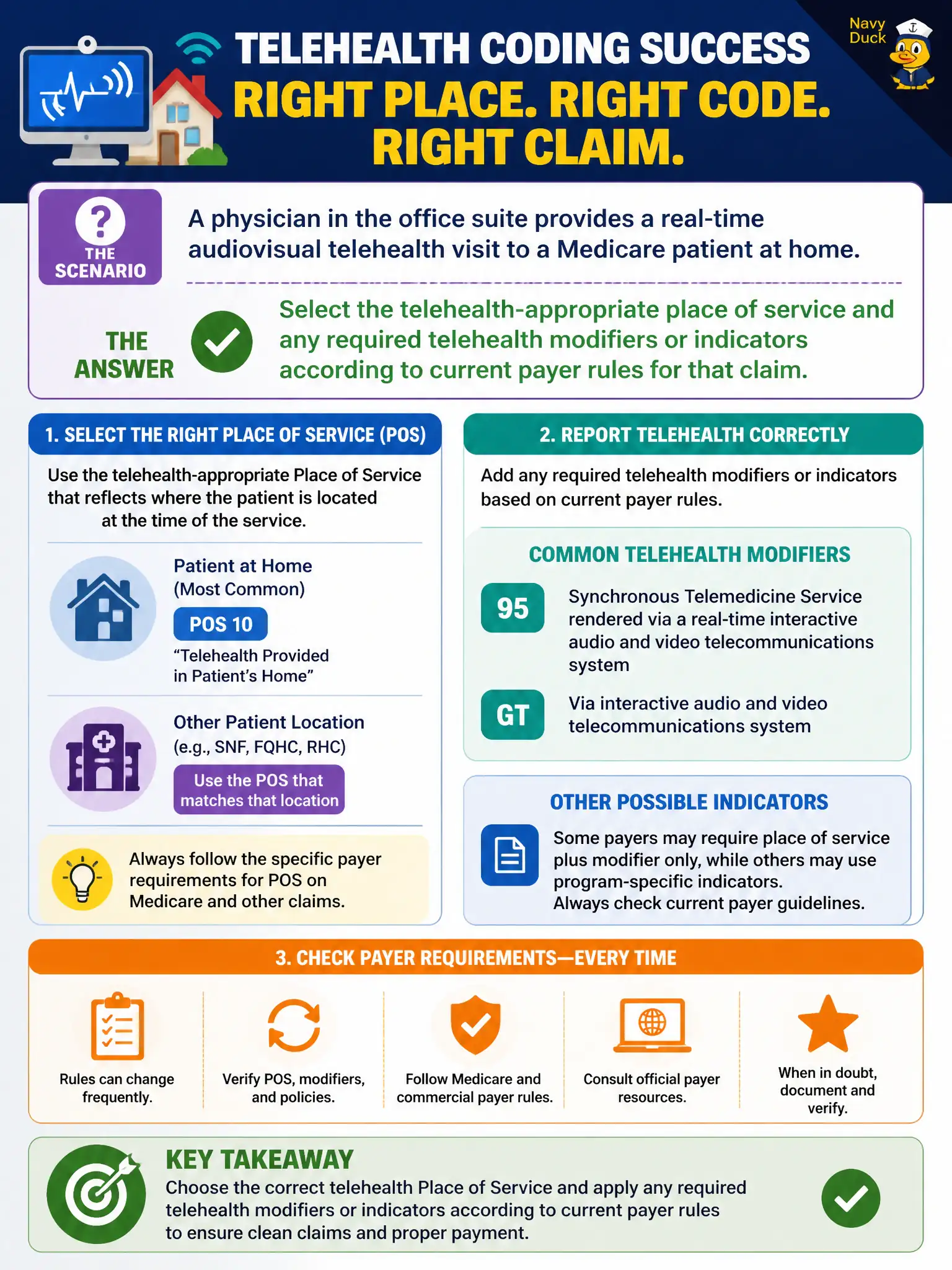
A physician in the office suite provides a real-time audiovisual telehealth visit to a Medicare patient at home. What is the coder’s best approach to place of service and telehealth reporting?
Select an answer to reveal the explanation.
Short Explanation
Telehealth POS isn’t one sticky label forever—payers publish the construct they want. Match today’s Medicare or commercial rule for home-to-office video, including any modifier. Guessing “ED” or leaving POS blank is how clean claims go sideways.
Full Explanation
For a real-time audiovisual telehealth visit furnished by a physician in the office suite to a Medicare patient at home, the coder must apply the telehealth-appropriate place of service and any required telehealth modifiers or indicators under current payer rules for that claim. Telehealth reporting constructs evolve; compliance means following the active Medicare or commercial instruction set rather than inventing a single permanent label. Civic clinics that expand virtual care must keep POS and modifier logic synchronized with published guidance to steward public-program payments correctly.
Always using inpatient hospital POS for any video visit fails by concept because telehealth POS is payer-defined and is not universally inpatient. Omitting POS and relying only on a telehealth add-on fails because POS remains a claim requirement and add-ons do not erase setting reporting. Reporting ED POS because the patient might have gone to the ED fails because hypothetical alternative care sites do not determine the POS for the service actually furnished.
Exam caveat: commercial payers may differ from Medicare on POS and modifier combinations; apply the rule set for the payer on the claim date of service. Operational check: maintain a current telehealth POS/modifier tip sheet, verify patient location and modality in the note, and reject claims that leave POS blank or use ED/inpatient POS without a true corresponding setting.