
Advanced practice providers and supervising physicians in a primary-care clinic are unclear when Medicare incident-to billing is allowed. What should compliance education prioritize?
Select an answer to reveal the explanation.
Short Explanation
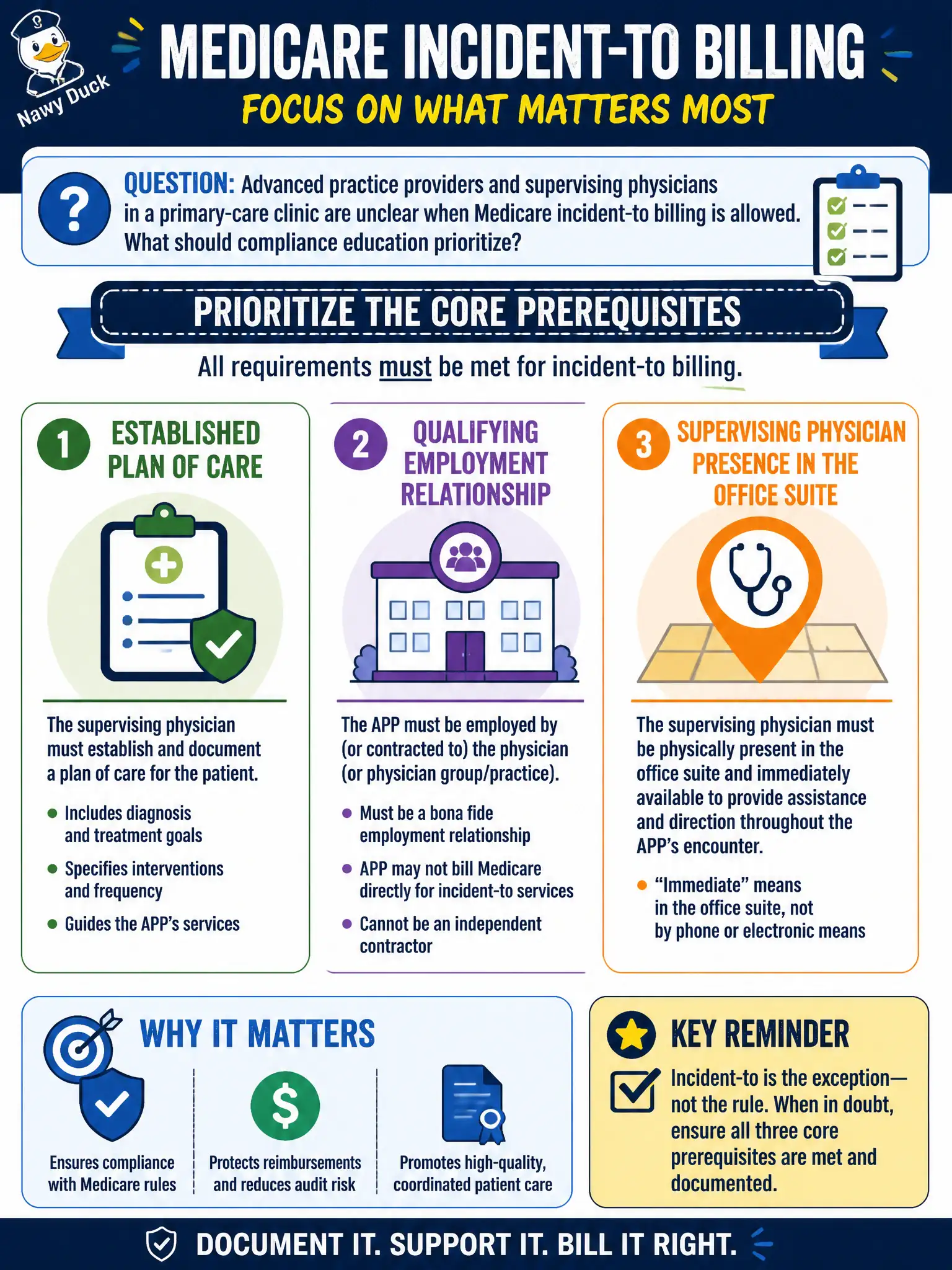
Incident-to isn’t a nickname for “APP saw the patient.” It’s a short checklist—plan already set, right employment setup, doctor actually in the suite. Train both APPs and supervisors on those gates before anyone bills under the physician.
Full Explanation
Medicare incident-to billing for advanced practice provider services in a physician office is a tightly conditioned construct. Compliance education for a civic primary-care clinic should prioritize core prerequisites: an established physician plan of care for the problem, a qualifying employment or leased-employee relationship, and required supervising-physician presence in the office suite (direct supervision), among other applicable conditions. Teaching those gates prevents improper billing under the physician NPI when the visit does not actually qualify.
Claiming any credentialed APP visit may be billed under the physician NPI fails by concept because credentialing alone does not satisfy incident-to. Asserting incident-to always applies identically in hospital outpatient clinics fails because the classic incident-to pathway is oriented to the physician office/clinic setting, not as a universal hospital outpatient shortcut. Allowing supervising physicians to be available only by phone from home for all incident-to office visits fails because direct supervision for incident-to contemplates presence in the office suite, not remote phone availability alone.
Exam caveat: state scope-of-practice and payer-specific split-share or shared-visit rules may coexist; do not confuse those frameworks with Medicare incident-to prerequisites. Operational check: before billing incident-to, verify plan-of-care linkage, employment status, and suite presence for that date of service, and fall back to APP direct billing when any gate fails.