
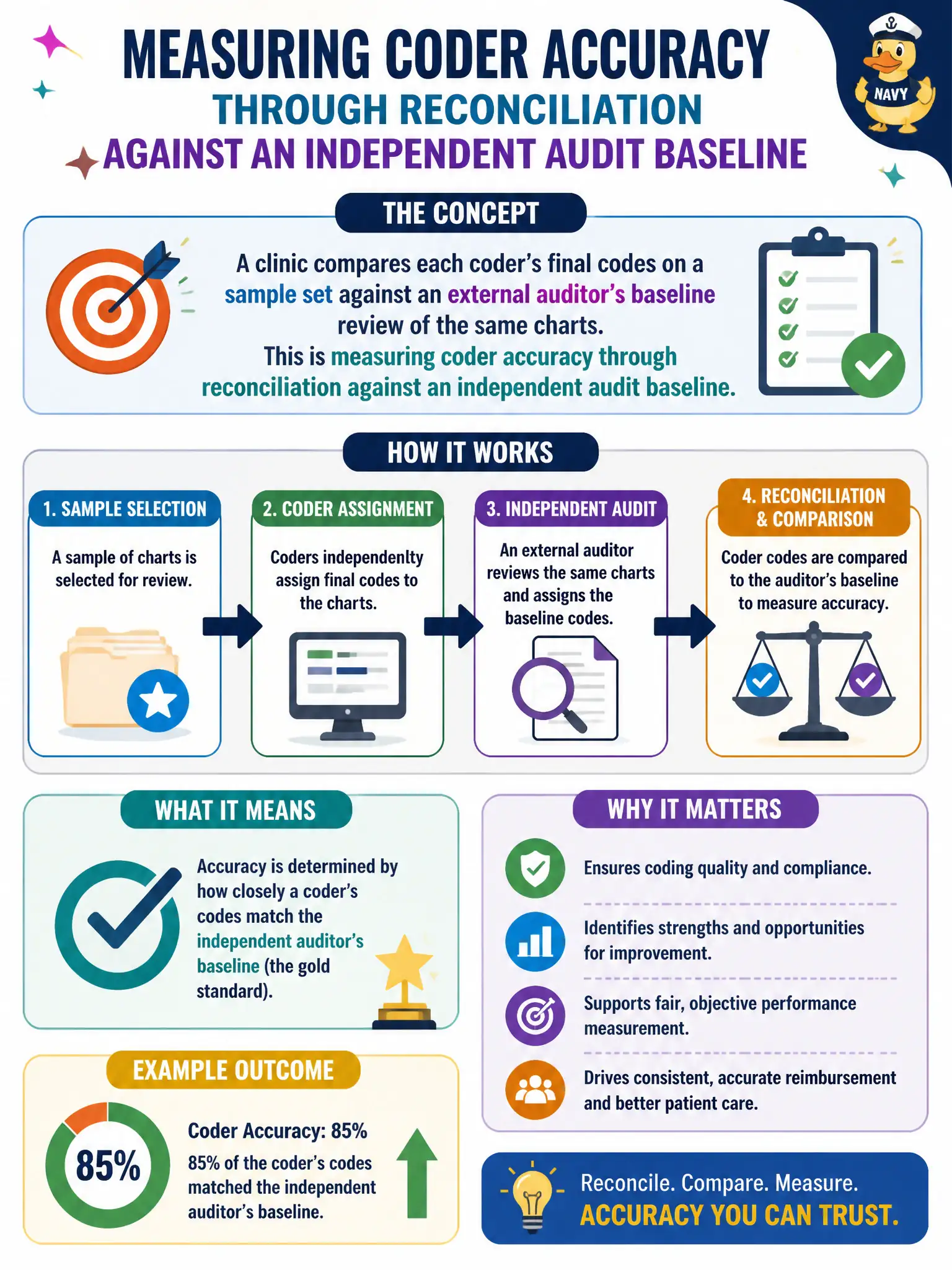
A clinic compares each coder's final codes on a sample set against an external auditor's baseline review of the same charts. What quality concept is being applied?
Select an answer to reveal the explanation.
Short Explanation
Accuracy isn't a vibes check—you compare what your coders put on the claim to a trusted second set of eyes. That reconciliation score tells you who's solid and who needs coaching.
Full Explanation
Coder quality measurement commonly reconciles internal code assignment with an external or senior auditor baseline on the same records. Agreement rates identify accuracy gaps by coder, code type, or provider documentation issue. When a civic clinic compares each coder’s final codes on a sample set against an external auditor’s baseline review of the same charts, the quality concept applied is measuring coder accuracy through reconciliation against an independent audit baseline. Productivity metrics alone do not substitute for accuracy auditing in a compliance program. Ranking coders solely by claims submitted per hour without accuracy review fails quality measurement. Eliminating external audits once internal productivity exceeds targets fails compliance assurance. Using charge-master defaults as the gold standard instead of documentation review fails because chargemasters are not documentation. Exam caveat: accuracy reconciliation needs a trusted baseline and clear disagreement adjudication rules—not just a productivity leaderboard. Operational check: run dual review on a sample, calculate agreement by domain, coach low-agreement concept families, protect accurate slow coding from pure speed pressure, and report accuracy KPIs to county HIM leadership.