
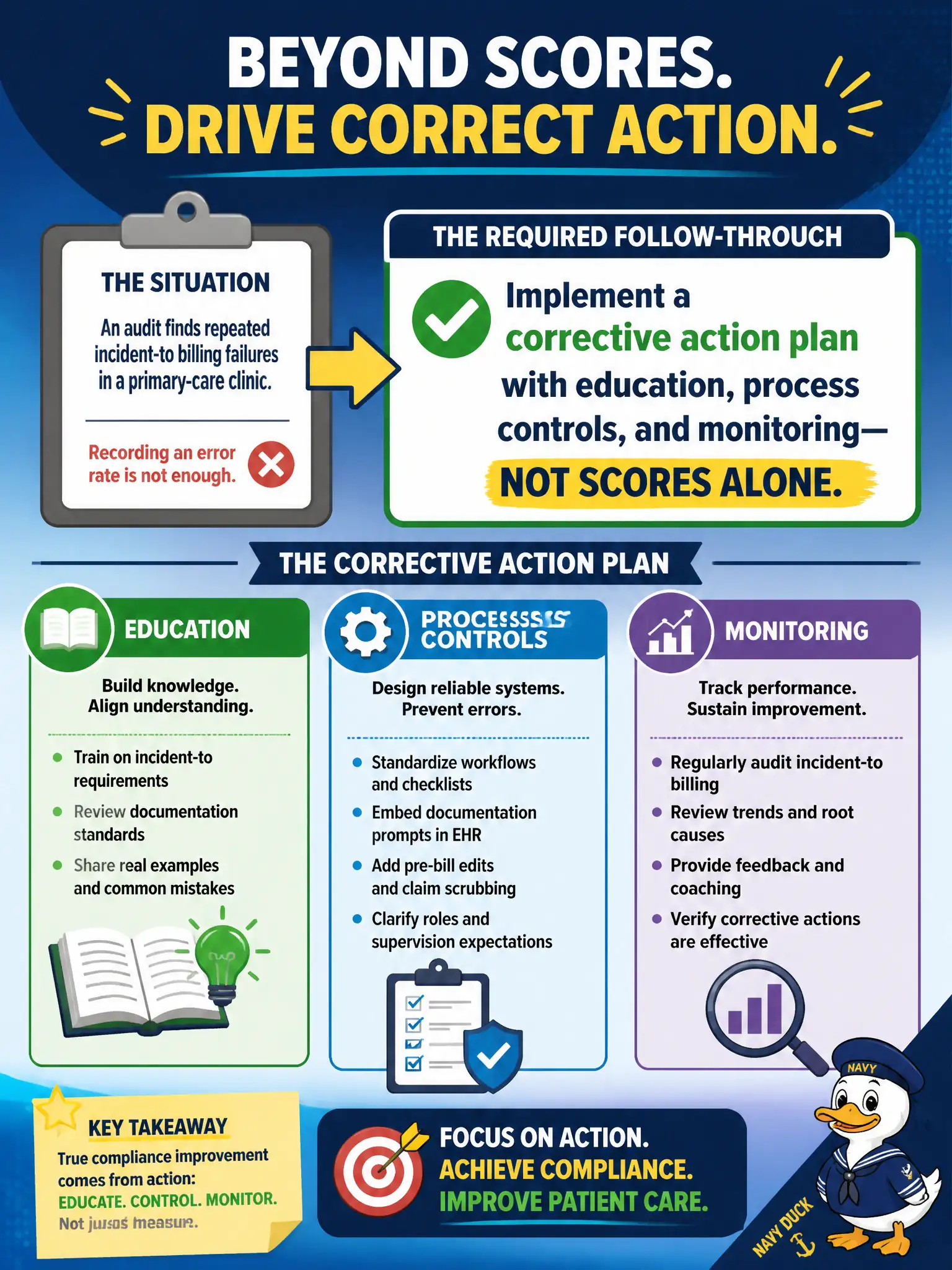
An audit finds repeated incident-to billing failures in a primary-care clinic. Beyond recording an error rate, what follow-through is required?
Select an answer to reveal the explanation.
Short Explanation
An audit without a fix is just a report card in a drawer. After incident-to failures, you teach, tighten the workflow, and recheck—don't just file the percentage and move on.
Full Explanation
Coding and documentation audits are intended to drive corrective action, not vanity scoring. After an internal audit finds repeated incident-to billing failures in a primary-care civic clinic, follow-through beyond recording an error rate requires implementing a corrective action plan with education, process controls, and monitoring. Scoring alone does not remediate risk to public programs; repayment analysis may also be needed when claims were improperly submitted under incident-to rules. Archiving the score and making no changes unless a payer demands a refund first fails proactive compliance duty. Increasing incident-to billing volume to offset prior underpayments fails and may compound noncompliance. Terminating all NPP visits so incident-to rules never apply again is an operational overreaction that avoids teaching compliant incident-to or appropriate direct billing pathways rather than fixing the control failures. Exam caveat: the expected compliance loop is findings → CAP with owners/dates → monitoring → effectiveness check; CCS-P items often test that follow-through, not the raw error percentage. Operational check: write a CAP with responsible owners and due dates, retrain providers and billers on incident-to supervision and documentation, fix EHR attestation prompts, re-audit in 60–90 days, and evaluate refunds with compliance counsel for the county clinic.