
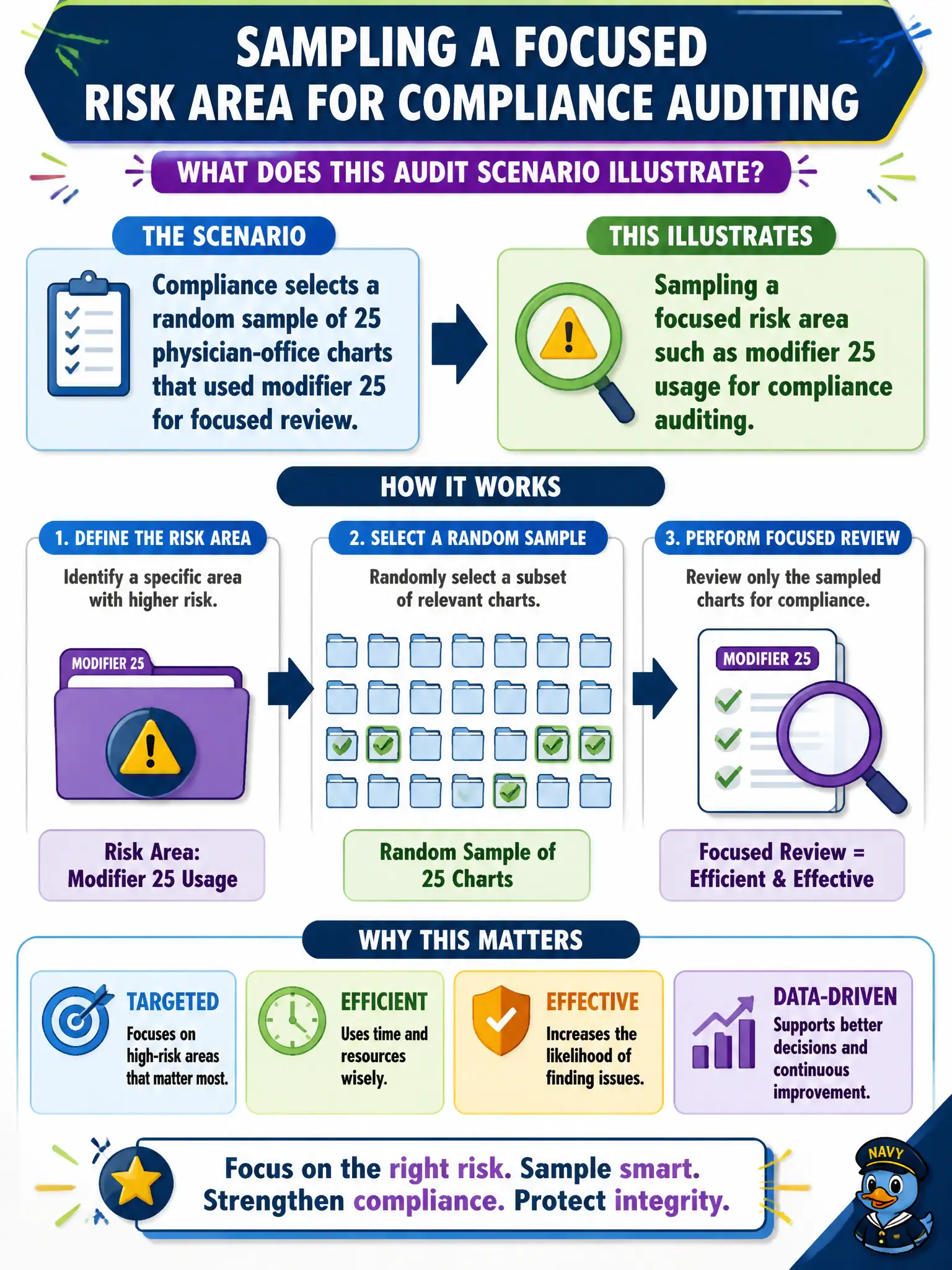
Compliance selects a random sample of 25 physician-office charts that used modifier 25 for focused review. What audit-methodology idea does this illustrate?
Select an answer to reveal the explanation.
Short Explanation
You don't need to boil the ocean—pick a risk hotspot like modifier 25, pull a sensible random sample, and learn the pattern. That's how smart audits stay practical and still catch trouble.
Full Explanation
Effective compliance auditing often uses sampling concentrated on known risk areas, such as modifier 25 reported with E/M services and procedures. When compliance selects a random sample of 25 physician-office charts that used modifier 25 for focused review, the methodology illustrated is sampling a focused risk area for compliance auditing. That approach assesses documentation support and coding accuracy without reviewing the entire claim population, and findings should drive education and process fixes in the civic clinic. Auditing only charts without modifiers because modifiers never create risk fails—modifiers such as 25 are frequently high-risk for unbundling and same-day E/M scrutiny. Reviewing every chart in the practice every day instead of risk-based sampling is usually operationally unrealistic and not required for a sound compliance methodology. Excluding modifier 25 encounters from audits to avoid provider pushback fails compliance independence and leaves the risk untested. Exam caveat: focused risk-based sampling is appropriate; the sample design should still be defensible (random within the risk stratum, adequate size, documented methodology, and clear scoring criteria). Operational check: define the modifier-25 universe for the audit period, draw a random sample of sufficient size, score each chart against distinct-service E/M criteria and NCCI/policy expectations, educate providers and coders on findings, and re-audit after corrective actions for the county practice.