
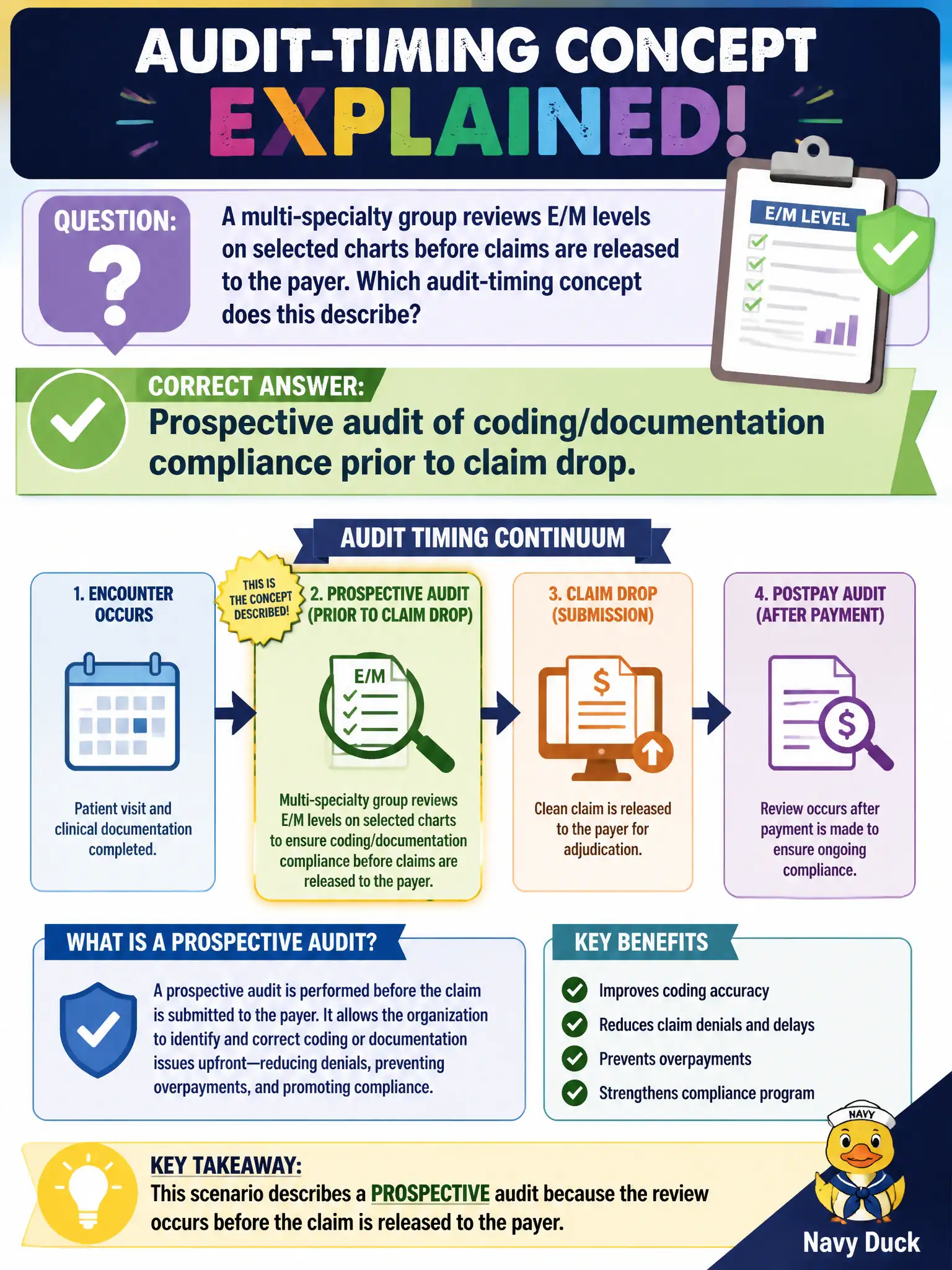
A multi-specialty group reviews E/M levels on selected charts before claims are released to the payer. Which audit-timing concept does this describe?
Select an answer to reveal the explanation.
Short Explanation
Catching E/M issues before the claim flies is a prospective audit—like proofreading before you hit send. Retrospective is the post-payment autopsy; both have a place, but pre-drop review is the early warning system.
Full Explanation
Prospective coding audits review documentation and code selection before claims are submitted, allowing correction of E/M or other errors prior to billing. Retrospective audits occur after submission or payment. When a multi-specialty civic group reviews E/M levels on selected charts before claims are released to the payer, that describes prospective audit of coding/documentation compliance prior to claim drop—a common high-risk-area control in effective compliance programs. Calling it retrospective only because all physician-practice reviews occur after payment fails—prospective review is both possible and recommended. Calling it a RAC recovery audit that practices perform on their own claims before submission fails: RACs are external Medicare recovery contractors, not an internal prebill review synonym. Calling it an external accreditation survey that replaces coding audits fails; accreditation does not eliminate the need for coding compliance audits. Exam caveat: prospective vs retrospective timing is a tested compliance-program concept—match the timing words in the stem. Operational check: route high-risk E/M charts to prebill review, correct levels before drop, trend prospective findings for education, and keep a clear separation between prospective QA and postpayment audits in the municipal compliance plan.