
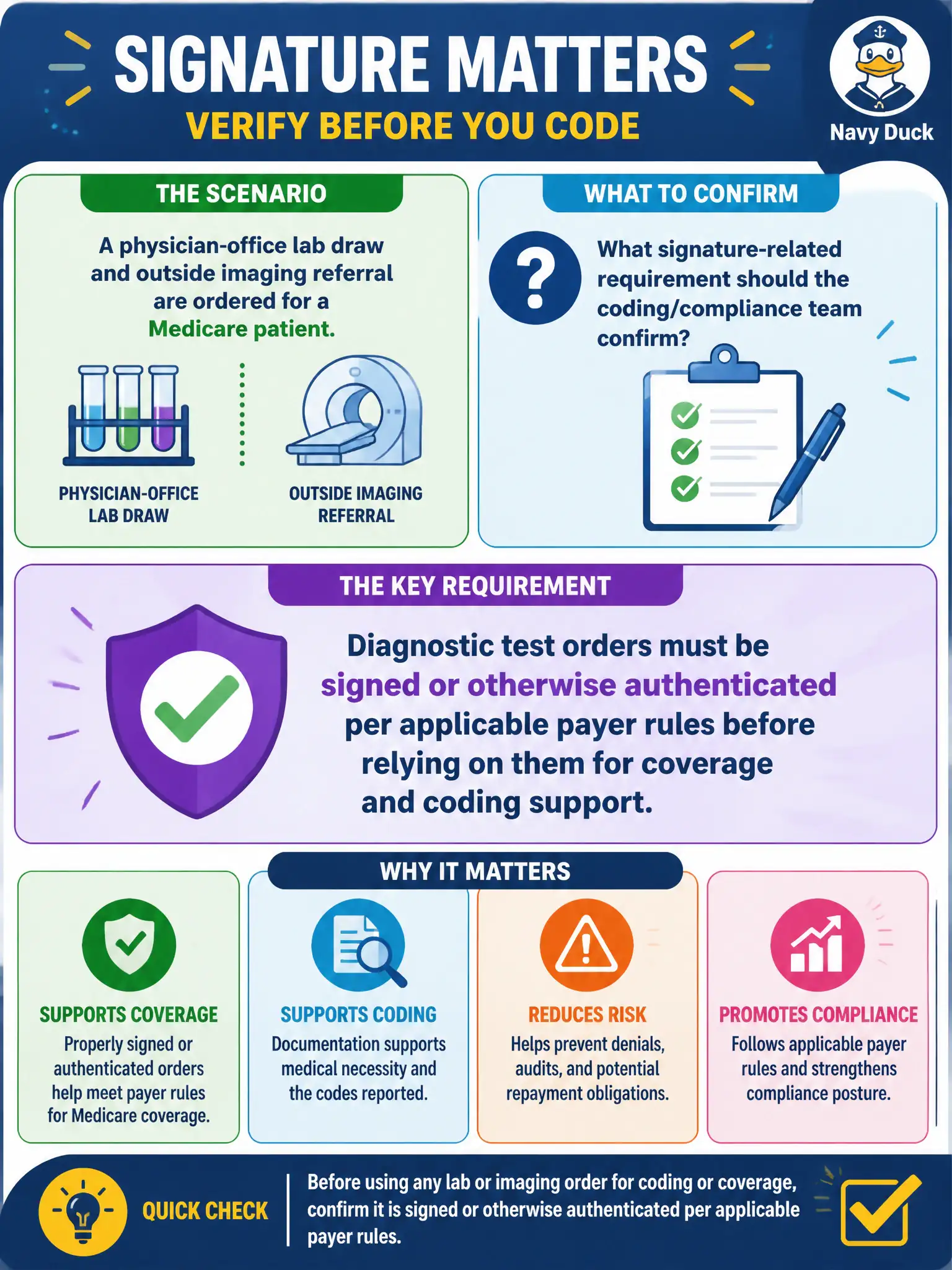
A physician-office lab draw and outside imaging referral are ordered for a Medicare patient. What signature-related requirement should the coding/compliance team confirm?
Select an answer to reveal the explanation.
Short Explanation
Tests don't order themselves. Whether it's a lab or imaging, the order needs a real authenticated provider trail—patient consent or a scheduler's typing isn't the doctor's signature.
Full Explanation
Payer rules, including Medicare guidance, generally require diagnostic test orders to be signed or authenticated by an authorized ordering clinician. Unsigned or unauthenticated orders create compliance and coverage risk for related services. For a Medicare patient in a physician office with a lab draw and outside imaging referral, the coding/compliance team should confirm diagnostic test orders are signed or otherwise authenticated per applicable payer rules before relying on them for coverage and coding support—distinct from patient consent forms. Assuming verbal orders for diagnostic tests never require later authentication fails professional-setting order rules. Believing the patient’s consent signature replaces a signed test order fails because consent is not an order. Treating unsigned orders as billable if the scheduler typed the test name fails authorship/authentication requirements. Exam caveat: order authentication is a documentation-readiness control separate from CPT code selection; both must be present for a clean civic clinic claim. Operational check: verify order signature/attestation before claim drop, query missing authentications, educate schedulers not to invent orders, and include order-signature checks in the municipal lab/imaging prebill checklist.