
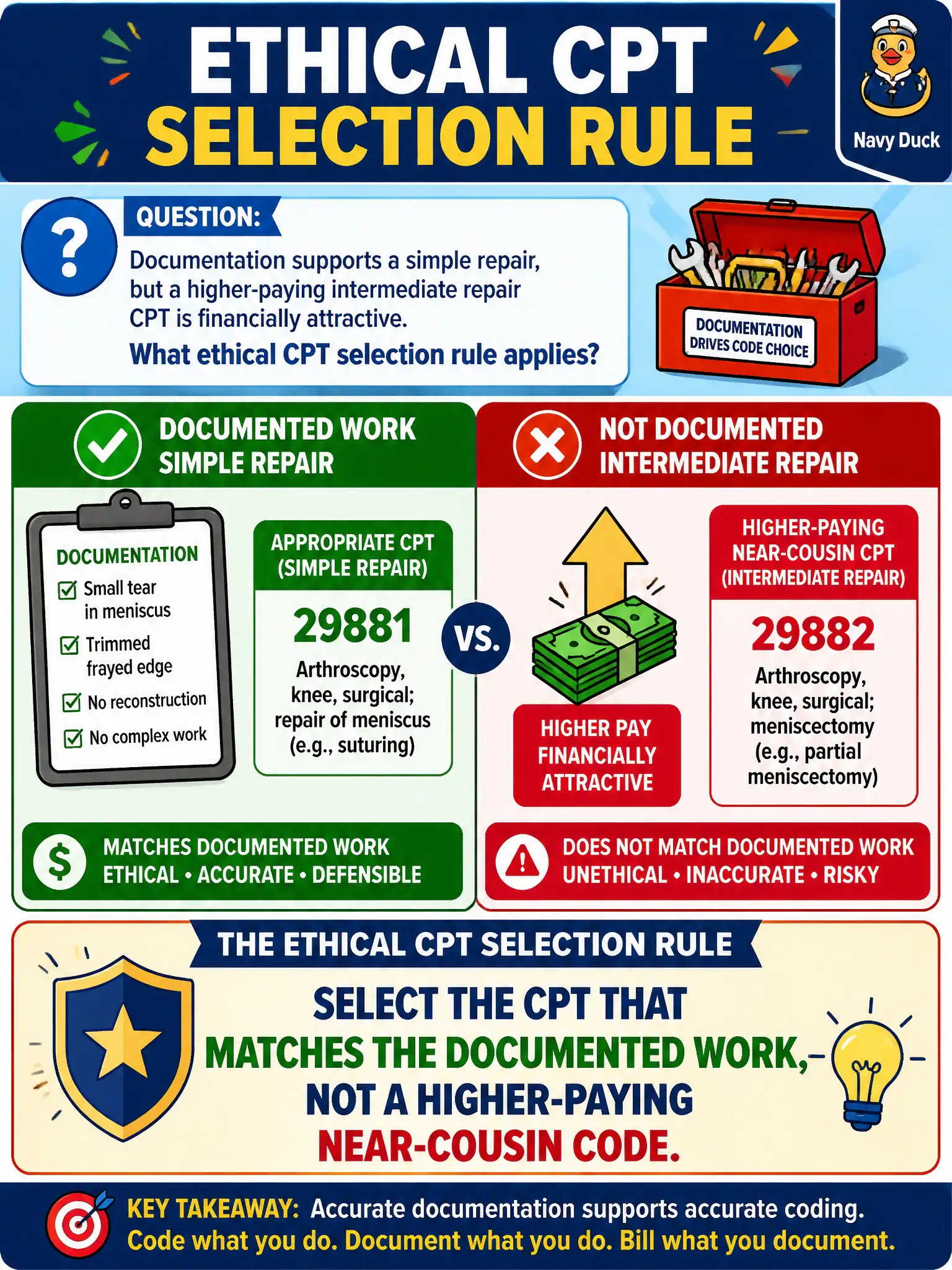
Documentation supports a simple repair, but a higher-paying intermediate repair CPT is financially attractive. What ethical CPT selection rule applies?
Select an answer to reveal the explanation.
Short Explanation
Close cousins in the CPT book can look alike until you read the note. If the work was a simple repair, you don't 'upgrade' to the richer code just because it pays more—match the story on the page.
Full Explanation
Ethical CPT assignment requires the selected code to reflect the service documented, including repair complexity definitions and other CPT guidelines. Choosing a higher-paying related code that the documentation does not support is intentional miscoding. When documentation supports a simple repair but a higher-paying intermediate repair is financially attractive, the civic clinic coder selects the CPT that matches the documented work, not a higher-paying near-cousin code. If documentation is unclear, a compliant query is appropriate; financial preference alone is never a valid selection criterion. Always choosing the highest-RVU code in the anatomic family when documentation is ambiguous and unanswered fails—ambiguity calls for query, not max-RVU default. Billing both simple and intermediate repair codes for the same closure fails as duplicate billing of one repair. Using the intermediate code whenever the charge master defaults to it fails because chargemaster defaults cannot override the note. Exam caveat: repair family questions test documentation-to-definition matching, not fee-schedule shopping. Operational check: compare wound repair details (layers, contamination, etc.) to CPT definitions, select the matching code, query if layers/complexity are unclear, and disable financially biased chargemaster nudges in the municipal PMS.