
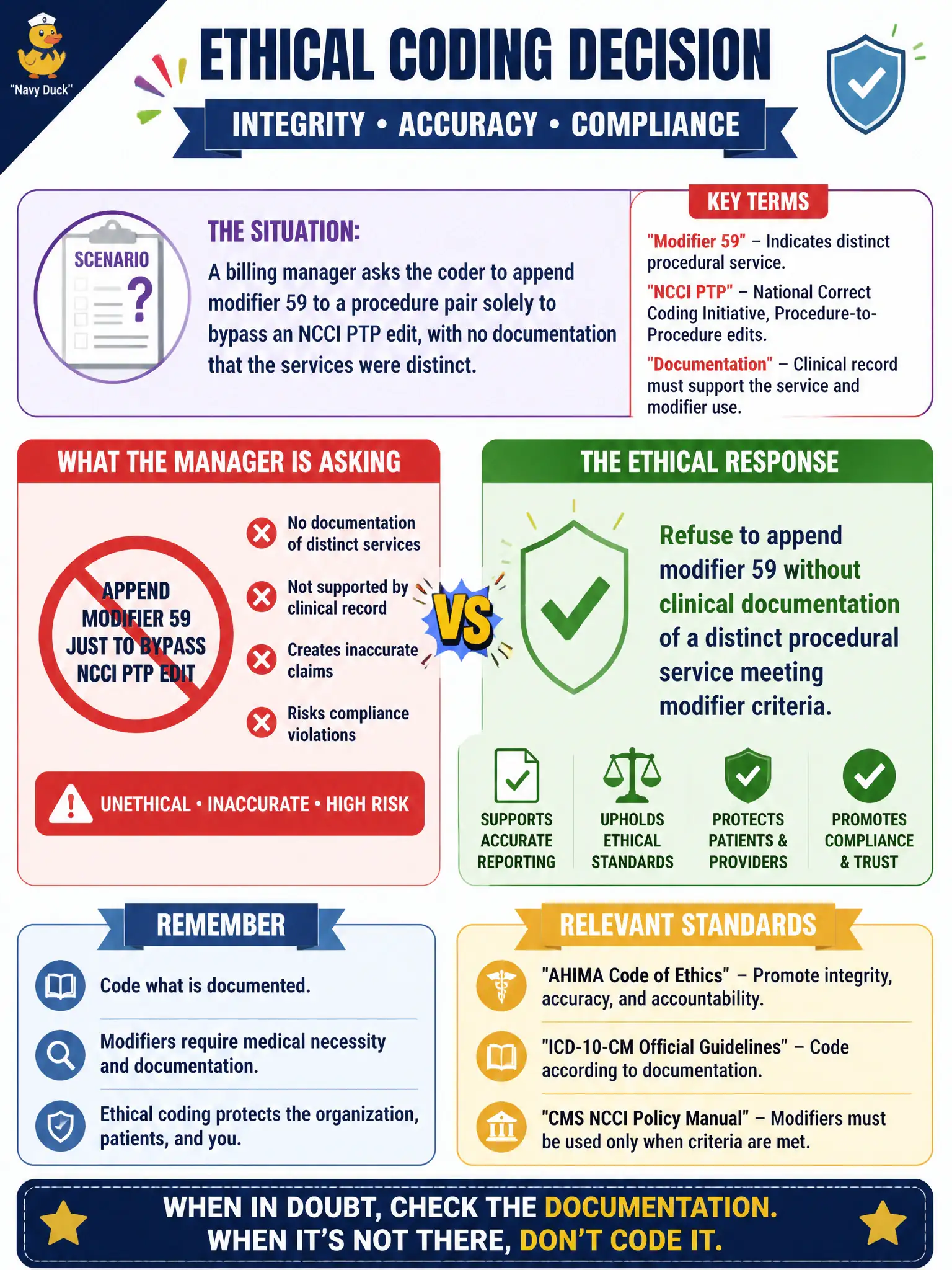
A billing manager asks the coder to append modifier 59 to a procedure pair solely to bypass an NCCI PTP edit, with no documentation that the services were distinct. What is the ethical response?
Select an answer to reveal the explanation.
Short Explanation
Modifier 59 isn't a skeleton key for every edit lock. If the work wasn't truly separate—different site, session, or distinct service—you don't slap 59 on just to chase payment. Ethical coding means the chart has to earn the override.
Full Explanation
AHIMA ethical coding standards and CMS NCCI guidance require that modifiers such as 59 be used only when documentation supports a distinct procedural service. When a billing manager asks a civic clinic coder to append modifier 59 solely to bypass an NCCI PTP edit with no documentation of distinctness, the ethical response is refusal. Appending 59 without clinical distinctness is improper unbundling and creates false-claims exposure for public-program claims. Appending 59 whenever an edit appears because edits exist only to be overridden fails correct-coding principles. Appending 59 with a note that the payer “usually pays” fails because historical payment does not create distinctness. Deleting the lesser procedure regardless of medical necessity of both services can be appropriate when the lesser is a bundled component—but as a blanket instruction ignoring clinical facts it can also understate separately identifiable work; the stem’s ethical core is refusing unsupported 59, not inventing documentation. Exam caveat: indicator “0” cannot be bypassed; indicator “1” still needs real distinctness matched to 59/X{EPSU}. Operational check: decline the request in writing to compliance, cite missing distinctness and NCCI indicator, educate the manager, and monitor forced-modifier requests on the municipal revenue-integrity dashboard.