
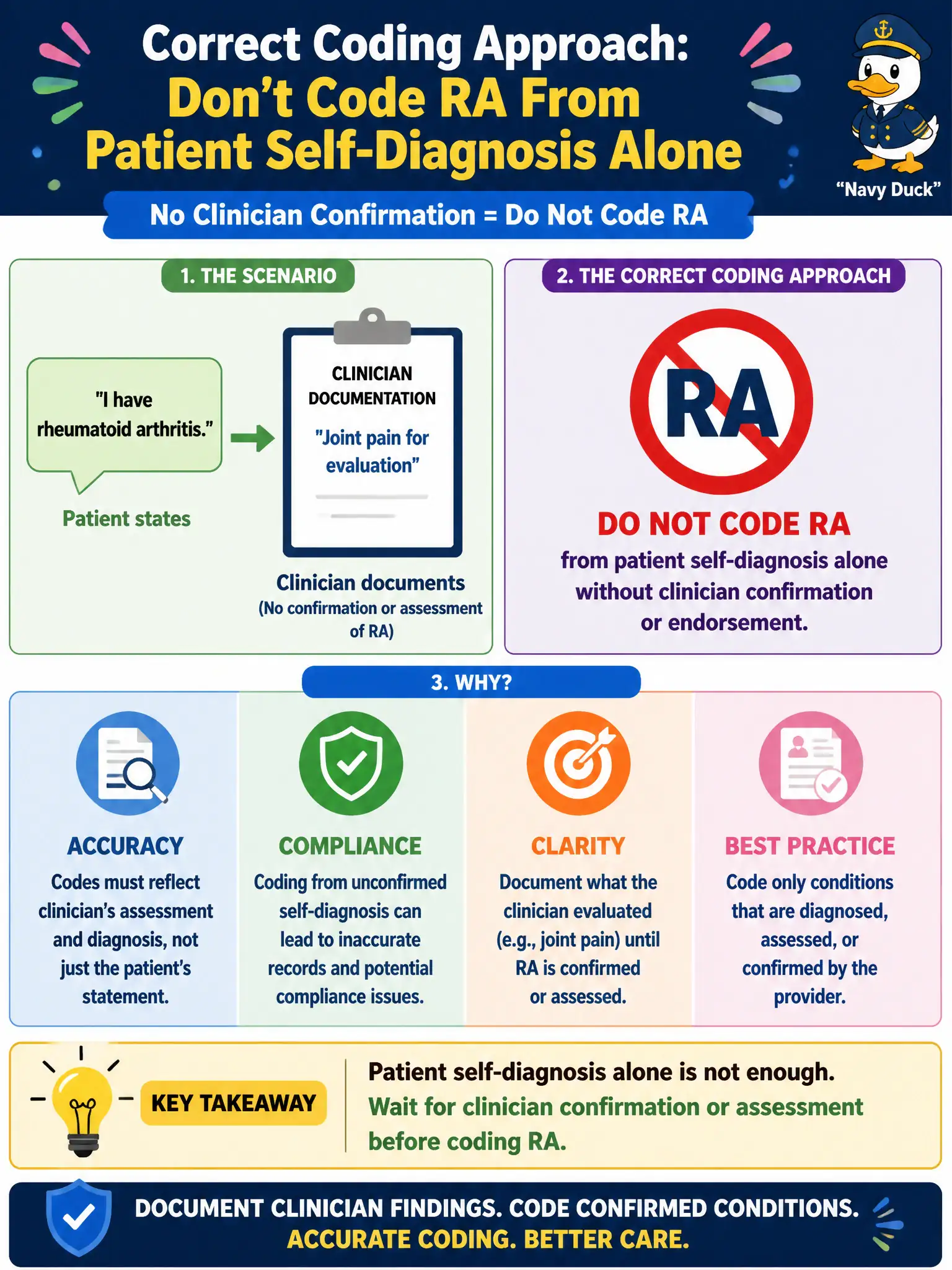
During an office visit the patient states, 'I have rheumatoid arthritis,' but the clinician documents joint pain for evaluation and does not confirm or assess RA. What is the correct coding approach?
Select an answer to reveal the explanation.
Short Explanation
Patients are great historians of how they feel, but they're not the ones signing the claim. If the doctor didn't confirm or work up 'RA' and only documented joint pain under evaluation, you don't code the patient's label just because it was spoken.
Full Explanation
Patient-stated diagnoses without clinician confirmation are not sufficient support for ICD-10-CM assignment on a professional claim. Codes should reflect conditions the treating provider documents, assesses, or otherwise endorses. When a civic clinic patient says “I have rheumatoid arthritis,” but the clinician documents joint pain for evaluation and does not confirm or assess RA, the coder does not report RA from self-diagnosis alone and instead reports the documented clinical impression. Coding RA because patient-stated diagnoses always override the assessment fails provider-documentation authority. Coding RA plus a Z code labeling the patient unreliable fails both clinically and ethically as a workaround. Always querying for every patient-stated condition even when the clinician documented a different working diagnosis and declined RA can be unnecessary harassment; query when indicators warrant clarification, not automatically for every patient label. Exam caveat: patient history can be clinically important narrative, but code assignment still hinges on clinician diagnostic statements for the encounter. Operational check: align codes to the assessment/plan, omit unverified self-labels, query only if objective indicators suggest RA needing confirmation, and coach rooming staff in the county clinic not to paste patient self-diagnoses into assessment fields.