
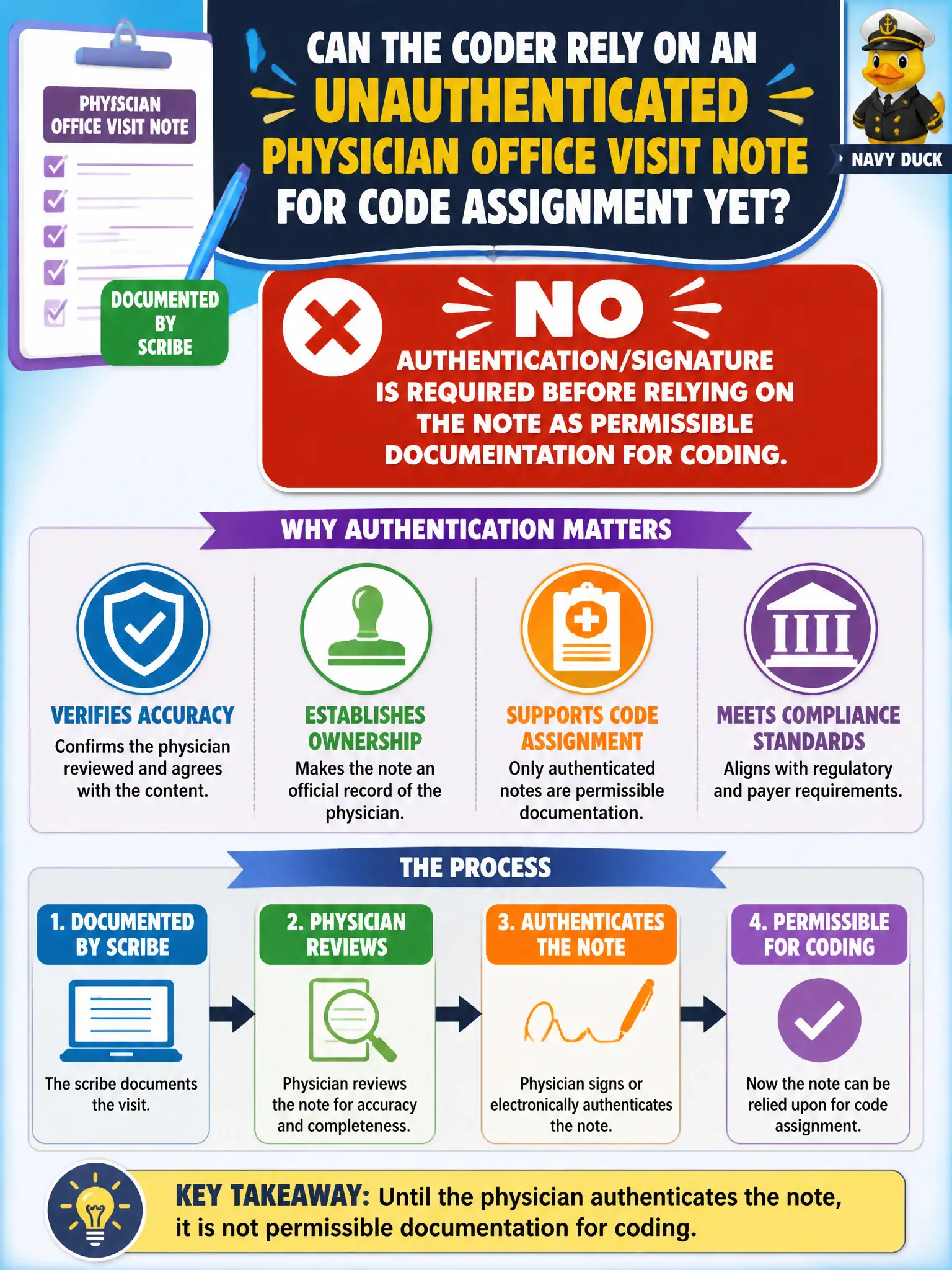
A scribe documents a complete physician office visit note that has not been authenticated by the physician. Can the coder rely on that note for code assignment yet?
Select an answer to reveal the explanation.
Short Explanation
A scribe can type fast, but the physician still has to own the note. Without authentication, that documentation is not ready for coding or billing. Wait for the signature—then code.
Full Explanation
Documentation used to support professional-fee code assignment must meet authentication and signature requirements under payer and organizational rules. An unsigned scribe note lacking physician attestation is not yet permissible documentation for coding. In a public clinic, the coder should not rely on that note for code assignment until the physician authenticates the record according to policy, then assign codes based on the authenticated content. Assuming scribe notes are billable without physician authentication in all payer programs fails signature/authentication requirements. Believing employee-scribe status removes signature rules fails because employment status does not replace provider authentication. Assuming commercial plans uniquely allow unsigned notes fails as an unsafe generalization; many commercial policies also require authentication. Exam caveat: scribe workflows are allowed when the physician reviews and authenticates; the scribe’s typing alone is not the authenticated professional record. Operational check: hold the claim in a documentation-incomplete workqueue, notify the provider to authenticate, verify signature/attestation timestamp before coding release, and audit scribe authentication lag for the municipal practice.