
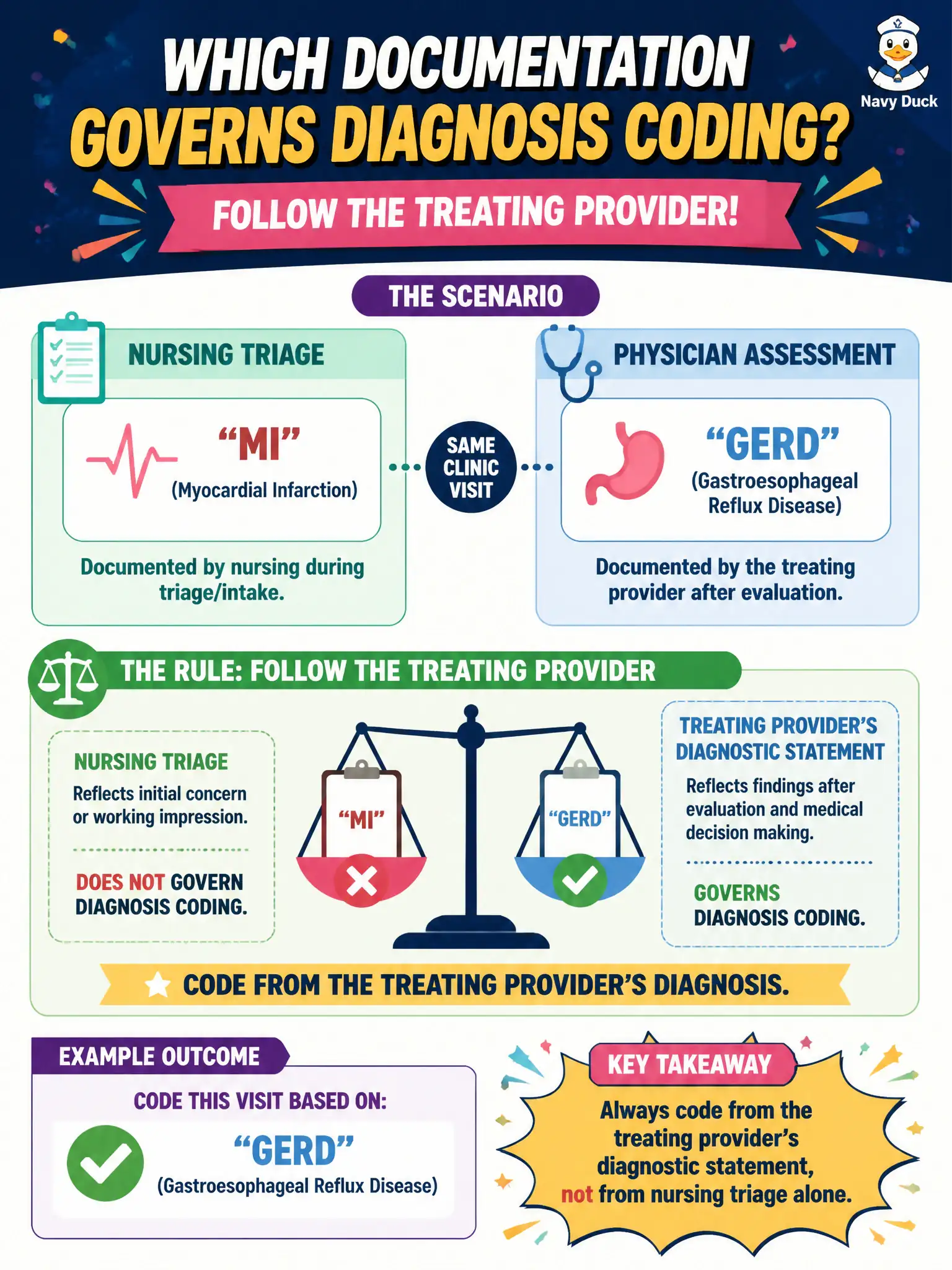
Nursing triage lists “MI,” but the physician’s assessment for the same clinic visit documents GERD as the diagnosis after evaluation. Which documentation governs diagnosis coding?
Select an answer to reveal the explanation.
Short Explanation
Triage can sound the alarm; the physician’s assessment calls the play. If nursing wrote “MI” and the doctor documented GERD after evaluating the patient, you code the provider’s diagnosis—not the triage shorthand.
Full Explanation
Diagnoses for physician professional coding must be supported by the treating provider’s documentation. Nursing triage impressions are not independently sufficient when the physician evaluates the patient and documents a different final diagnosis. In a civic clinic visit where triage lists “MI” but the physician assessment documents GERD after evaluation, GERD is the permissible diagnostic basis; myocardial infarction should not be coded from nursing language alone without provider confirmation. Coding acute MI from the nursing triage line alone fails provider-documentation authority rules. Coding both MI and GERD equally because any clinician note establishes diagnoses fails when the treating physician’s final diagnostic statement supersedes triage speculation. Coding MI primary and GERD secondary automatically for HCC value fails as risk-driven sequencing divorced from clinical documentation. Exam caveat: triage/nurse findings can support symptoms or justify queries, but final diagnosis coding follows the billing clinician’s diagnostic statements for the encounter. Operational check: compare triage vs physician assessment, code the physician’s confirmed diagnosis, query only if indicators conflict and clarification is needed, and suppress auto-coding from triage abbreviations in the county EHR rules.