
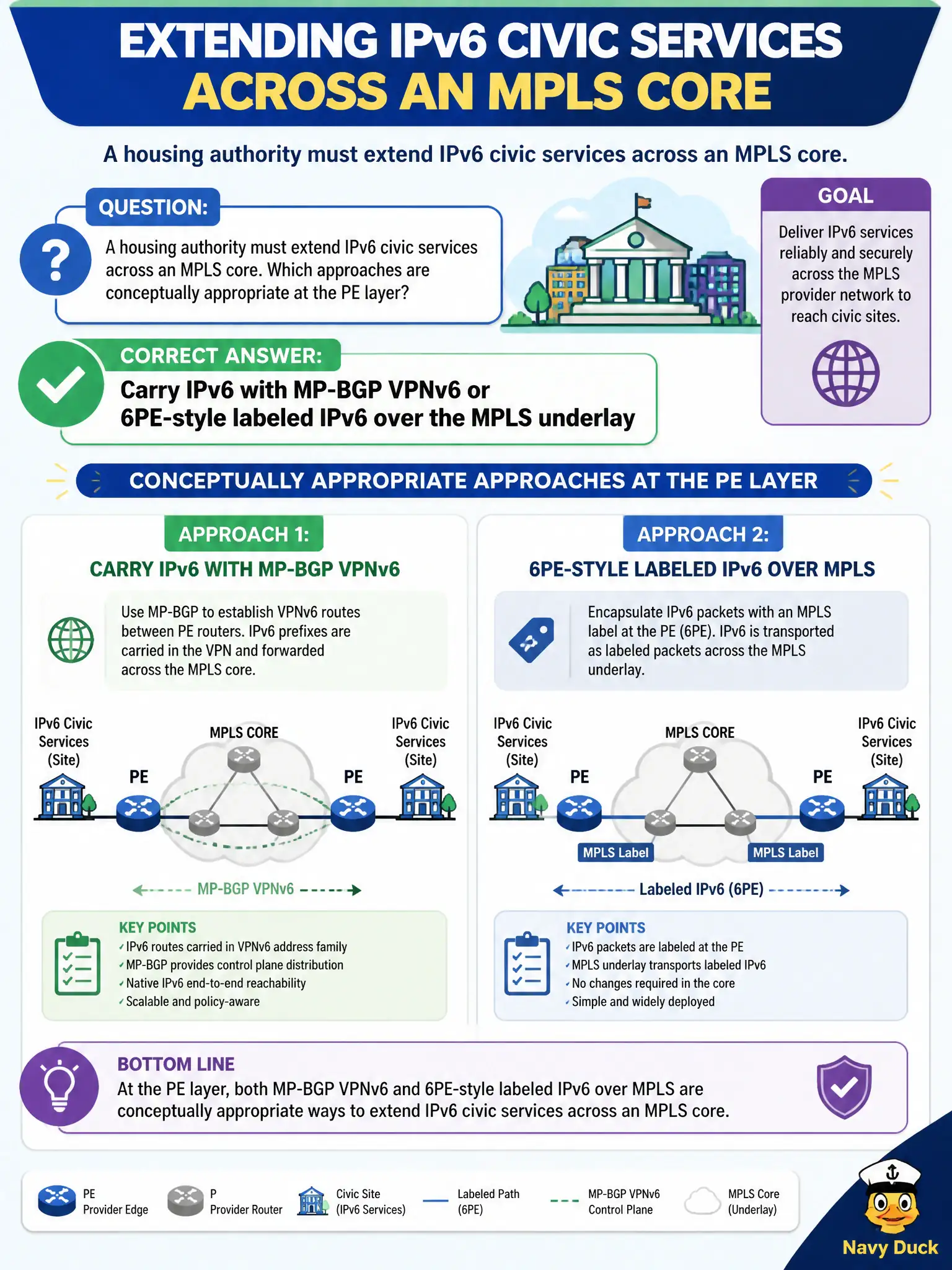
A housing authority must extend IPv6 civic services across an MPLS core. Which approaches are conceptually appropriate at the PE layer?
Select an answer to reveal the explanation.
Short Explanation
IPv6 can ride the same MPLS rails—either as VPNv6 inside VRFs or via 6PE-style labeled IPv6. You don’t have to melt the MPLS core or NAT everything to IPv4 at the CE first. Pick the PE address-family approach that matches the design.
Full Explanation
Extending IPv6 civic services across a housing-authority MPLS core commonly uses MP-BGP VPNv6 for VRF-aware L3VPN or 6PE-style labeled IPv6 unicast over the existing MPLS underlay. Those PE-layer approaches preserve MPLS transport while signaling IPv6 reachability appropriately for the design, rather than abandoning the labeled core.
Disabling MPLS on P routers and flooding IPv6 multicast as the only transport throws away the MPLS underlay the network already operates. Translating all IPv6 to IPv4 on every CE before traffic enters the PE is not a required prerequisite for carrying IPv6 across MPLS. Using only RIPng between P routers with no BGP address families is not the standard PE solution for scalable IPv6 VPN or 6PE designs.
Exam caveat: know VPNv6 versus 6PE conceptually—both ride MPLS; choice depends on VRF awareness and design goals, not on melting the core.
Operational check: enable the chosen IPv6 address family on PEs, advertise a test civic IPv6 prefix, confirm labeled forwarding across the core, and validate dual-stack services before production cutover. For civic operations, record the chosen control and the rejected alternatives in the change record so future on-call engineers understand which failure modes were avoided for citizen-facing services.