
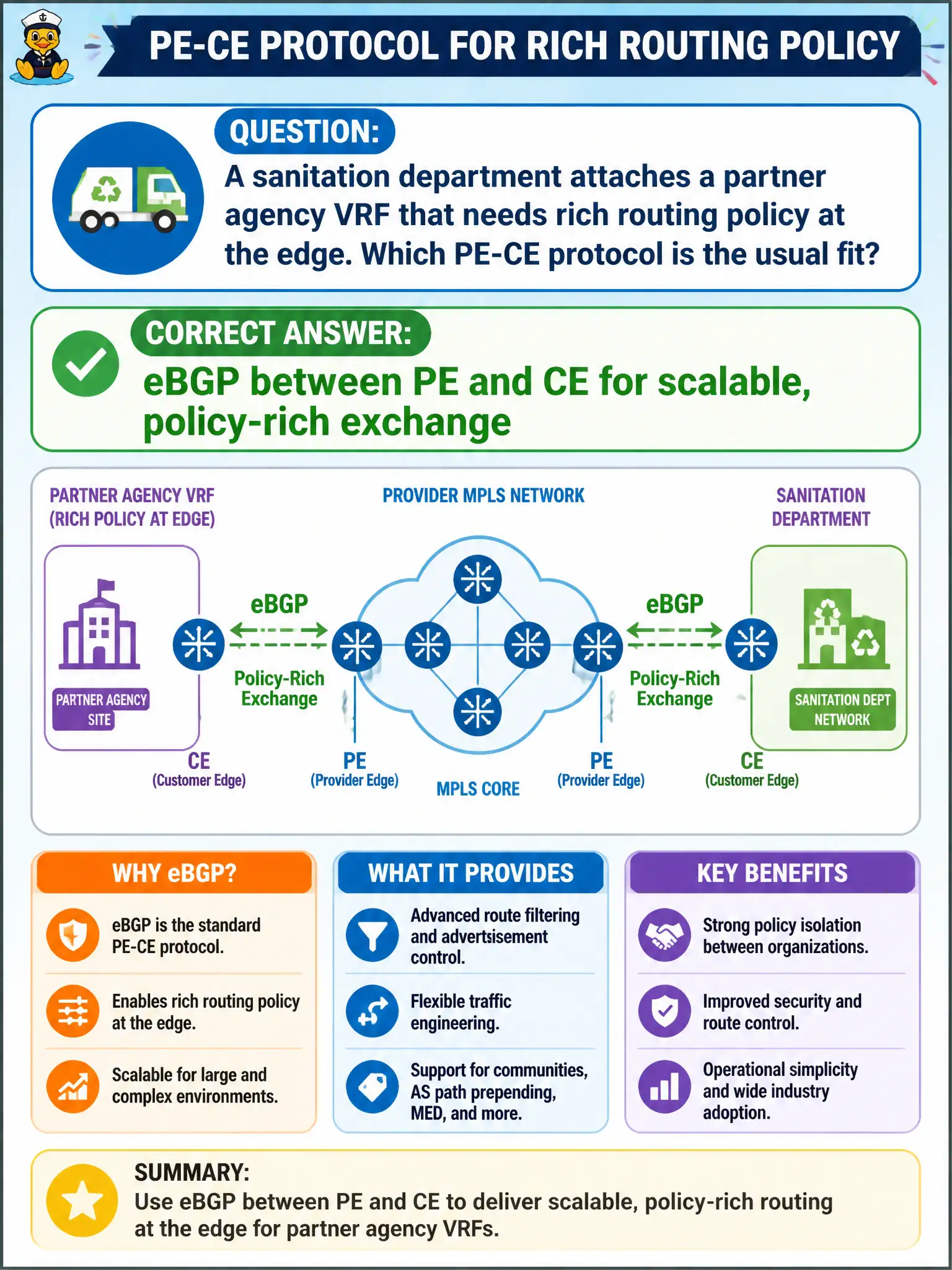
A sanitation department attaches a partner agency VRF that needs rich routing policy at the edge. Which PE-CE protocol is the usual fit?
Select an answer to reveal the explanation.
Short Explanation
When the partner needs communities, filters, and scalable route exchange, eBGP on the PE-CE link is the usual adult choice. Statics work for tiny stubs; LDP isn’t a PE-CE routing protocol. Policy-rich attachments love BGP.
Full Explanation
When a sanitation department attaches a partner agency VRF that needs rich routing policy at the edge, eBGP between PE and CE is the usual fit. BGP inside the VRF context scales well, supports communities and detailed filters, and draws a clean administrative boundary between provider PE and partner CE—ideal for policy-rich attachments.
Static routing only because “BGP cannot run inside a VRF” is false; BGP is commonly used as PE-CE inside VRFs. IS-IS solely on P-core links addresses underlay, not PE-CE policy exchange with the partner. LDP session establishment directly with the partner CE is about labels, not the typical PE-CE routing protocol choice for rich policy.
Exam caveat: statics suit tiny stubs; eBGP is the default mental model for policy-heavy PE-CE on CCIE-style designs.
Operational check: establish eBGP in the partner VRF, apply inbound/outbound prefix and community policy, verify only intended routes install, and monitor maximum-prefix guards on the sanitation PE. For civic operations, record the chosen control and the rejected alternatives in the change record so future on-call engineers understand which failure modes were avoided for citizen-facing services. Re-validate after the next platform or policy change.