
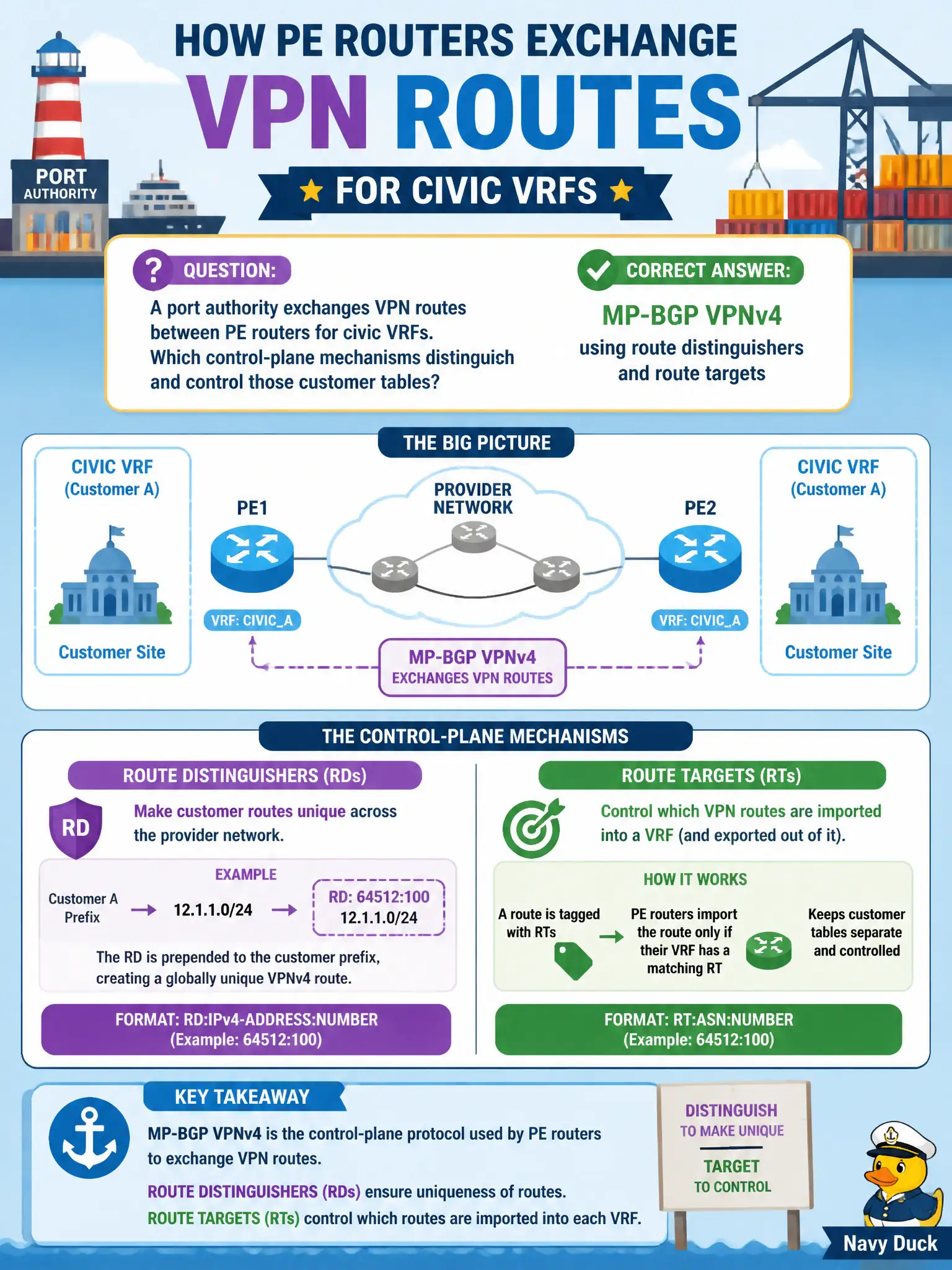
A port authority exchanges VPN routes between PE routers for civic VRFs. Which control-plane mechanisms distinguish and control those customer tables?
Select an answer to reveal the explanation.
Short Explanation
RD makes overlapping civic prefixes unique in BGP; RT decides who imports what. MP-BGP VPNv4 is the PE-to-PE control plane that carries those VPN routes. LDP still does transport labels—different job.
Full Explanation
MP-BGP VPNv4 is the PE-to-PE control plane that exchanges VPN routes for a port authority’s civic VRFs. Route distinguishers uniquify prefixes in the BGP table when address spaces overlap, and route targets control which VRFs import and export which routes. Together they distinguish and control customer tables across the MPLS VPN.
Relying only on IS-IS wide metrics without BGP involvement addresses underlay metrics, not VPN table exchange. LDP IGP synchronization timers alone without route distinguishers do not carry VPNv4 state between PEs. Static VRF routes on every P router with no PE-PE signaling violate the classic P-versus-PE model and do not scale as the VPN control plane.
Exam caveat: IGP and LDP serve the underlay; MP-BGP with RD/RT serves the VPN overlay control plane—keep those jobs separate on the exam.
Operational check: verify VPNv4 sessions between PEs or to route reflectors, confirm RD uniqueness and RT import/export for each civic VRF, and show that P routers still lack per-VRF customer routes. For civic operations, record the chosen control and the rejected alternatives in the change record so future on-call engineers understand which failure modes were avoided for citizen-facing services.