
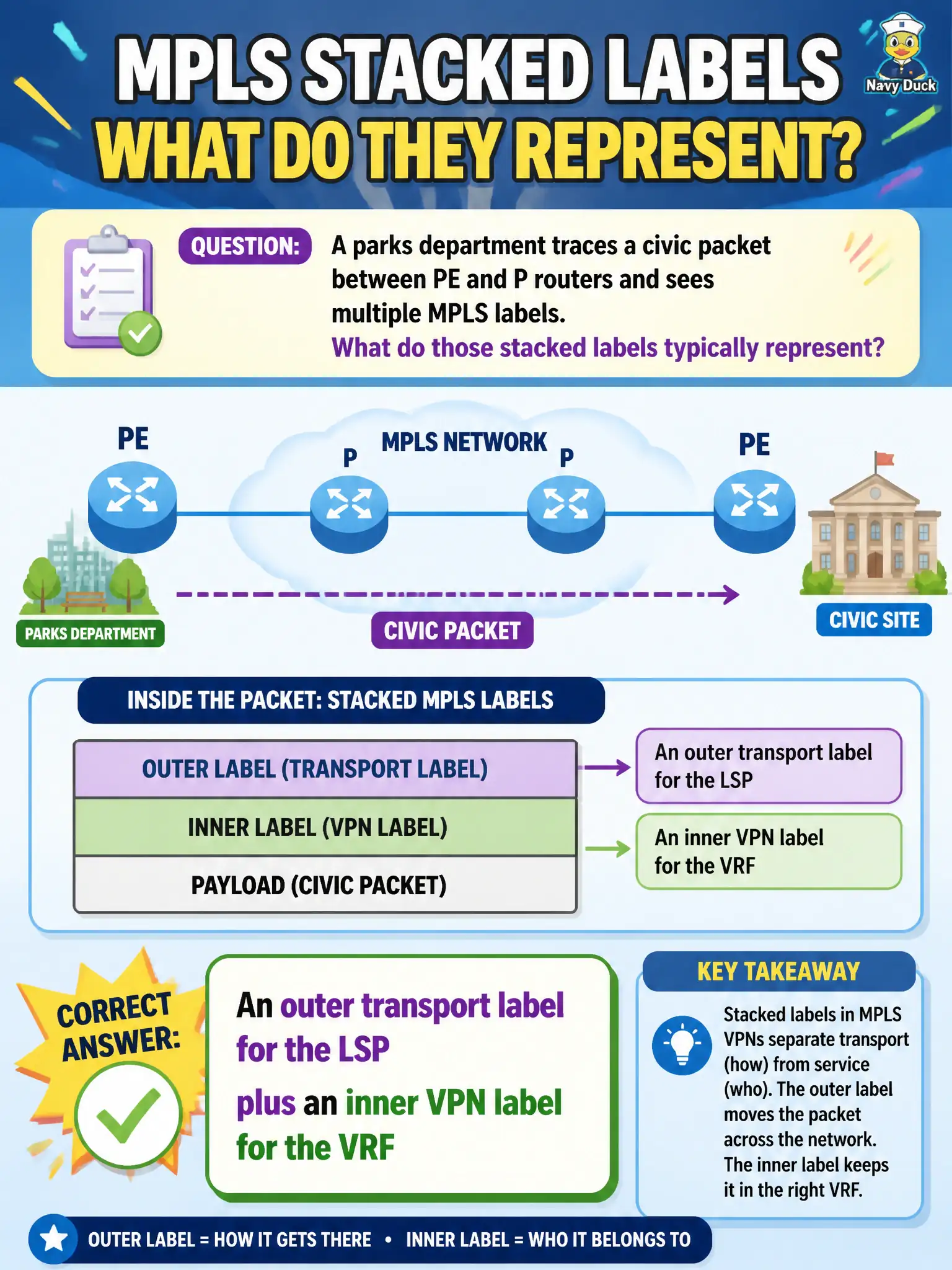
A parks department traces a civic packet between PE and P routers and sees multiple MPLS labels. What do those stacked labels typically represent?
Select an answer to reveal the explanation.
Short Explanation
Two stickers on the same envelope: the outer one gets the packet across the county core LSP, and the inner one tells the far PE which VRF it belongs to. That’s the classic transport-plus-VPN label stack—not AS-path tattooed on the wire.
Full Explanation
In MPLS L3VPN forwarding used by a parks department across a county core, packets commonly carry an outer transport label that switches the LSP across P routers and an inner VPN label that identifies the target VRF at the egress PE. P routers typically forward on the outer label only and remain unaware of the inner VPN context. That stacked-label model is what operators see when tracing a civic packet between PE and P hops.
Duplicate copies of the same Layer 2 MAC rewrite for every hop misdescribe MPLS as Ethernet MAC rewriting rather than label switching. Treating the stack as only QoS markings with no role in destination forwarding ignores that labels drive LSP and VRF selection. Encoding BGP AS-path segments directly into the label stack confuses BGP path attributes with MPLS label semantics.
Exam caveat: near egress you may see PHP remove the outer label one hop early—do not confuse a normal penultimate pop with a missing VPN label or a broken LSP without further checks.
Operational check: capture or traceroute the labeled path, confirm outer transport and inner VPN labels where expected, verify P hops swap/pop transport labels only, and map the inner label to the correct parks VRF at the egress PE.