
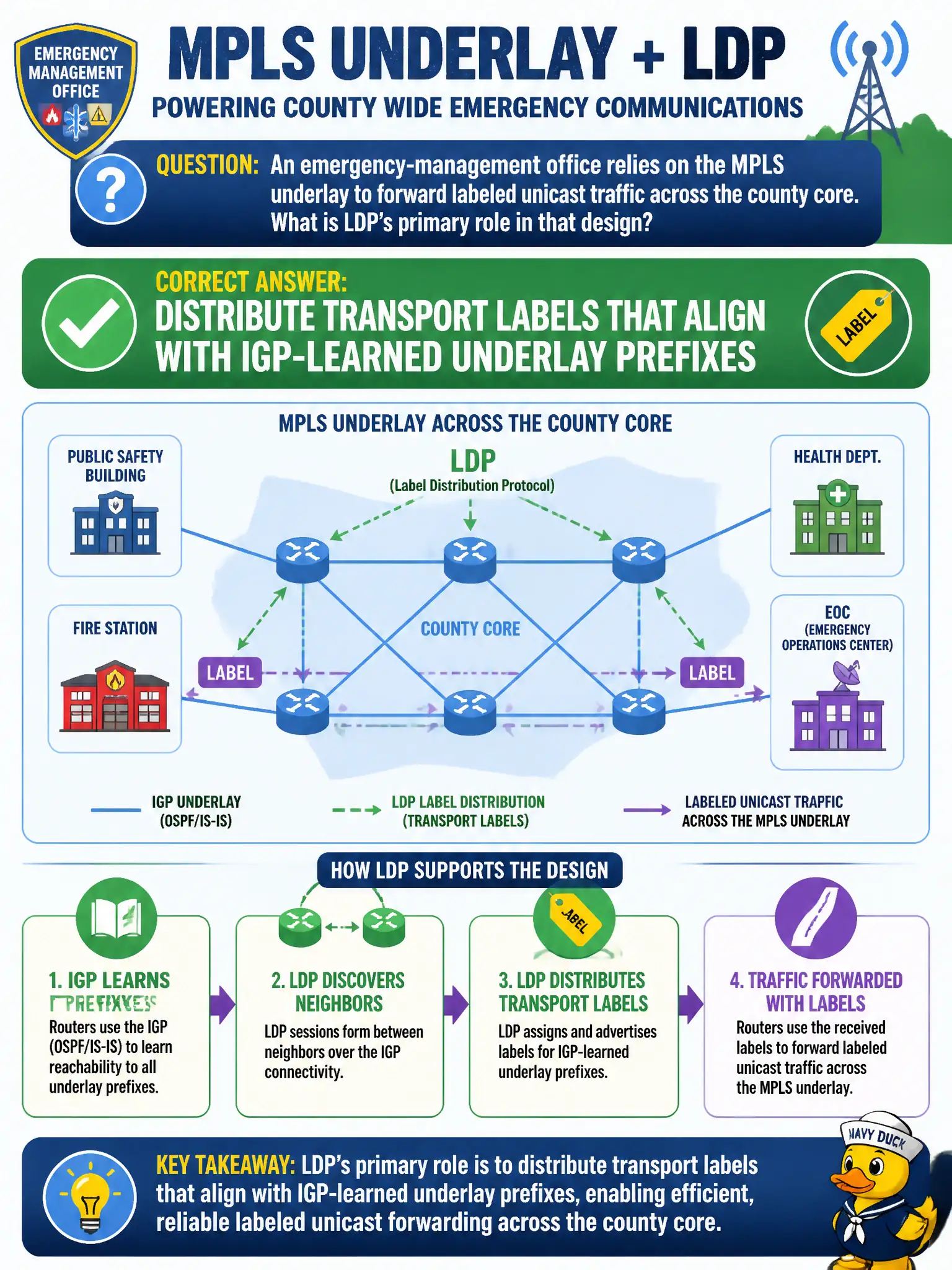
An emergency-management office relies on the MPLS underlay to forward labeled unicast traffic across the county core. What is LDP’s primary role in that design?
Select an answer to reveal the explanation.
Short Explanation
LDP is the label mailman for the underlay. Wherever the IGP knows a prefix, LDP hands out a transport label so P and PE routers can build LSPs. It isn’t the RT factory and it isn’t IPsec.
Full Explanation
Label Distribution Protocol’s primary role in an emergency-management MPLS underlay is to distribute transport labels that align with IGP-learned underlay prefixes, enabling unicast LSPs across P and PE routers. Wherever the IGP knows a loopback or other FEC, LDP (or an equivalent label distribution method) binds a label so labeled unicast can traverse the county core.
Encrypting PE-CE routing updates between partner agencies is a security function orthogonal to LDP. Assigning VRF route targets for VPNv4 import and export is an MP-BGP VPN job, not LDP. Terminating DMVPN NHRP mappings belongs to DMVPN overlays, not MPLS underlay label distribution.
Exam caveat: LDP builds transport LSPs; it does not replace MP-BGP for VPN routes or IPsec for confidentiality. IGP/LDP sync issues can black-hole labeled traffic even when IGP alone looks up.
Operational check: verify IGP convergence to PE loopbacks, confirm LDP bindings and end-to-end LSPs with MPLS OAM, and only then escalate emergency-management VPN complaints to PE-CE or RT policy. For civic operations, record the chosen control and the rejected alternatives in the change record so future on-call engineers understand which failure modes were avoided for citizen-facing services.