
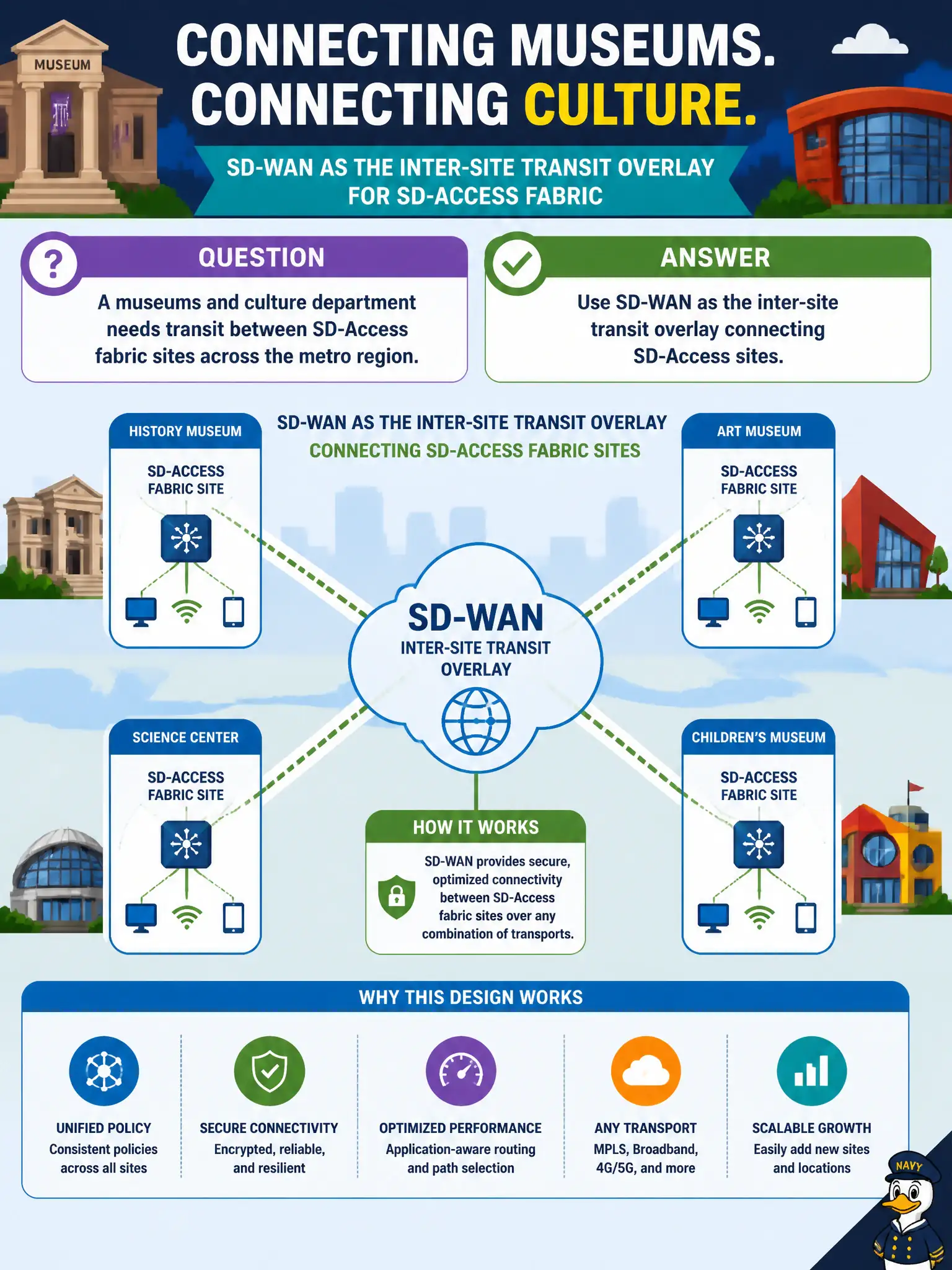
A museums and culture department needs transit between SD-Access fabric sites across the metro region. How does SD-WAN commonly fit that design?
Select an answer to reveal the explanation.
Short Explanation
SD-Access runs the museum campuses; SD-WAN is the metro shuttle between them. You don’t rip out every fabric edge—you hand traffic to SD-WAN at the border for site-to-site transit. Two fabrics, one job each.
Full Explanation
When museums and culture need transit between SD-Access fabric sites, SD-WAN commonly provides the inter-site transit overlay that interconnects those fabrics while preserving each site’s SD-Access design. Fabric border or handoff constructs connect into the SD-WAN transit so inter-site traffic rides the WAN overlay without requiring every fabric edge node to become a WAN Edge. Segmentation intent between virtual networks must be mapped deliberately across that transit.
Replacing every fabric edge node with an SD-WAN Edge misreads the division of labor between campus fabric edges and WAN transit. Running VXLAN exclusively on VPN 0 without the SD-WAN control and policy model is not the standard inter-site transit pattern these designs use. Merging SD-Access VNIs into a single SD-WAN service VPN without a deliberate mapping can destroy campus segmentation.
Exam caveat: SD-Access plus SD-WAN integration questions emphasize transit overlay roles—fabric edges stay fabric edges; SD-WAN stitches sites together.
Operational check: validate SD-WAN transit handoff between fabric sites, confirm virtual-network connectivity maps as intended, test inter-site museum application flows, and only then decommission any interim transit links.