
A city clerk’s office is scaling vSmart controllers and needs a clear data-plane versus control-plane boundary. Which statement is correct?
Select an answer to reveal the explanation.
Short Explanation
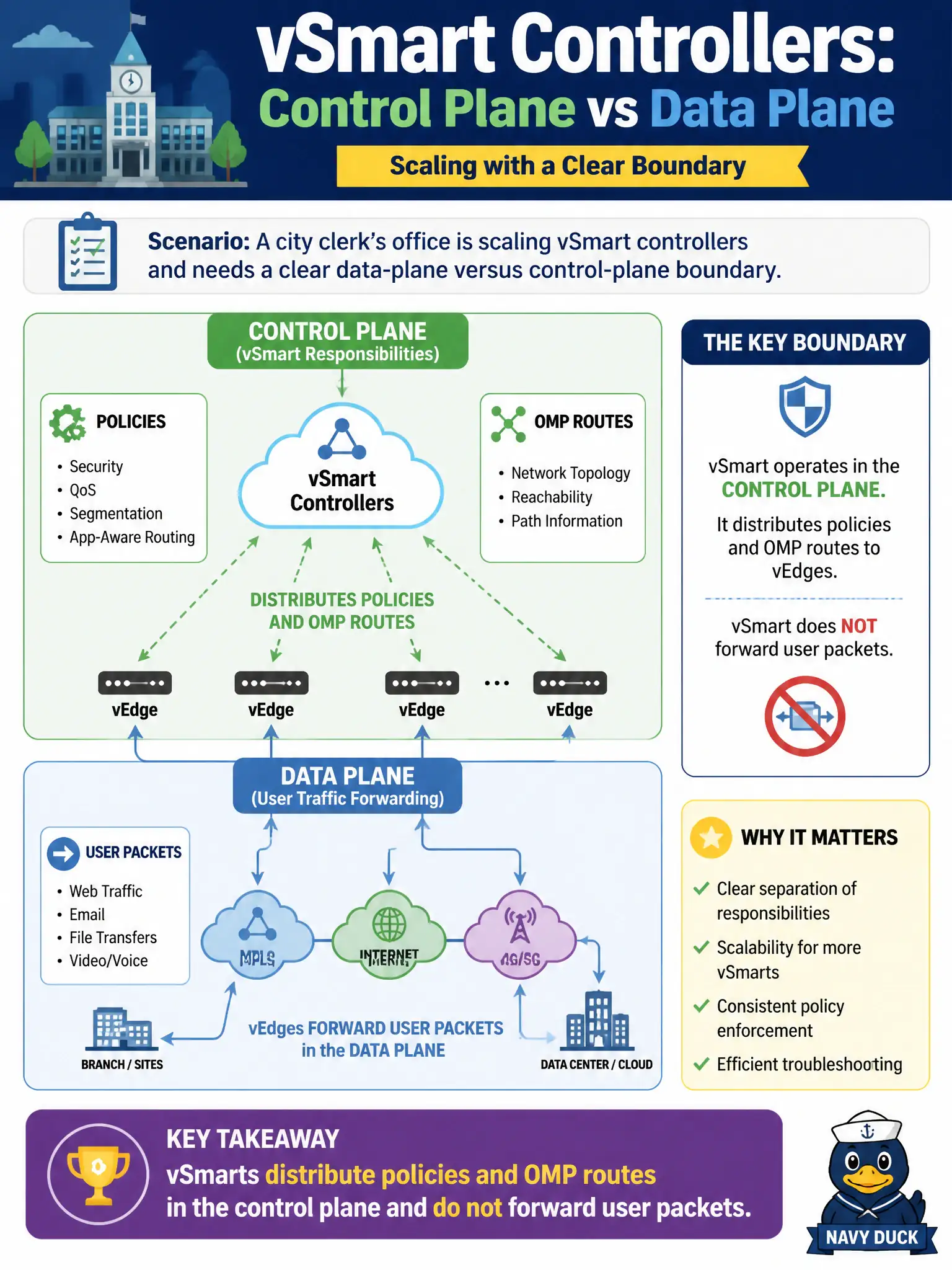
vSmarts are air-traffic control, not the airplanes—they hand out routes and policies, but user packets still fly through WAN Edges. Scaling more vSmarts does not mean they suddenly haul library or clerk traffic. If someone says the controller forwards the data plane, send them back to the architecture diagram.
Full Explanation
A city clerk’s office scaling vSmart controllers needs a clear boundary: vSmarts distribute policies and OMP routes in the control plane and do not forward user packets. User traffic stays on WAN Edge data planes; vSmarts are control/policy elements in the civic overlay.
vSmarts forwarding all civic user packets and terminating every branch IPsec data tunnel by design confuses control plane with Edge data plane.
vSmarts replacing WAN Edges so branches no longer need local data-plane devices is false—branches still need Edges.
vSmarts only storing NetFlow and never participating in overlay routing or policy distribution understates their OMP/policy role.
Exam caveat: scaling vSmarts is about control connections and policy scale—not about turning vSmarts into packet forwarders.
Operational check: confirm Edges form OMP to vSmarts, verify no user traffic hairpins through vSmart, and review control-connection counts as sites grow. Update the clerk SD-WAN capacity plan with vSmart sizing notes. In municipal operations, record the rationale in the change ticket so future on-call staff know which control was chosen and which failure modes the rejected options would create for city services. Re-validate after the next maintenance window that the same control still holds under the platform code and policy revisions used by the civic network team.