
County courts need consistent SD-WAN configs for many fire-station platform models. How should feature templates be used?
Select an answer to reveal the explanation.
Short Explanation
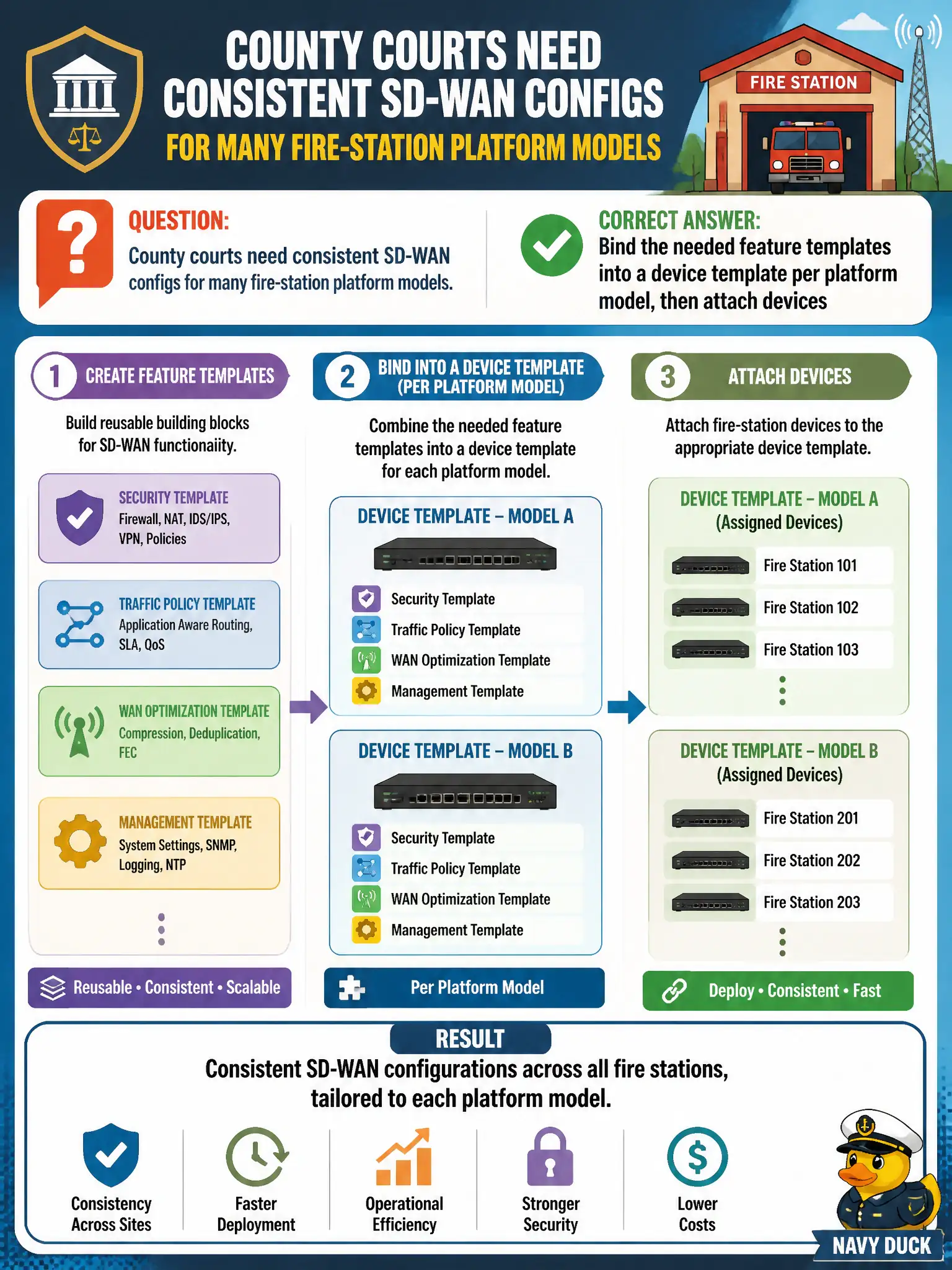
Feature templates are ingredients; the device template is the recipe for a specific fire-station router model. Mix the ingredients into the right recipe, then assign stations to it. Dumping SNMP CLI scraps or forcing one mega-template for every SKU is how courts end up with half-baked Edges.
Full Explanation
County courts needing consistent SD-WAN configs for many fire-station platform models should bind the needed feature templates into a device template per platform model, then attach devices. That is the intended template composition model for scale across heterogeneous civic Edges.
Applying unrelated feature templates directly to vBond as the only device type misuses the orchestrator and skips Edge device templates.
Ignoring device templates and pushing random CLI snippets through SNMP set bypasses SD-WAN configuration management.
Creating one global feature template that must include every possible hardware SKU variable at once with no device template produces an unmaintainable mega-object.
Exam caveat: shared feature templates plus platform-specific device templates beat copy-paste device templates with duplicated Ethernet feature blocks.
Operational check: create/attach a device template for each fire-station platform, push to a pilot, and validate. Publish the template hierarchy for courts/fire WAN Edge provisioning. In municipal operations, record the rationale in the change ticket so future on-call staff know which control was chosen and which failure modes the rejected options would create for city services. Re-validate after the next maintenance window that the same control still holds under the platform code and policy revisions used by the civic network team.