
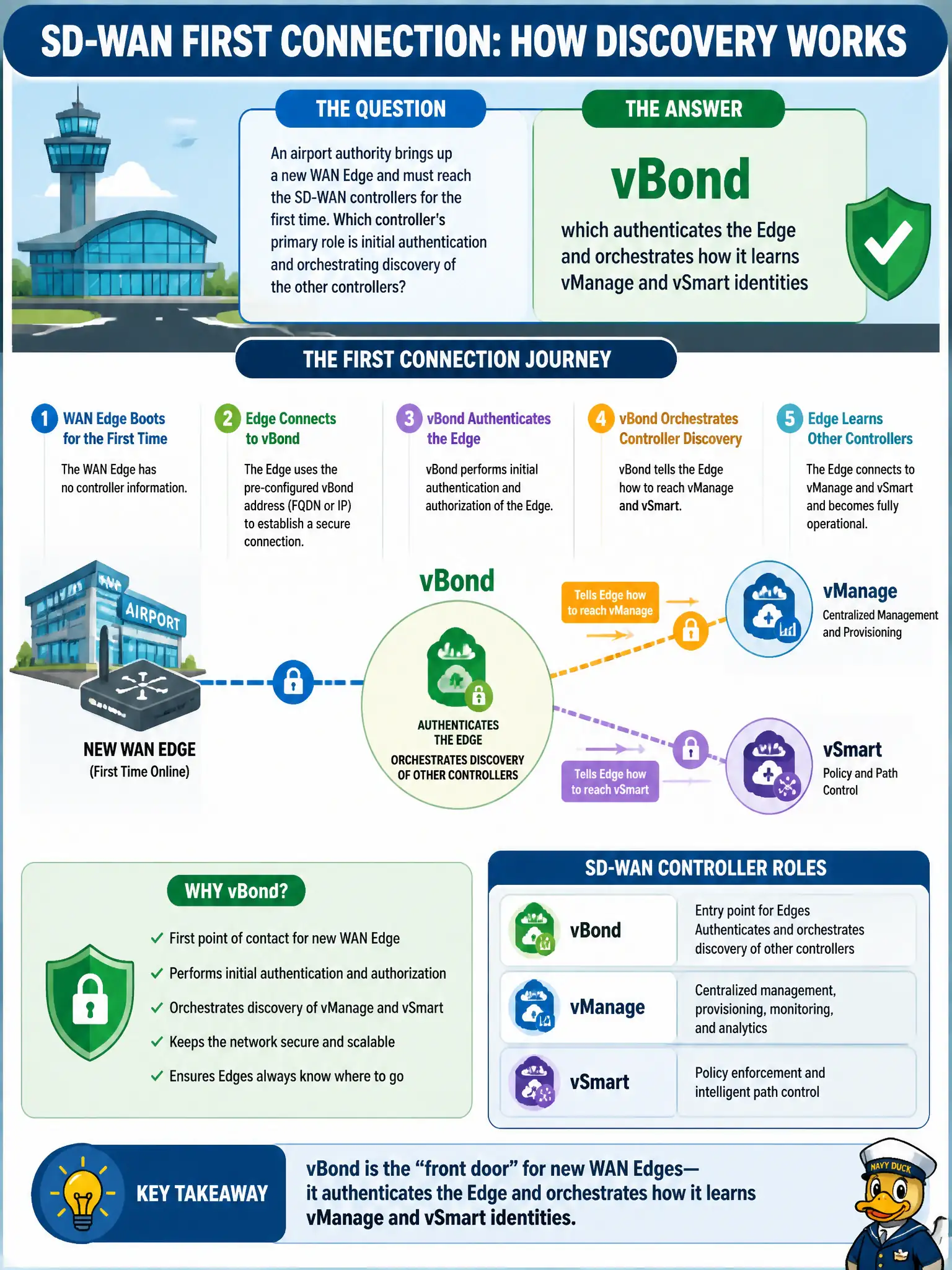
An airport authority brings up a new WAN Edge and must reach the SD-WAN controllers for the first time. Which controller’s primary role is initial authentication and orchestrating discovery of the other controllers?
Select an answer to reveal the explanation.
Short Explanation
vBond is the airport greeter: it checks the Edge’s credentials and points it to vManage and vSmart so the rest of onboarding can proceed. vSmart is not the template store, and a wireless LAN controller is not the SD-WAN orchestrator. Skipping vBond’s job leaves first contact incomplete.
Full Explanation
When an airport authority brings up a new WAN Edge for first contact, vBond’s primary role is authenticating the Edge and orchestrating how it learns vManage and vSmart identities. That orchestrator function is essential for zero-touch-style join of civic Edges.
vSmart alone storing all device templates and never involving vBond misassigns template storage (vManage) and skips orchestrated discovery.
A campus wireless LAN controller acting as the SD-WAN orchestrator is the wrong product plane.
vManage exclusively with no orchestrator needed for first contact ignores vBond’s role in authenticated discovery.
Exam caveat: after first contact, steady-state control connections are primarily to vManage/vSmart; vBond remains critical for re-onboarding and orchestration events.
Operational check: point the Edge at vBond, complete auth, and confirm it learns and connects to vManage/vSmart. Record first-contact DNS/IP and cert steps in the airport Edge onboarding sheet. In municipal operations, record the rationale in the change ticket so future on-call staff know which control was chosen and which failure modes the rejected options would create for city services. Re-validate after the next maintenance window that the same control still holds under the platform code and policy revisions used by the civic network team.