
A museums and culture department asks what OMP contributes in Cisco SD-WAN. Which statement best describes OMP’s role?
Select an answer to reveal the explanation.
Short Explanation
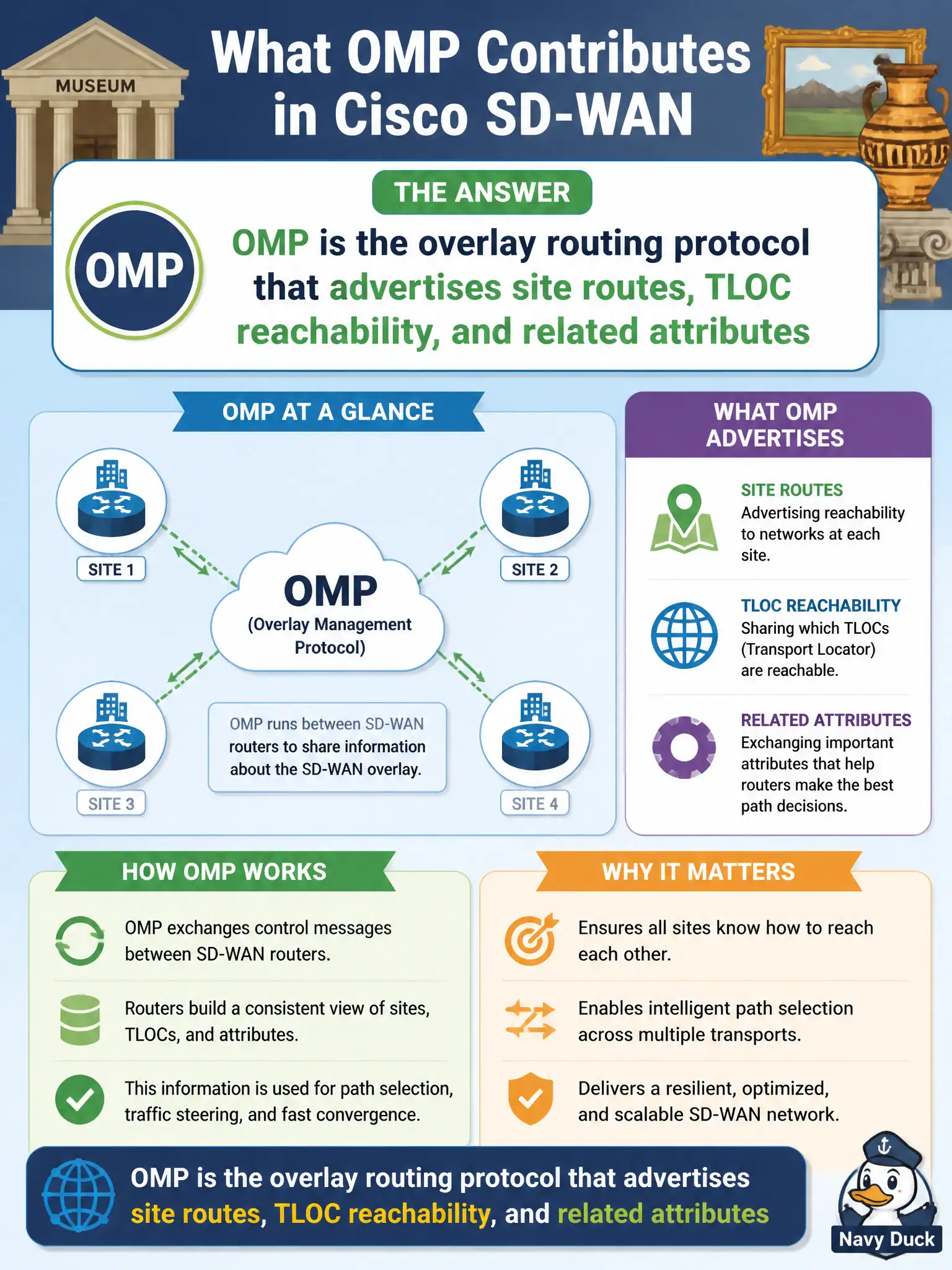
OMP is the overlay’s gossip protocol—Edges and vSmarts share which site prefixes and TLOCs exist, like museums swapping exhibit maps. It is not BFD, not a substitute for IPsec encryption, and not a LAN spanning-tree replacement. Without OMP, the overlay does not know how to find the other buildings.
Full Explanation
For a museums and culture department, OMP is the overlay routing protocol that advertises site routes, TLOC reachability, and related attributes among SD-WAN sites via vSmart. Understanding OMP’s role clarifies how civic branches learn overlay paths distinct from underlay IGP.
OMP being only an underlay BFD echo protocol and never carrying site prefixes confuses liveliness detection with overlay routing.
OMP replacing IPsec entirely so data-plane packets need no encryption misstates security; data plane remains encapsulated/encrypted separately from OMP’s routing role.
OMP as the LAN switching protocol instead of STP inside museum closets confuses WAN overlay routing with campus L2 loop prevention.
Exam caveat: OMP best-path uses attributes such as preference, TLOC preference, and originator—inspect those when paths look wrong.
Operational check: on vSmart/Edge, show OMP routes/TLOCs for a museum site and correlate with forwarding. Keep an OMP attribute cheat sheet in the culture SD-WAN ops binder. In municipal operations, record the rationale in the change ticket so future on-call staff know which control was chosen and which failure modes the rejected options would create for city services. Re-validate after the next maintenance window that the same control still holds under the platform code and policy revisions used by the civic network team.