
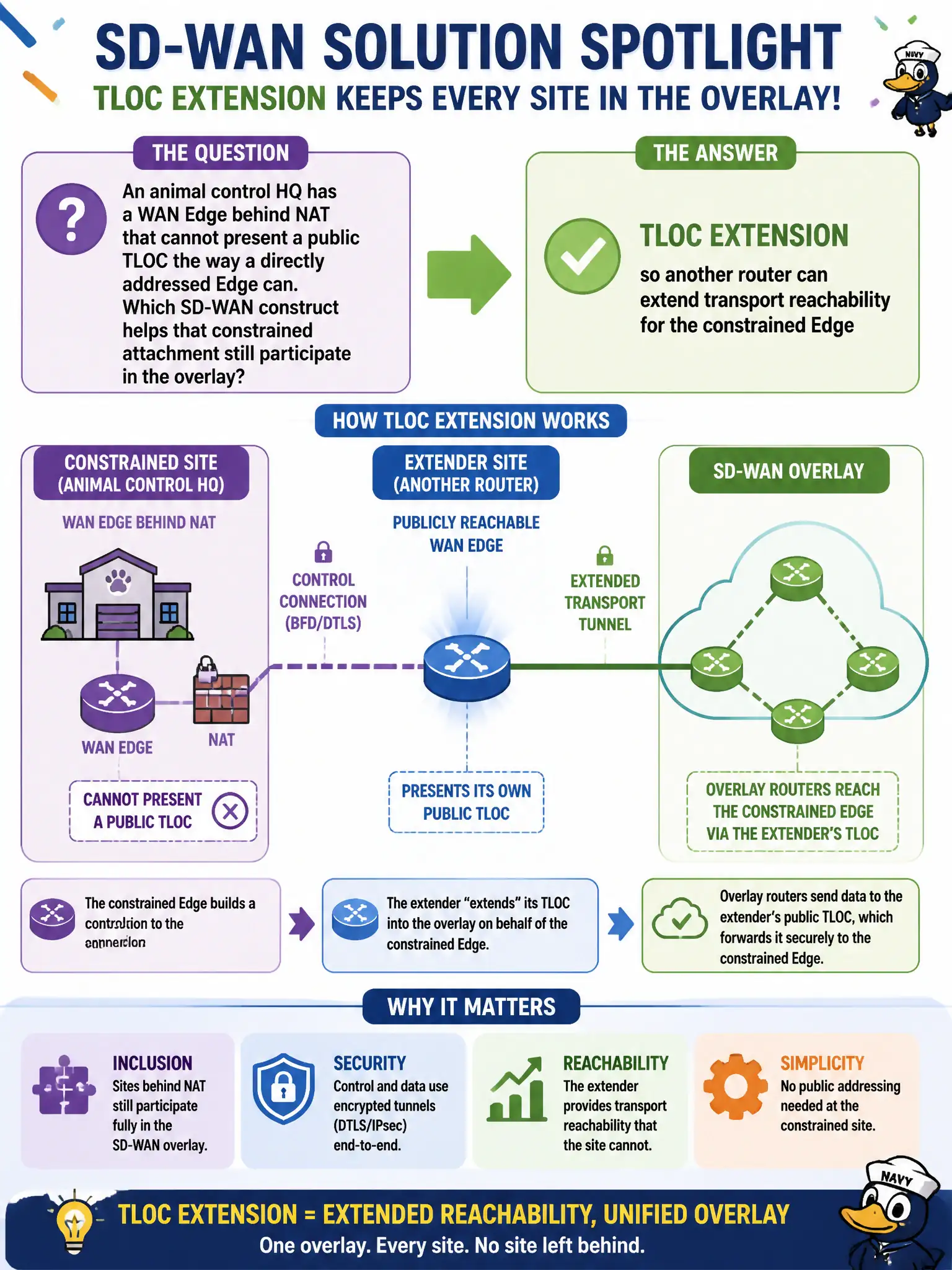
An animal control HQ has a WAN Edge behind NAT that cannot present a public TLOC the way a directly addressed Edge can. Which SD-WAN construct helps that constrained attachment still participate in the overlay?
Select an answer to reveal the explanation.
Short Explanation
TLOC extension is like borrowing a neighbor’s driveway when your own curb cut is blocked by NAT. Another router extends the transport color so the tucked-away Edge can still form tunnels. Killing OMP or inventing STP toward the ISP does not solve constrained underlay attachment.
Full Explanation
When animal-control HQ has a WAN Edge behind NAT that cannot present a public TLOC like a directly addressed Edge, TLOC extension helps that constrained attachment still participate: another router extends transport reachability for the constrained Edge. That construct is the SD-WAN answer for certain NAT/attachment limits in civic sites.
Converting the Edge into an underlay-only BGP route reflector for the city core abandons overlay participation.
Disabling OMP so the Edge uses only static defaults forever removes overlay routing.
Replacing SD-WAN with spanning-tree toward the ISP handoff is not an overlay WAN design.
Exam caveat: TLOC extension has topology and transport implications—validate supported designs for the code train rather than assuming it fixes every NAT case identically.
Operational check: implement TLOC extension per design, verify TLOC state on the constrained Edge, and pass test traffic. Document the NAT/TLOC pattern in the animal-control SD-WAN attachment guide. In municipal operations, record the rationale in the change ticket so future on-call staff know which control was chosen and which failure modes the rejected options would create for city services. Re-validate after the next maintenance window that the same control still holds under the platform code and policy revisions used by the civic network team.