
County IT redistributes service-side BGP prefixes into OMP at a regional SD-WAN hub. What concern should engineers prioritize?
Select an answer to reveal the explanation.
Short Explanation
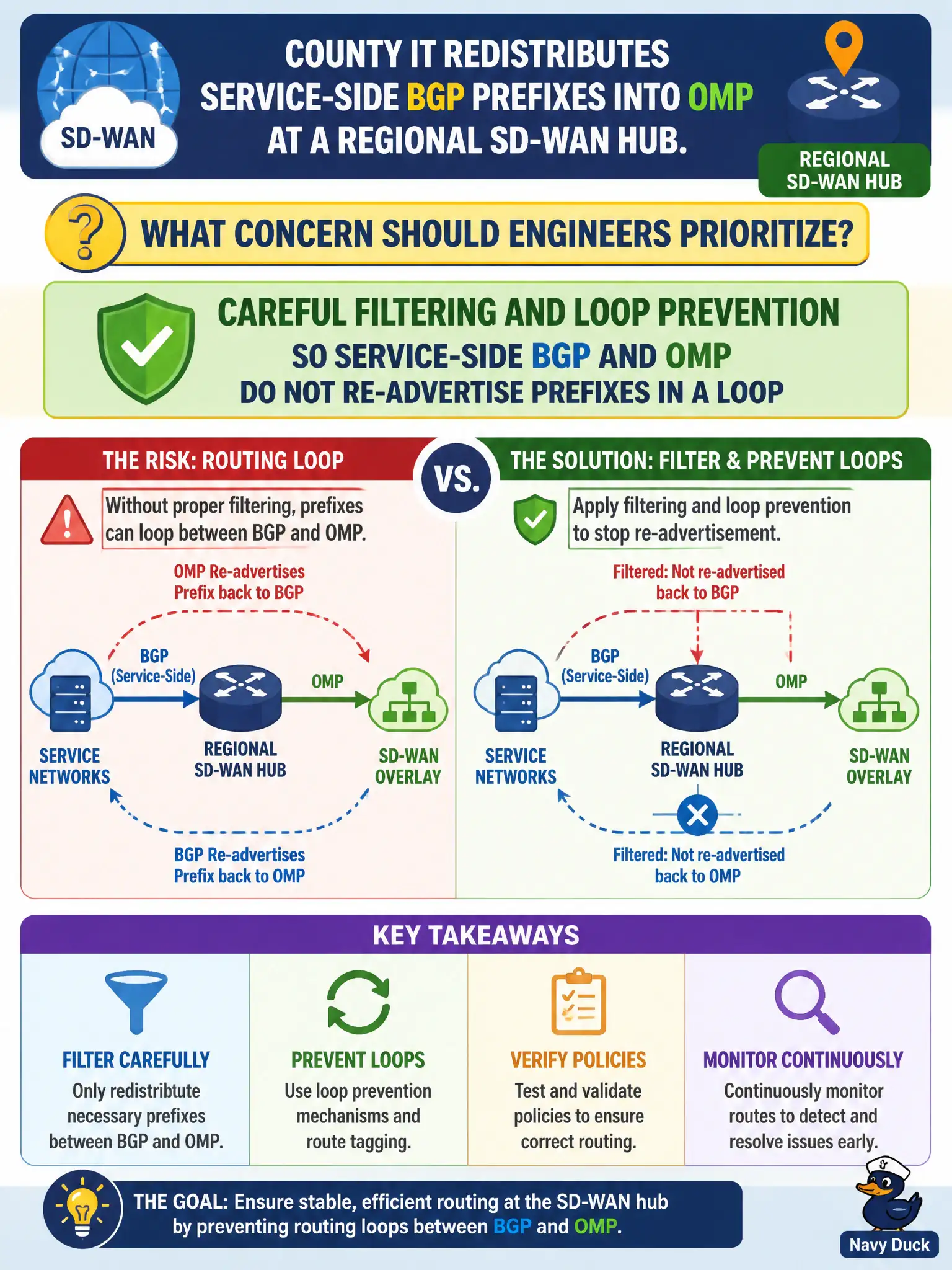
Redistribution is a two-way street with no traffic cop unless you add filters—BGP routes into OMP can bounce right back and create loops. Be picky about what enters the overlay at the county hub. Dumping the whole Internet table into OMP is a scalability nightmare, and STP has nothing to do with OMP best-path.
Full Explanation
When county IT redistributes service-side BGP prefixes into OMP at a regional SD-WAN hub, engineers should prioritize careful filtering and loop prevention so service-side BGP and OMP do not re-advertise prefixes in a loop. Redistribution without policy is a classic civic hub outage pattern.
Redistributing every Internet full table into OMP without filters to maximize path options overwhelms the overlay control plane.
Disabling site-IDs so OMP treats all hubs as one site automatically breaks site semantics and loop-prevention tools.
Using spanning-tree priorities on the WAN Edge to influence OMP best-path confuses L2 STP with overlay best-path selection.
Exam caveat: use site-ID, tags, AS-path/OMP attributes, and explicit export/import policies—know which knobs your design uses.
Operational check: apply redistribute filters at the hub, test prefix advertisement with a probe network, and watch for re-advertisement loops. Document redistribution policy in the county hub SD-WAN routing standard. In municipal operations, record the rationale in the change ticket so future on-call staff know which control was chosen and which failure modes the rejected options would create for city services. Re-validate after the next maintenance window that the same control still holds under the platform code and policy revisions used by the civic network team.