
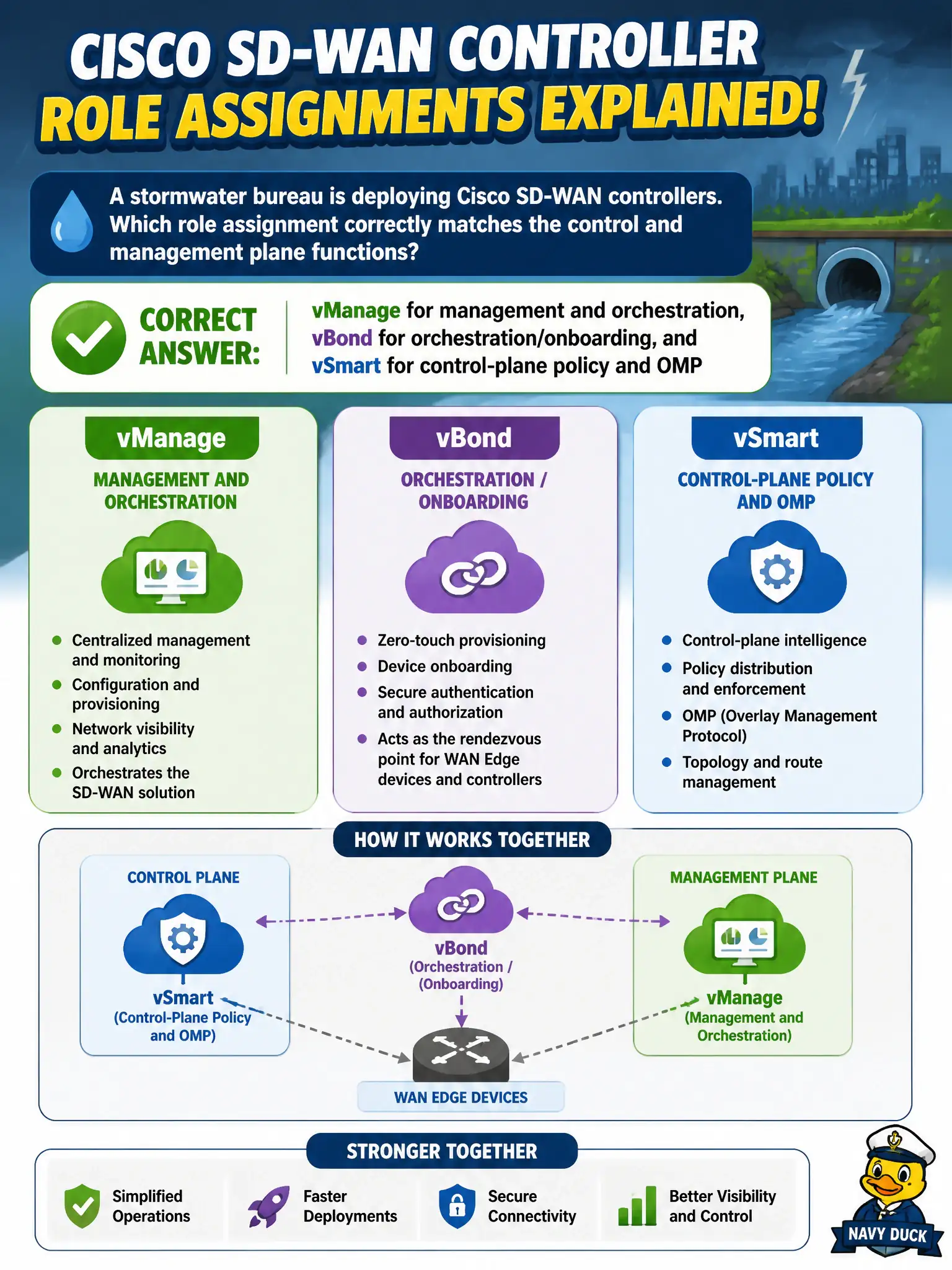
A stormwater bureau is deploying Cisco SD-WAN controllers. Which role assignment correctly matches the control and management plane functions?
Select an answer to reveal the explanation.
Short Explanation
Remember the trio: vManage is the ops desk, vBond is the greeter that introduces everyone, and vSmart is the traffic-cop brain for overlay policy—not the truck that hauls user packets. Mixing those jobs is how stormwater WANs get weird fast. Production still needs all three roles, not a lone vManage pretending to be everything.
Full Explanation
A stormwater bureau deploying Cisco SD-WAN controllers should assign vManage for management and orchestration, vBond for orchestration/onboarding, and vSmart for control-plane policy and OMP. That role split is the standard control/management plane model for civic SD-WAN.
vSmart forwarding all user packets while vManage only stores Syslog and vBond terminating data-plane IPsec reverses responsibilities—Edges carry user data plane; vSmart is control/policy.
vBond hosting feature templates, vManage authenticating only wireless APs, and vSmart being optional misstates which controller does what.
A single vManage replacing vBond and vSmart in every production civic deployment by design oversimplifies; production overlays use the controller roles even when some functions are clustered/scaled.
Exam caveat: learn the first-contact flow (Edge → vBond → learn vManage/vSmart) separately from steady-state OMP to vSmart.
Operational check: verify controller certificates and reachability, bring up an Edge, and confirm it forms control connections to the expected roles. Diagram controller roles in the stormwater SD-WAN architecture pack. In municipal operations, record the rationale in the change ticket so future on-call staff know which control was chosen and which failure modes the rejected options would create for city services. Re-validate after the next maintenance window that the same control still holds under the platform code and policy revisions used by the civic network team.