
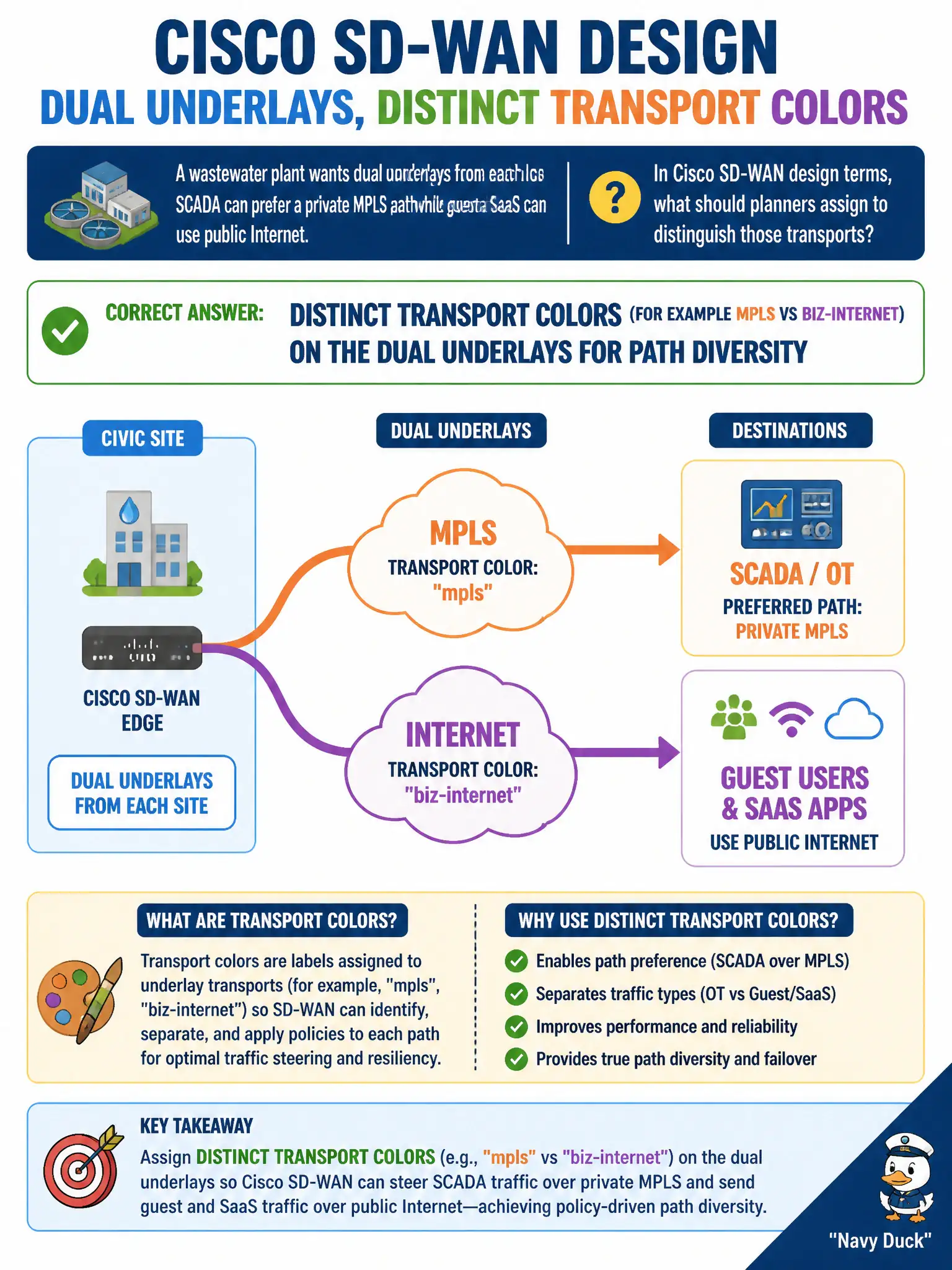
A wastewater plant wants dual underlays from each civic site so SCADA can prefer a private MPLS path while guest and SaaS can use public Internet. In Cisco SD-WAN design terms, what should planners assign to distinguish those transports?
Select an answer to reveal the explanation.
Short Explanation
Colors are name tags on the pipes leaving the plant—MPLS gets one tag, broadband another—so policies can prefer SCADA on the private pipe and guests on the public one. If both circuits wear the same color, the overlay cannot steer traffic by transport type. Site-IDs and OSPF PIDs are not substitutes for transport colors.
Full Explanation
A wastewater plant wanting dual underlays so SCADA prefers private MPLS while guest/SaaS use public Internet should assign distinct transport colors (for example mpls vs biz-internet) on those underlays. In Cisco SD-WAN, colors distinguish TLOC transports so policies and AAR can steer civic traffic by path type.
Identical colors on both circuits so OMP cannot tell paths apart defeats transport differentiation.
A single TLOC color shared by MPLS and Internet to force ECMP only removes the semantic separation planners need for preference and SLA policy.
Reusing underlay OSPF process IDs as SD-WAN site-IDs for every Edge confuses IGP process identifiers with SD-WAN site identity.
Exam caveat: color names must be consistent in templates and policies across the domain or steering silently fails.
Operational check: configure dual-color TLOCs on plant Edges, verify both TLOCs up, and test SCADA vs guest path preference. Record color standards in the utility SD-WAN transport guide. In municipal operations, record the rationale in the change ticket so future on-call staff know which control was chosen and which failure modes the rejected options would create for city services. Re-validate after the next maintenance window that the same control still holds under the platform code and policy revisions used by the civic network team.