
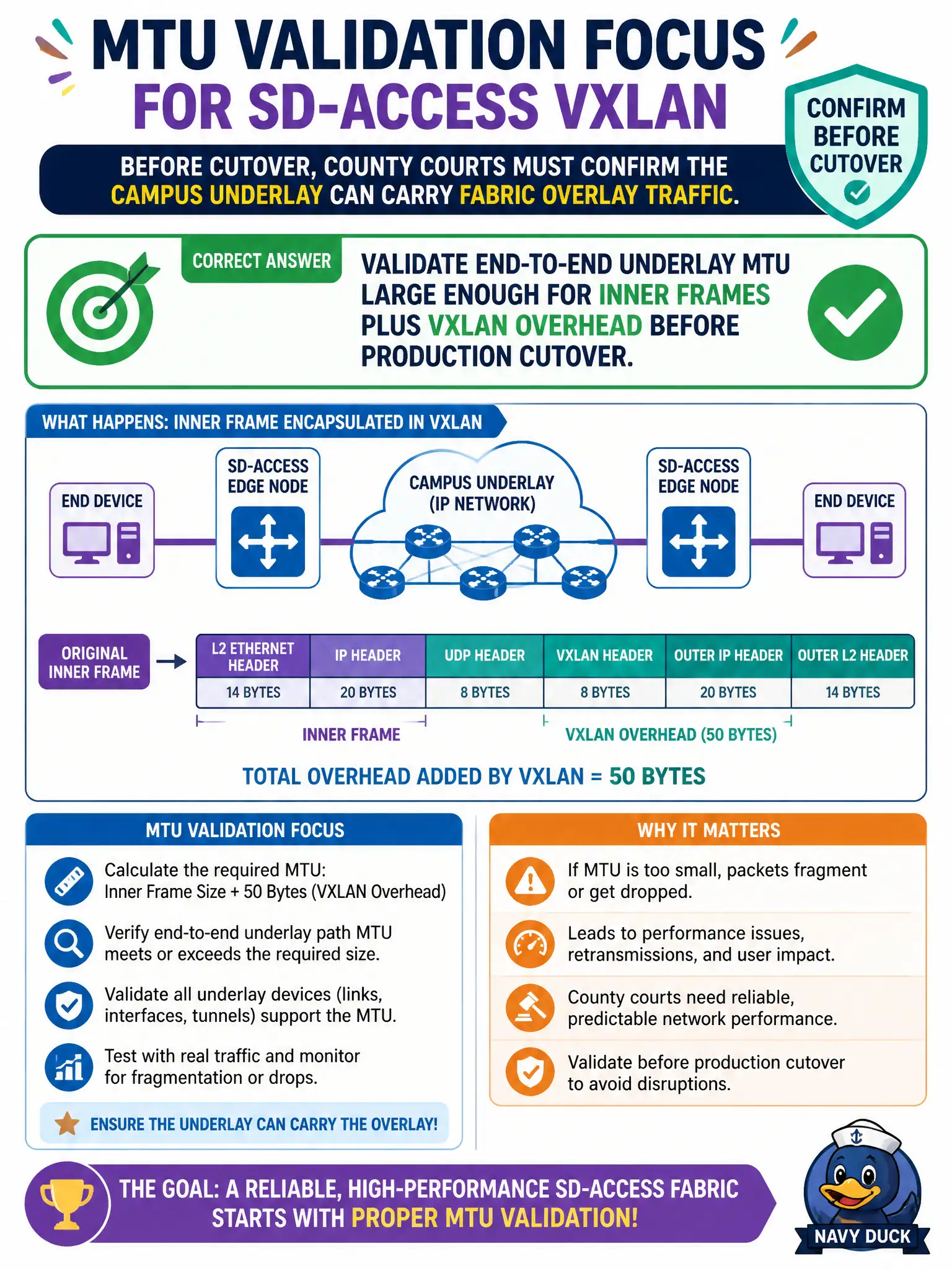
Before cutover, county courts must confirm the campus underlay can carry fabric overlay traffic. Which MTU validation focus is most appropriate for SD-Access VXLAN encapsulation?
Select an answer to reveal the explanation.
Short Explanation
VXLAN is like putting a parcel in a thicker shipping box—you need wider conveyor belts. If the underlay MTU is sized only for bare IP, the boxed overlay frames get stuck. Prove end-to-end MTU can swallow VXLAN overhead before opening day at the courts.
Full Explanation
Before cutover, county courts must confirm the campus underlay can carry fabric overlay traffic by validating end-to-end underlay MTU large enough for inner frames plus VXLAN overhead. Undersized MTU is a frequent silent failure after fabric enablement on civic campuses.
Setting access-port MTU to 576 end-to-end and ignoring spine and border interfaces guarantees fragmentation/drops for normal traffic and skips the critical transit hops.
Validating only wireless CAPWAP MTU because wired VXLAN never adds overhead is false—wired VXLAN adds encapsulation bytes that underlay must carry.
Lowering underlay MTU below host MSS so fragmentation is guaranteed is the opposite of a healthy overlay design.
Exam caveat: jumbo/raised MTU must be consistent on every underlay hop and link; one short hop breaks the path.
Operational check: measure path MTU between edges, borders, and CP nodes with DF-bit tests sized for VXLAN, remediate short interfaces, then retest. Record required underlay MTU in the courts fabric cutover checklist. In municipal operations, record the rationale in the change ticket so future on-call staff know which control was chosen and which failure modes the rejected options would create for city services. Re-validate after the next maintenance window that the same control still holds under the platform code and policy revisions used by the civic network team.