
A city clerk’s office is expanding SD-Access and must onboard badge-authenticated wired PCs first. Which blueprint check best confirms the wired host-onboarding path before wireless expansion?
Select an answer to reveal the explanation.
Short Explanation
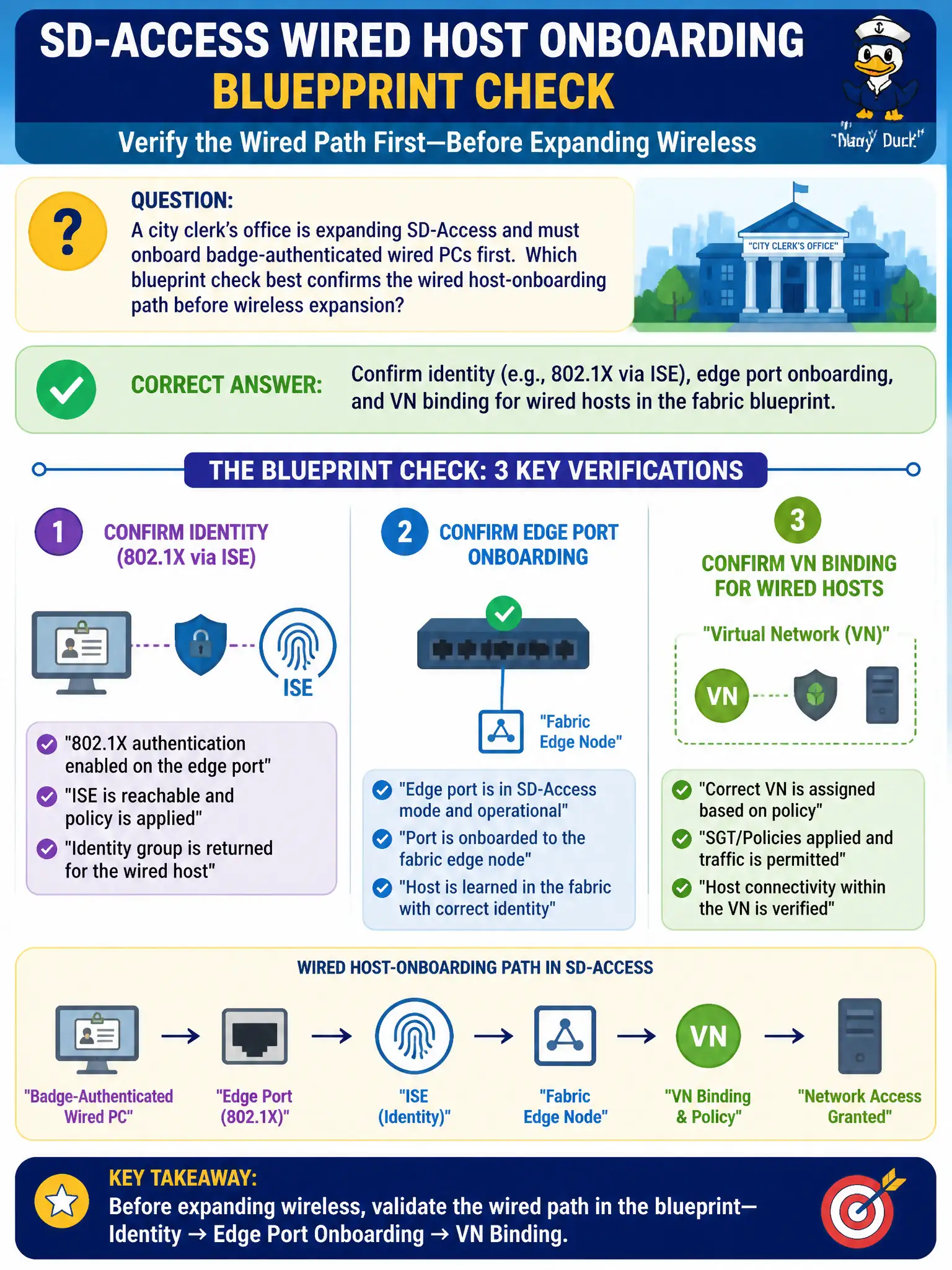
Before you invite Wi-Fi to the party, make sure the wired story works: who are you (identity), which port did you plug into, and which VN do you belong in? That triad is wired host onboarding in the fabric blueprint. Nail it for badge PCs, then extend the same policy ideas to wireless.
Full Explanation
A city clerk’s office expanding SD-Access and onboarding badge-authenticated wired PCs first should confirm identity (for example 802.1X via ISE), edge port onboarding, and VN binding for wired hosts in the fabric blueprint before wireless expansion. Proving the wired host-onboarding path reduces variables when Wi-Fi fabric is added later.
Skipping identity integration and statically mapping every PC MAC into the underlay OSPF database pollutes the underlay and skips fabric policy onboarding.
Onboarding wired PCs only by assigning them to the wireless WLC as local EAP users misuses the WLC for wired fabric hosts.
Binding wired hosts exclusively to a transit control-plane node loopback instead of an edge VN misunderstands edge onboarding versus CP locator addressing.
Exam caveat: critical/auth-fail VLANs and low-impact mode behaviors should be tested so badge outages do not strand clerks incorrectly.
Operational check: authenticate a wired clerk PC end-to-end, confirm VN/SGT/pool assignment, then lock the blueprint check before wireless rollout. Store the wired onboarding test script in the clerk IT fabric runbook. In municipal operations, record the rationale in the change ticket so future on-call staff know which control was chosen and which failure modes the rejected options would create for city services. Re-validate after the next maintenance window that the same control still holds under the platform code and policy revisions used by the civic network team.