
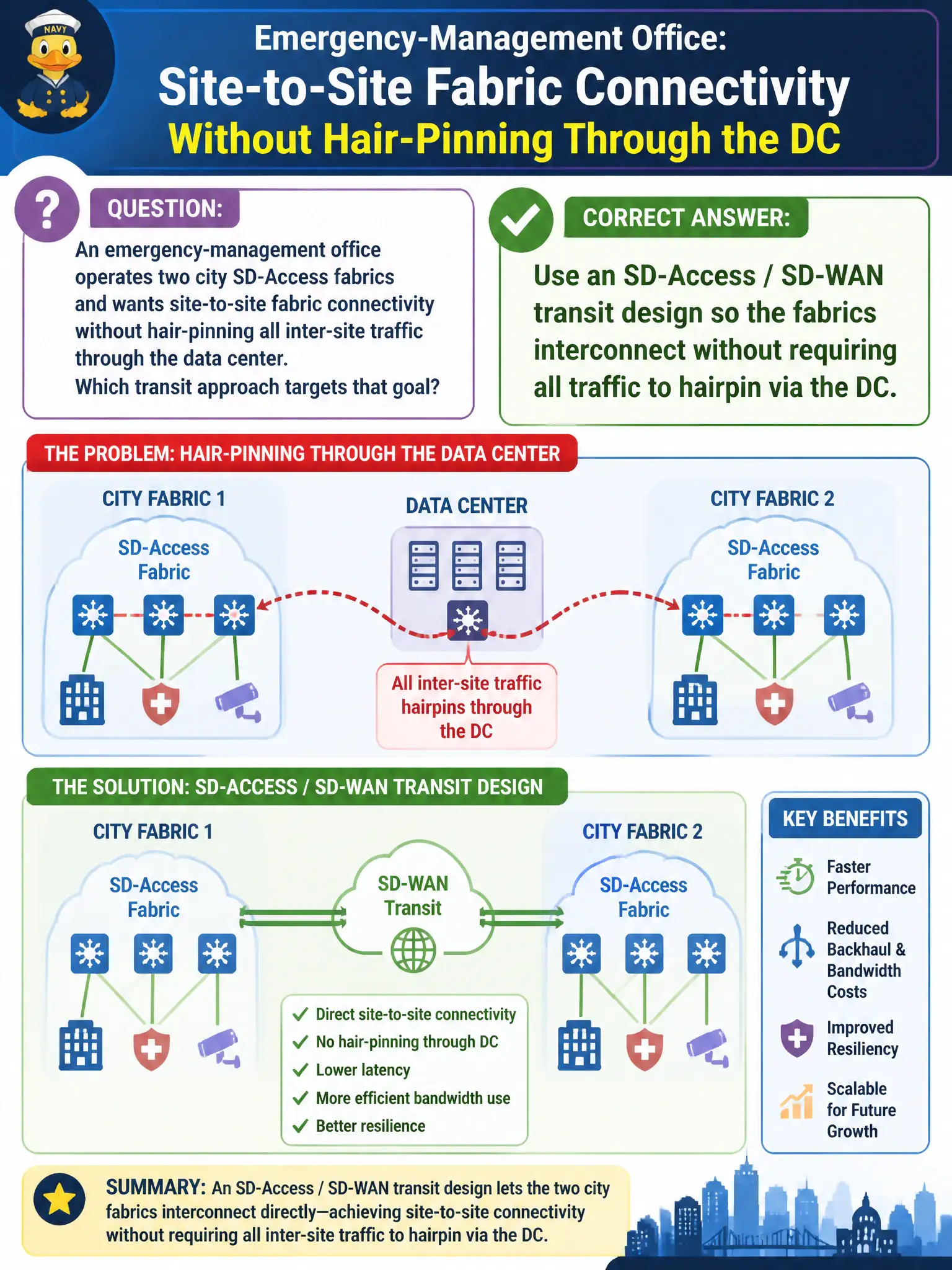
An emergency-management office operates two city SD-Access fabrics and wants site-to-site fabric connectivity without hair-pinning all inter-site traffic through the data center. Which transit approach targets that goal?
Select an answer to reveal the explanation.
Short Explanation
Two city fabrics should shake hands without driving every packet downtown first. SD-Access with SD-WAN transit (or SDA transit patterns) stitches sites so traffic can take a planned path instead of a mandatory DC hairpin. That keeps emergency apps responsive when sites talk to each other.
Full Explanation
An emergency-management office with two city SD-Access fabrics that wants site-to-site connectivity without hair-pinning all inter-site traffic through the data center should use an SD-Access / SD-WAN transit design so fabrics interconnect without requiring every flow to trombonethrough the DC. That transit approach targets efficient civic inter-site paths.
Stretching a single user VLAN between fabrics across dark fiber without a transit control plane recreates large L2 domains and is not the scalable fabric transit model.
Forcing every inter-site flow to NAT through a central Internet edge firewall pair only adds hairpinning and is unrelated to fabric transit design goals.
Disabling borders at both sites and relying on wireless guest anchoring for inter-site reachability cannot replace fabric/WAN transit for production networks.
Exam caveat: transit VN, border roles, and SD-WAN handoff details must be designed together—inter-site fabric is not “turn on VXLAN over dark fiber.”
Operational check: establish the chosen transit, test site-A to site-B application flows without DC hairpin where intended, and capture path traces. Update the emergency-management WAN/fabric interconnect diagram accordingly.