
A water utility wants wireless SSIDs to land clients into the same Virtual Networks and policies used by wired users. What fabric wireless integration concept should guide WLC placement and SSID mapping?
Select an answer to reveal the explanation.
Short Explanation
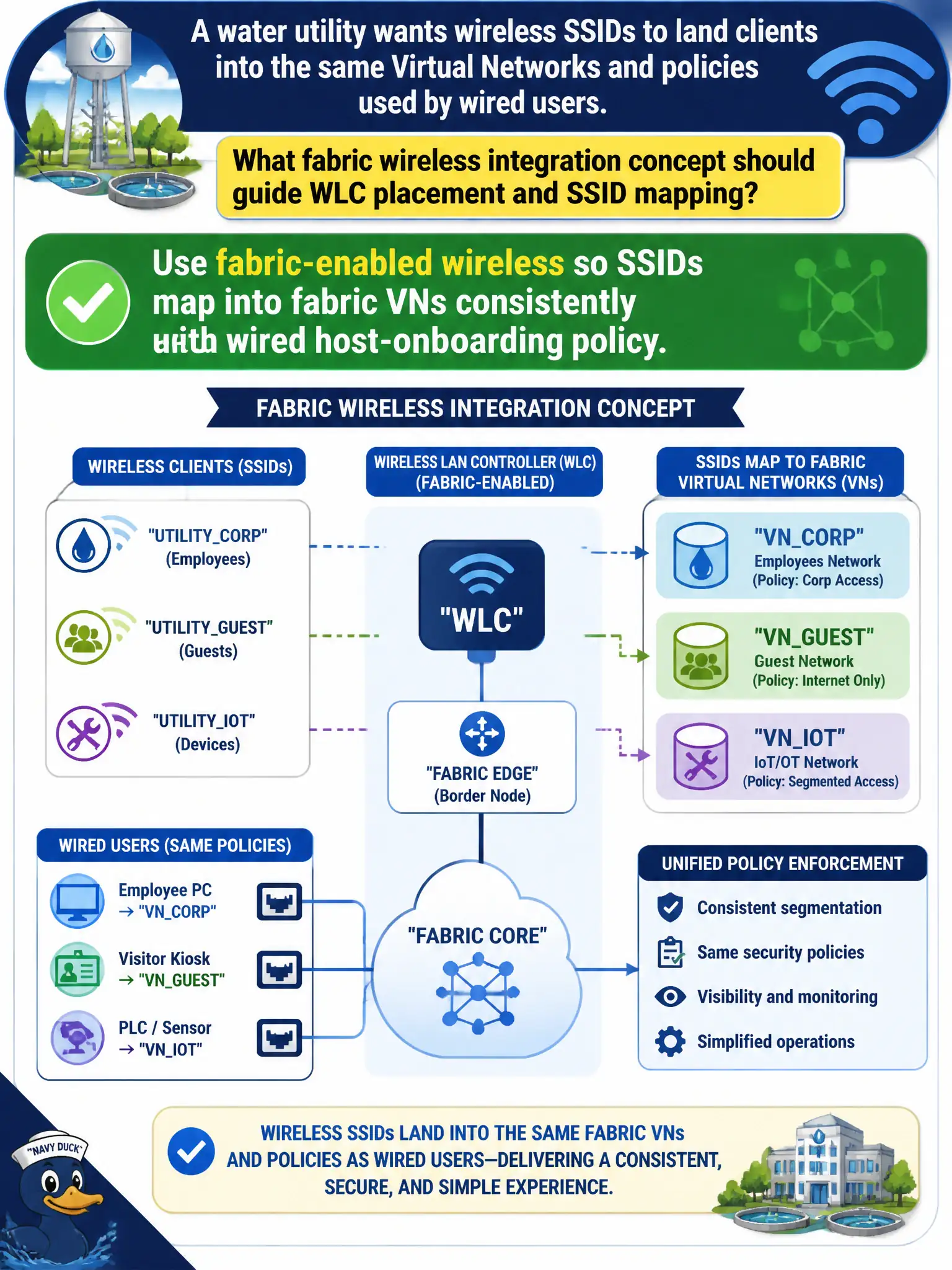
Wired and wireless staff should not live under different policy universes for the same job role. Fabric-enabled wireless ties SSIDs into the same VNs and group policy story the wired edges already use. That is how a utility keeps badge-based intent consistent whether someone docks or joins Wi-Fi.
Full Explanation
A water utility that wants wireless SSIDs to land clients into the same Virtual Networks and policies as wired users should use fabric-enabled wireless so SSIDs map into fabric VNs consistently with wired host-onboarding policy. WLC placement and SSID-to-VN mapping must align with fabric segmentation so Wi-Fi and copper users share the same civic policy model.
Keeping wireless entirely outside fabric and bridging all SSIDs into a single underlay VLAN shared with OSPF abandons fabric VN consistency.
Mapping every SSID only to the underlay management VRF so VN policy never applies to Wi-Fi defeats parity with wired policy.
Terminating CAPWAP on the control-plane node exclusively and ignoring VN assignment for APs misplaces CAPWAP termination and skips VN mapping.
Exam caveat: fabric wireless modes and WLC integration details vary by release—verify Catalyst Center wireless fabric workflow for the deployed code.
Operational check: map a test SSID to a staff VN, associate a client, and confirm the same VN/SGT policy path as a wired peer. Record SSID-to-VN bindings in the utility wireless fabric matrix. In municipal operations, record the rationale in the change ticket so future on-call staff know which control was chosen and which failure modes the rejected options would create for city services. Re-validate after the next maintenance window that the same control still holds under the platform code and policy revisions used by the civic network team.