
A school district wants day-0 underlay configuration landed automatically on new access switches before they become fabric edges. Which approach matches that SD-Access operational goal?
Select an answer to reveal the explanation.
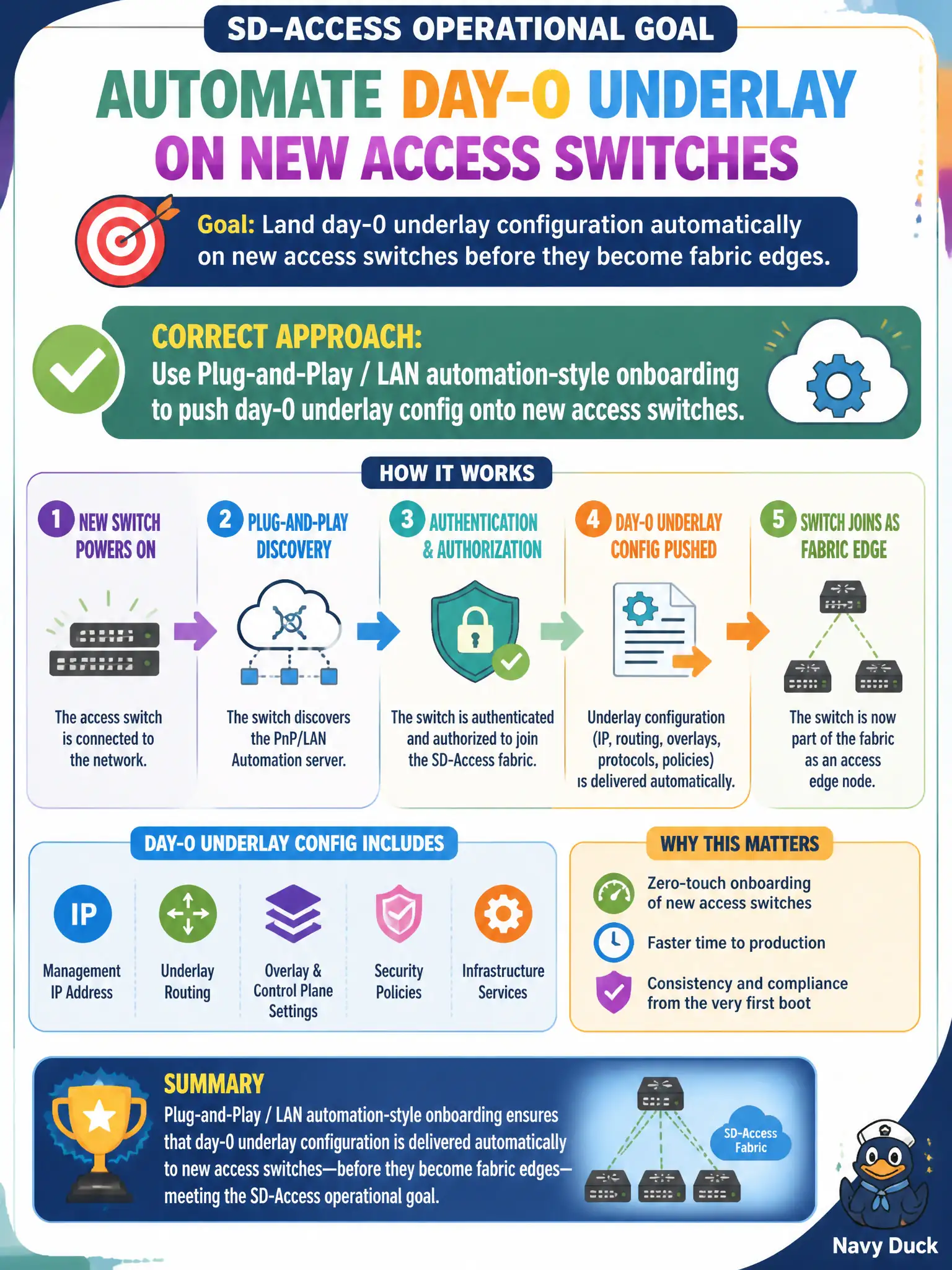
Short Explanation
New switches show up like empty desks—you want the basics filled in before people sit down. PnP / LAN automation drops day-0 underlay config so the box can talk on the transport network. Overlay fabric roles come after that foundation, not before.
Full Explanation
A school district wanting day-0 underlay configuration on new access switches before they become fabric edges should use Plug-and-Play / LAN automation-style onboarding to push day-0 underlay config automatically. That operational pattern establishes addressing and routing first so later fabric provisioning has a reachable underlay.
Requiring engineers to paste full overlay VN configs first and skip underlay addressing reverses the safe build order.
Disabling discovery protocols campus-wide so switches never appear in inventory until production cutover blocks automation and inventory.
Onboarding switches only by stretching a user VLAN from an existing edge into the new closet reintroduces VLAN extension instead of underlay automation.
Exam caveat: PnP/LAN automation still needs seed reachability, DHCP/option or DNS discovery, and correct site credentials—automation is not zero prerequisites.
Operational check: claim a new access switch via PnP/LAN automation, verify underlay IP/IGP, then provision fabric edge role. Log serial-to-closet mapping in the district closet inventory. In municipal operations, record the rationale in the change ticket so future on-call staff know which control was chosen and which failure modes the rejected options would create for city services. Re-validate after the next maintenance window that the same control still holds under the platform code and policy revisions used by the civic network team.